68-76-8
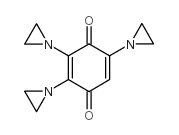
68-76-8 structure
- Name: 2,5-Cyclohexadiene-1,4-dione,2,3,5-tri-1-aziridinyl
- Chemical Name: triaziquone
- CAS Number: 68-76-8
- Molecular Formula: C12H13N3O2
- Molecular Weight: 231.25100
- Catalog: Pharmaceutical intermediate Heterocyclic compound Pyridine compound Methylpyridine
- Create Date: 2018-08-04 00:18:46
- Modify Date: 2026-07-25 14:33:47
-
Trenimon is a compound with anti-cancer effects. Trenimon shows mutagenic actions in many species by inducing point and chromosomal mutations, sister-chromatid exchanges, recombination phenomena and phage induction. Trenimon can be used for the research of cancer[1][2][3][4].
| Name | triaziquone |
|---|---|
| Synonyms |
NSC-29215
2,3,5-tris(aziridinyl)-1,4-benzoquinone Trenimon 2,3,5-triethylenimino-p-benzoquinone Riker 601 Treninon Triaziquone Tris(aziridinyl)-pa-benzoquinone prenimon Tris (1-aziridinyl)-pa-benzoquinone 2,5-Cyclohexadiene-1,4-dione, 2,3,5-tris(1-aziridinyl) Triaziquinone triaziquinone 2.3.5-Tris-aziridino-benzo-1.4-chinon oncovedex bayer tris(1-aziridinyl)p-benzoquinone 2,3,5-tris(aziridin-1-yl)cyclohexa-2,5-diene-1,4-dione trisethyleneiminoquinone //BP tris(trenimom) 2,3,5-triethyleneimino-1,4-benzoquinone Tris(trenimon) 2,3,5-tris(1-aziridinyl)-2,5-cyclohexadiene-1,4-dione Oncoredox Triethyleneiminobenzoquinone triethyleneiminobenzoquinone Prenimon riker 2,3,5-TRIS(1-AZIRIDINYL)-PA-BENZOQUINONE trisethyleneiminoquinone 10257 R.P 1,1',1''-(3,6-dioxo-1,4-cyclohexadiene-1,2,4-triyl)tris aziridine TRIS(AZIRIDINYL)-P-BENZOQUINONE(TRIAZIQUINONE) Oncovedex TRENIMONE Triaziquon 2,3,5-tris(1-aziridinyl)-p-benzoquinone |
| Description | Trenimon is a compound with anti-cancer effects. Trenimon shows mutagenic actions in many species by inducing point and chromosomal mutations, sister-chromatid exchanges, recombination phenomena and phage induction. Trenimon can be used for the research of cancer[1][2][3][4]. |
|---|---|
| Related Catalog | |
| In Vitro | Trenimon (0.17 mM) penetrates readily into mouse lymphoma cells in vitro[1]. Trenimon (0.17 nM; 5 min-16 h) time-denpendently reduces the priming activity of DNA[2]. Trenimon (1 nM-10 μM; 10-20 min) leds HeLa cells death after 2 weeks with a dose of 10 μM and dose-dependently suppresses mitosis in cells[3]. |
| In Vivo | Trenimon (0.25 mg/kg; i.p. once) rapidly depresseas of the cellular elements of the peripheral blood (granulocytes, lymphocytes, reticulocytes, platelets and erythrocytes), and reduces the cell number of bone marrow[4]. Trenimon (0.03 mg/kg; i.v. once per week for 52 weeks) shows an cancerogenic effect in vivo[4]. Animal Model: BR 46 male rats[4] Dosage: 0.03 mg/kg Administration: Intravenous injection; 0.03 mg/kg once per week for 52 weeks Result: Showed an cancerogenic effect and 24% animals developed malign tumors, and showed a induction time of the tumors is 16 months. |
| Density | 1.727g/cm3 |
|---|---|
| Boiling Point | 376.5ºC at 760 mmHg |
| Melting Point | 162.5-163ºC |
| Molecular Formula | C12H13N3O2 |
| Molecular Weight | 231.25100 |
| Flash Point | 175.1ºC |
| Exact Mass | 231.10100 |
| PSA | 43.17000 |
| Index of Refraction | 1.846 |
CHEMICAL IDENTIFICATION
HEALTH HAZARD DATAACUTE TOXICITY DATA
MUTATION DATA
|
| RIDADR | UN 3249 |
|---|---|
| Packaging Group | II |
| Hazard Class | 6.1(a) |
|
~%
68-76-8 |
| Literature: Gauss Chemische Berichte, 1958 , vol. 91, p. 2216,2222 |