65-61-2
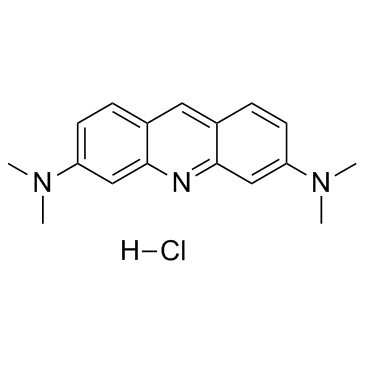
65-61-2 structure
- Name: Acridine Orange hydrochloride
- Chemical Name: acridine orange
- CAS Number: 65-61-2
- Molecular Formula: C17H20ClN3
- Molecular Weight: 301.81400
- Catalog: Biochemical Biochemical reagent Biological dye
- Create Date: 2018-09-25 11:11:07
- Modify Date: 2026-06-29 23:10:38
-
Acridine orange is a cell-permeable fluorescent dye that binds to nucleic acids, resulting in an altered spectral emission.
| Name | acridine orange |
|---|---|
| Synonyms |
3,6-Bis(dimethylamino) acridine, zinc chloride double salt
Acridine Orange hydrochloride solution,3,6-Bis(dimethylamino)acridine hydrochloride acridineorangens Acridine Orange hydrate hydrochloride acridineorangeno 3,6-Acridinediamine,N,N,N’,N’-tetramethyl-,monohydrochloride Acridine Orange solution hydrochloride N,N,N',N'-Tetramethyl-3,6-acridinediamine hydrochloride ACRIDINE ORANGE HYDROCHLORIDE Acridin-orange Sumitomo Acridine Orange No AOX1 Acridine, 3,6-bis(dimethylamino)-, Hydrochloride ACRIDING ORANGE HYDROCHLORIDE N’-Tetramethyl-3 ACRIDINE ORANGE N Sumitomo acridine Orange Rk Conc N3,N3,N6,N6-Tetramethylacridine-3,6-diamine hydrochloride ACRIDINE ORANGE HYDROCHLORIDE SOLUTION, ~ IN WATER BIS(DIMETHYLAMINO) ACRIDINE HYDROCHLORIDE Acridine orange hydrochloride, hydrate, (HPLC) Acridine, 3,6-bis(dimethylamino)-, Monohydrochloride 6-acridinediamine RHODULINE ORANGE acridine orange hydrochloride solution 3,6-Bis(dimethylamino)acridine,hydrochloride,hydrate,aqueoussolution acridineoranger ACRIDINE ORANGE SOLUTION EINECS 200-614-0 Acridine Orange (hydrochloride) 6-Bis(dimethylamino)acridine hydrochloride 3 Acridinorangekation Acridine Orange Solution [for Cell Staining] EUCHRYSINE 3RX ACRIDINE ORANGE HYDROCHLORIDE HYDRATE, F OR MICROSCOPY Acridine Orange hydrochloride Zamifenacin fumarate Euchrysine 3r 3,6-acridinediamine, N,n,n0,n0-tetramethyl-, monohydrochloride Cellstain-Ao Cellstain-AoSolution Cellstain AO Solution (1mg/ml H2O) 3,6-BIS(DIMETHYLAMINO)ACRIDINE, HCL MFCD00150070 c.i.basicorange14 BASIC ORANGE Lysotraker ACRIDINE ORANGE HYDROCHLORIDE HYDRATE N,N,N',N'-tetramethylacridin-3,6-yldiamine hydrochloride Acridiniumorange-Kation rhodulineorangeno CI NO C.I.Basic Orange 14:C.I 3,6-BIS(DIMETHYLAMINO)ACRIDINE HYDROCHLORIDE ACRIDINE ORANGE (E GURR) 3,6-bis(dimethylamino)-acridinmonohydrochloride ACRIDINE ORANGE HYDROCHLORIDE HYDRATE , FOR MICROSCOPY ((FL., HIST.)) Acridine Orange, hydrochloride hydrate, ca. dye content Basic orange 14 ACRIDINE ORANGE FOR MICROSCOPY Acridine Orange, hydrochloride hydrate,ca. dye content N3,N3,N6,N6-tetramethylacridine-3,6-diamine chloride 6-acridinediamine,n,n,n’,n’-tetramethyl-monohydrochloride ACRIDINE ORANGE N-HYRATE |
| Description | Acridine orange is a cell-permeable fluorescent dye that binds to nucleic acids, resulting in an altered spectral emission. |
|---|---|
| Related Catalog | |
| In Vitro | Acridine orange has been employed extensively as a cytochemical stain and has shown to stain differentially DNA and RNA, and double-restranded nucleic acids in situ. Acridine orange can either intercalate into double helical nucleic acids (green fluorescence at 530 nm), or bind electrostatically to phosphate groups of single-stranded molecules (red fluorescence at 640 nm). This unique characteristic makes acridine orange useful for cell-cycle studies[1]. Acridine orange staining of unfixed cells may be used as a simple, fast means of obtaining information on cell ploidy levels and cell cycle status from DNA measurements (green fluorescence), and cell transcriptional activity from RNA staining (red fluorescence), in human and murine cells lines, peripheral blood and bone marrow specimens from patients with leukemia and mitogenically (phytohemagglutinin) or antigenically (mixed lymphocyte culture) stimulated human peripheral blood cultures[2]. |
| Cell Assay | Two-step, pH 3.0: Aliquots (0.2 mL, containing approximately 2-5x10⁵ cells) are withdrawn from cultures and are added to 0.5 mL of a solution containing: 0.1% (v/v) Triton X-100, 0.2 M sucrose, 10-4 M EDTA and 2x10⁻² M citrate-phosphate buffer, at pH 3.0. Triton X-100 is included in the various procedures at the indicated pH to increase cell permeability yet maintain cellular integrity. The chelating agent EDTA is used to facilitate RNA denaturation. The cells are stained one minute later by addition of 1 mL of a solution containing 0.002% (20 μg/mL) AO, 0.1 M NaCl and 10-2 M citrate-phosphate buffer, pH 3.8. Cations are included in the staining mixture to ensure staining specificity. The final AO concentration is approximately 4x10⁻⁵ M[2]. |
| References |
| Density | 1.001 g/mL at 20ºC |
|---|---|
| Boiling Point | 468.6ºC at 760 mmHg |
| Melting Point | 284-287ºC(lit.) |
| Molecular Formula | C17H20ClN3 |
| Molecular Weight | 301.81400 |
| Flash Point | 237.2ºC |
| Exact Mass | 301.13500 |
| PSA | 19.37000 |
| LogP | 4.32200 |
| Index of Refraction | n20/D 1.338 |
| Water Solubility | Soluble in water, ethanol, dimethyl sulfoxide |
CHEMICAL IDENTIFICATION
HEALTH HAZARD DATAACUTE TOXICITY DATA
MUTATION DATA
|
| Personal Protective Equipment | Eyeshields;Gloves;half-mask respirator (US);multi-purpose combination respirator cartridge (US) |
|---|---|
| Safety Phrases | S22-S24/25 |
| RIDADR | NONH for all modes of transport |
| WGK Germany | 3 |
| RTECS | AR7601000 |
| HS Code | 32041300 |