GLP-1(7-36) Acetate
Modify Date: 2025-08-28 03:47:09
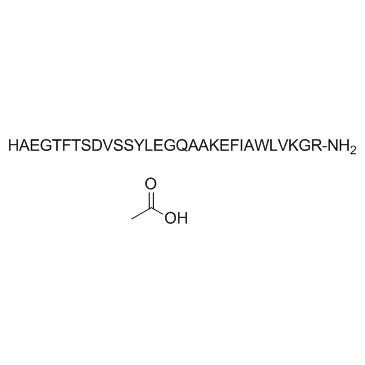
GLP-1(7-36) Acetate structure
|
Common Name | GLP-1(7-36) Acetate | ||
|---|---|---|---|---|
| CAS Number | 1119517-19-9 | Molecular Weight | 3357.68 | |
| Density | N/A | Boiling Point | N/A | |
| Molecular Formula | C149H226N40O45.xC2H4O2 | Melting Point | N/A | |
| MSDS | N/A | Flash Point | N/A | |
Use of GLP-1(7-36) AcetateGLP-1(7-36) Acetate is a major intestinal hormone that stimulates glucose-induced insulin secretion from β cells. Sequence: His-Ala-Glu-Gly-Thr-Phe-Thr-Ser-Asp-Val-Ser-Ser-Tyr-Leu-Glu-Gly-Gln-Ala-Ala-Lys-Glu-Phe-Ile-Ala-Trp-Leu-Val-Lys-Gly-Arg-NH2. |
| Name | GLP-1(7-36) Acetate |
|---|
| Description | GLP-1(7-36) Acetate is a major intestinal hormone that stimulates glucose-induced insulin secretion from β cells. Sequence: His-Ala-Glu-Gly-Thr-Phe-Thr-Ser-Asp-Val-Ser-Ser-Tyr-Leu-Glu-Gly-Gln-Ala-Ala-Lys-Glu-Phe-Ile-Ala-Trp-Leu-Val-Lys-Gly-Arg-NH2. |
|---|---|
| Related Catalog | |
| In Vitro | Cells treated with phorbol 12-myristate 13-acetate for 2 h has significantly higher active GLP-1(7-36) concentrations in the media than those in the control. The glucose treatment also increases active GLP-1 secretion from cells in dose-dependent manner. Palmitic, oleic, linoleic or linolenic acid dose-dependently stimulated active GLP-1 secretion from cells. Active GLP-1 secretion is significantly greater with unsaturated fatty acids such as oleic, linoleic and linolenic acids than with palmitic acid. The treatment of NCI-H716 cells with CPE dose-dependently increases active GLP-1 concentrations in the media. A 37% increase is observed in active GLP-1 secretion from these cells at a concentration of 0.1 % CPE[1]. |
| In Vivo | Gastric administration of glucose increases active GLP-1(7-36) amide levels in the portal blood after 10 min, followed by a marked decrease at 30 min. The gastric administration of TO also increases active GLP-1 levels after 10 min, and followed by a decrease to basal levels at 60 min. Individually, glucose and TO increase the secretion of GLP-1 in a dose-dependent manner. Furthermore, the co-administration of glucose and TO additively increase peak GLP-1 levels. CPE-administered mice have higher active GLP-1 levels in the portal blood at 10 and 30 min than those in the control mice. When glucose is administered with CPE, active GLP-1 and insulin levels in the portal blood are slightly higher in CPE-administered mice than in the control mice. High-fat diet-fed C57BL/6J mice develop hyperglycaemia and impair glucose tolerance[1]. |
| References |
| Molecular Formula | C149H226N40O45.xC2H4O2 |
|---|---|
| Molecular Weight | 3357.68 |
| InChIKey | BCNDXSMWLGNKFT-AMEUXXCWSA-N |
| SMILES | CC(=O)O.CCC(C)C(NC(=O)C(Cc1ccccc1)NC(=O)C(CCC(=O)O)NC(=O)C(CCCCN)NC(=O)C(C)NC(=O)C(C)NC(=O)C(CCC(N)=O)NC(=O)CNC(=O)C(CCC(=O)O)NC(=O)C(CC(C)C)NC(=O)C(Cc1ccc(O)cc1)NC(=O)C(CO)NC(=O)C(CO)NC(=O)C(NC(=O)C(CC(=O)O)NC(=O)C(CO)NC(=O)C(NC(=O)C(Cc1ccccc1)NC(=O)C(NC(=O)CNC(=O)C(CCC(=O)O)NC(=O)C(C)NC(=O)C(N)Cc1cnc[nH]1)C(C)O)C(C)O)C(C)C)C(=O)NC(C)C(=O)NC(Cc1c[nH]c2ccccc12)C(=O)NC(CC(C)C)C(=O)NC(C(=O)NC(CCCCN)C(=O)NCC(=O)NC(CCCNC(=N)N)C(N)=O)C(C)C |