Oxybutynin chloride
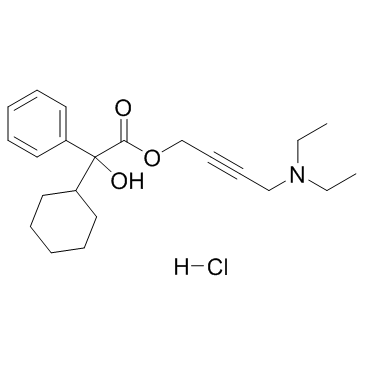
Oxybutynin chloride structure
|
Common Name | Oxybutynin chloride | ||
|---|---|---|---|---|
| CAS Number | 1508-65-2 | Molecular Weight | 393.947 | |
| Density | N/A | Boiling Point | 494.4ºC at 760 mmHg | |
| Molecular Formula | C22H32ClNO3 | Melting Point | 126-128ºC | |
| MSDS | Chinese USA | Flash Point | N/A | |
| Symbol |

GHS07 |
Signal Word | Warning | |
Use of Oxybutynin chlorideOxybutynin is an anticholinergic medication used to relieve urinary and bladder difficulties.Target: mAChROxybutynin is an anticholinergic medication used to relieve urinary and bladder difficulties, including frequent urination and inability to control urination (urge incontinence), by decreasing muscle spasms of the bladder. Oxybutynin competitively antagonizes the M1, M2, and M3 subtypes of the muscarinic acetylcholine receptor. It also has direct spasmolytic effects on bladder smooth muscle as a calcium antagonist and local anesthetic, but at concentrations far above those used clinically. Oxybutynin is available orally in generic formulation or as the brand-names Ditropan, Lyrinel XL, or Ditrospam, as a transdermal patch under the brand name Oxytrol, and as a topical gel under the brand name Gelnique. Oxybutynin is also a possible treatment of hyperhidrosis (hyper-active sweating) [1-3]. |
This table lists Chinese names, IUPAC names and various aliases of this chemical substance.
| Name | oxybutynin chloride |
|---|---|
| Synonym | More Synonyms |
This table contains bioactivity, target information and biological‑assay experimental data of this compound.
| Description | Oxybutynin is an anticholinergic medication used to relieve urinary and bladder difficulties.Target: mAChROxybutynin is an anticholinergic medication used to relieve urinary and bladder difficulties, including frequent urination and inability to control urination (urge incontinence), by decreasing muscle spasms of the bladder. Oxybutynin competitively antagonizes the M1, M2, and M3 subtypes of the muscarinic acetylcholine receptor. It also has direct spasmolytic effects on bladder smooth muscle as a calcium antagonist and local anesthetic, but at concentrations far above those used clinically. Oxybutynin is available orally in generic formulation or as the brand-names Ditropan, Lyrinel XL, or Ditrospam, as a transdermal patch under the brand name Oxytrol, and as a topical gel under the brand name Gelnique. Oxybutynin is also a possible treatment of hyperhidrosis (hyper-active sweating) [1-3]. |
|---|---|
| Related Catalog | |
| References |
This table shows physicochemical parameters including melting point, boiling point, density, solubility and optical rotation. Missing data is marked as N/A.
| Boiling Point | 494.4ºC at 760 mmHg |
|---|---|
| Melting Point | 126-128ºC |
| Molecular Formula | C22H32ClNO3 |
| Molecular Weight | 393.947 |
| Exact Mass | 393.207062 |
| PSA | 49.77000 |
| LogP | 4.14490 |
| Vapour Pressure | 1.37E-10mmHg at 25°C |
| InChIKey | SWIJYDAEGSIQPZ-UHFFFAOYSA-N |
| SMILES | CCN(CC)CC#CCOC(=O)C(O)(c1ccccc1)C1CCCCC1.Cl |
| Storage condition | Room temp |
This table provides MSDS information including hazard classification, first‑aid, fire‑fighting, spill handling, operation and storage instructions.
This table summarizes toxicological test data, acute & chronic toxicity and ecological hazard parameters for this chemical.
CHEMICAL IDENTIFICATION
HEALTH HAZARD DATAACUTE TOXICITY DATA
|
This table covers safety warnings, protective measures, incompatible substances and disposal guidelines for this compound.
| Symbol |
GHS07 |
|---|---|
| Signal Word | Warning |
| Hazard Statements | H302 |
| Precautionary Statements | P301 + P312 + P330 |
| Personal Protective Equipment | dust mask type N95 (US);Eyeshields;Faceshields;Gloves |
| Hazard Codes | Xn |
| Risk Phrases | R22 |
| Safety Phrases | 36 |
| RIDADR | NONH for all modes of transport |
| RTECS | GV2800000 |
| HS Code | 2921590090 |
This table lists upstream starting materials and downstream derivative products related to this chemical.
| Precursor 0 | |
|---|---|
| DownStream 3 | |
 CAS#:5633-20-5
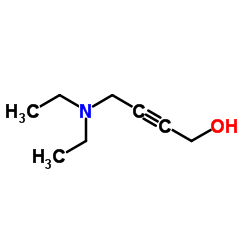 CAS#:10575-25-4
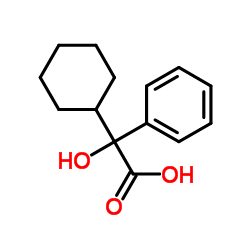 CAS#:4335-77-7
This table shows customs‑related data including HS‑code, tariff and regulatory conditions for import and export.
| HS Code | 2922509090 |
|---|---|
| Summary | 2922509090. other amino-alcohol-phenols, amino-acid-phenols and other amino-compounds with oxygen function. VAT:17.0%. Tax rebate rate:13.0%. . MFN tariff:6.5%. General tariff:30.0% |
This table lists relevant public references with title, journal and publication metadata for this compound.
|
Developing structure-activity relationships for the prediction of hepatotoxicity.
Chem. Res. Toxicol. 23 , 1215-22, (2010) Drug-induced liver injury is a major issue of concern and has led to the withdrawal of a significant number of marketed drugs. An understanding of structure-activity relationships (SARs) of chemicals ... |
|
|
A predictive ligand-based Bayesian model for human drug-induced liver injury.
Drug Metab. Dispos. 38 , 2302-8, (2010) Drug-induced liver injury (DILI) is one of the most important reasons for drug development failure at both preapproval and postapproval stages. There has been increased interest in developing predicti... |
|
|
Chemical genetics reveals a complex functional ground state of neural stem cells.
Nat. Chem. Biol. 3(5) , 268-273, (2007) The identification of self-renewing and multipotent neural stem cells (NSCs) in the mammalian brain holds promise for the treatment of neurological diseases and has yielded new insight into brain canc... |
This table contains target information, in‑vitro & in‑vivo assay data for this compound.
|
Name: Luminescence-based cell-based primary high throughput screening assay to identify ago...
Source: The Scripps Research Institute Molecular Screening Center
Target: mu-type opioid receptor isoform MOR-1 [Homo sapiens]
External Id: OPRM1-OPRD1_AG_LUMI_1536_1X%ACT PRUN
|
|
Name: Inhibition of neurosphere proliferation of mouse neural precursor cells by MTT assay
Source: ChEMBL
Target: N/A
External Id: CHEMBL1266185
|
|
Name: Fluorescence-based cell-based primary high throughput screening assay to identify ago...
Source: The Scripps Research Institute Molecular Screening Center
Target: muscarinic acetylcholine receptor M1 [Homo sapiens]
External Id: CHRM1_AG_FLUO8_1536_1X%ACT PRUN
|
|
Name: Antibacterial activity against Staphylococcus aureus MRSA ATCC 43300 (CO-ADD:GP_020);...
Source: ChEMBL
Target: Staphylococcus aureus
External Id: CHEMBL4296184
|
|
Name: Antibacterial activity against Klebsiella pneumoniae MDR ATCC 70063 (CO-ADD:GN_003); ...
Source: ChEMBL
Target: Klebsiella pneumoniae
External Id: CHEMBL4296186
|
|
Name: Antibacterial activity against Escherichia coli ATCC 25922 (CO-ADD:GN_001); MIC in CA...
Source: ChEMBL
Target: Escherichia coli
External Id: CHEMBL4296185
|
|
Name: Confirmed allosteric antagonists of M1 Muscarinic receptor
Source: 1043
Target: Muscarinic acetylcholine receptor M1
External Id: SAID_435034
|
|
Name: Dicer-mediated maturation of pre-microRNA
Source: Center for Chemical Genomics, University of Michigan
Target: N/A
External Id: TargetID_659_CEMA
|
|
Name: Fluorescence-based cell-based primary high throughput screening assay to identify pos...
Source: The Scripps Research Institute Molecular Screening Center
Target: muscarinic acetylcholine receptor M1 [Homo sapiens]
External Id: CHRM1_PAM_FLUO8_1536_1X%ACT PRUN
|
|
Name: Fluorescence polarization-based biochemical high throughput primary assay to identify...
Source: The Scripps Research Institute Molecular Screening Center
Target: RecName: Full=Sialate O-acetylesterase; AltName: Full=H-Lse; AltName: Full=Sialic acid-specific 9-O-acetylesterase; Flags: Precursor [Homo sapiens]
External Id: SIAE_INH_FP_1536_1X%INH PRUN
|
This table collects all English aliases, systematic names and CAS‑related synonyms of the compound.
| EINECS 216-139-7 |
| a-Cyclohexyl-a-hydroxybenzeneacetic Acid 4-(Diethylamino)-2-butynyl Ester Hydrochloride |
| a-Phenylcyclohexaneglycolic Acid 4-(Diethylamino)-2-butynyl Ester Hydrochloride |
| Oxybutynin hydrochloride |
| Oxybutynin Chloride |
| benzeneacetic acid, a-cyclohexyl-a-hydroxy-, 4-(diethylamino)-2-butyn-1-yl ester, hydrochloride (1:1) |
| 4-(Diethylamino)but-2-in-1-ylcyclohexyl(hydroxy)phenylacetathydrochlorid |
| MFCD00072150 |
| 4-(Diethylamino)but-2-yn-1-yl cyclohexyl(hydroxy)phenylacetate hydrochloride (1:1) |
| cyclohexyl(hydroxy)phénylacétate de 4-(diéthylamino)but-2-yn-1-yle chlorhydrate |
| Benzeneacetic acid, α-cyclohexyl-α-hydroxy-, 4-(diethylamino)-2-butyn-1-yl ester, hydrochloride (1:1) |
| 4-Diethylamino-2-butynyl Phenylcyclohexylglycolate Hydrochloride |
| benzeneacetic acid, α-cyclohexyl-α-hydroxy-, 4-(diethylamino)-2-butynyl ester, hydrochloride |
| 4-(Diethylamino)-2-butyn-1-yl cyclohexyl(hydroxy)phenylacetate hydrochloride (1:1) |
| 4-{[cyclohexyl(hydroxy)phenylacetyl]oxy}-N,N-diethylbut-2-yn-1-aminium chloride |
| Oxybutynin HCl |
This section contains frequently‑asked‑questions about this compound, including basic parameters, properties, storage conditions and corresponding answers.
| Q: What is the LogP of oxybutynin chloride? |
| A: LogP of oxybutynin chloride is 4.14490. |
| Q: What is the SMILES notation of oxybutynin chloride? |
| A: SMILES notation of oxybutynin chloride is CCN(CC)CC#CCOC(=O)C(O)(c1ccccc1)C1CCCCC1.Cl. |
| Q: What is the boiling point of oxybutynin chloride? |
| A: Boiling point of oxybutynin chloride is 494.4ºC at 760 mmHg. |
| Q: What is the English name of oxybutynin chloride? |
| A: The English name of oxybutynin chloride is oxybutynin chloride. |
| Q: What is the CAS number of oxybutynin chloride? |
| A: CAS number of oxybutynin chloride is 1508-65-2. |
| Q: What is the safety information for oxybutynin chloride? |
| A: Safety information for oxybutynin chloride: 36. |
| Q: What are the downstream products of oxybutynin chloride? |
| A: Related downstream products(CAS) of oxybutynin chloride: 5633-20-5;10575-25-4;4335-77-7. |
| Q: What is the polar surface area (PSA) of oxybutynin chloride? |
| A: Polar surface area (PSA) of oxybutynin chloride is 49.77000. |
| Q: What is the melting point of oxybutynin chloride? |
| A: Melting point of oxybutynin chloride is 126-128ºC. |
| Q: What are the storage conditions for oxybutynin chloride? |
| A: Storage conditions for oxybutynin chloride: Room temp. |
This table lists manufacturers and suppliers of this compound, including vendor names and product supply reference information.
| Shanghai Nianxing Industrial Co., Ltd |
| Dayang Chem (Hangzhou) Co., Ltd. |