antarelix
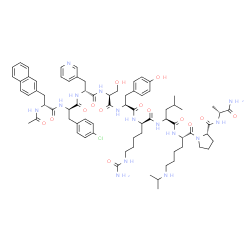
antarelix structure
|
Common Name | antarelix | ||
|---|---|---|---|---|
| CAS Number | 151272-78-5 | Molecular Weight | 1459.131 | |
| Density | 1.3±0.1 g/cm3 | Boiling Point | 1692.9±65.0 °C at 760 mmHg | |
| Molecular Formula | C74H100ClN15O14 | Melting Point | N/A | |
| MSDS | N/A | Flash Point | 977.6±34.3 °C | |
Use of antarelixTeverelix (EP 24332) is a GnRH antagonist. Teverelix binds competitively and reversibly to GnRH receptors, thereby suppressing the release of LH and FSH. Teverelix can be used in the research of prostatic hyperplasia, endometriosis, and prostate cancer[1][2]. |
This table lists Chinese names, IUPAC names and various aliases of this chemical substance.
| Name | teverelix |
|---|---|
| Synonym | More Synonyms |
This table contains bioactivity, target information and biological‑assay experimental data of this compound.
| Description | Teverelix (EP 24332) is a GnRH antagonist. Teverelix binds competitively and reversibly to GnRH receptors, thereby suppressing the release of LH and FSH. Teverelix can be used in the research of prostatic hyperplasia, endometriosis, and prostate cancer[1][2]. |
|---|---|
| Related Catalog | |
| In Vitro | Teverelix (10 nM, 45 mins) inhibits GnRH-induced intracellular Ca2+ increase in HEK293/GnRHR cells[2]. Teverelix (0.1 nM-1 μM, 45 mins) inhibits GnRH-induced cAMP accumulation in HEK293/GnRHR cells[2]. Teverelix (10 nM-1 μM, 15 mins) inhibits GnRH-induced pERK1/2 and pCREB activation in HEK293/GnRHR cells[2]. Teverelix inhibits histamine release in a peritoneal rat mast cell, with an EC50value of 81 μg/mL[3]. Western Blot Analysis[2] Cell Line: HEK293/GnRHR cells Concentration: 10 nM, 100 nM, 1 μM Incubation Time: 15 mins Result: Inhibited GnRH-induced pERK1/2 and pCREB activation. |
| In Vivo | Teverelix (3-300 μg/kg, intramuscular injection) inhibits testosterone in rats[3]. Teverelix (1 mg/kg, s.c, daily for 3 days) abolishes luteal function in stumptailed macaques[4]. Animal Model: Rats[3] Dosage: 300, 100, 30, 10 and 3 μg/kg Administration: Intramuscular injection Result: Showed dose-response and time-course of testosterone inhibitory activity. |
This table shows physicochemical parameters including melting point, boiling point, density, solubility and optical rotation. Missing data is marked as N/A.
| Density | 1.3±0.1 g/cm3 |
|---|---|
| Boiling Point | 1692.9±65.0 °C at 760 mmHg |
| Molecular Formula | C74H100ClN15O14 |
| Molecular Weight | 1459.131 |
| Flash Point | 977.6±34.3 °C |
| Exact Mass | 1457.726318 |
| LogP | 4.49 |
| Vapour Pressure | 0.0±0.3 mmHg at 25°C |
| Index of Refraction | 1.597 |
| InChIKey | NOENHWMKHNSHGX-IAOPALDYSA-N |
| SMILES | CC(=O)NC(Cc1ccc2ccccc2c1)C(=O)NC(Cc1ccc(Cl)cc1)C(=O)NC(Cc1cccnc1)C(=O)NC(CO)C(=O)NC(Cc1ccc(O)cc1)C(=O)NC(CCCCNC(N)=O)C(=O)NC(CC(C)C)C(=O)NC(CCCCNC(C)C)C(=O)N1CCCC1C(=O)NC(C)C(N)=O |
This table collects all English aliases, systematic names and CAS‑related synonyms of the compound.
| 7079 |
| D19V7048JK |
| N-Acetyl-3-(2-naphthyl)-D-alanyl-p-chloro-D-phenylalanyl-3-(3-pyridyl)-D-alanyl-L-seryl-L-tyrosyl-N6-carbamoyl-D-lysyl-L-leucyl-N6-isopropyl-L-lysyl-L-prolyl-D-alaninamide |
| (2S)-N-[(2R)-1-Amino-1-oxo-2-propanyl]-1-[(2S,5S,8R,11S,14S,17R,20R,23R)-8-[4-(carbamoylamino)butyl]-20-(4-chlorobenzyl)-11-(4-hydroxybenzyl)-14-(hydroxymethyl)-5-isobutyl-2-[4-(isopropylamino)butyl]-23-(2-naphthylmethyl)-4,7,10,13,16,19,22,25-octaoxo-17-(3-pyridinylmethyl)-3,6,9,12,15,18,21,24-octaazahexacosan-1-oyl]-2-pyrrolidinecarboxamide |
| teverelix |
This section contains frequently‑asked‑questions about this compound, including basic parameters, properties, storage conditions and corresponding answers.
| Q: What is the English name of teverelix? |
| A: The English name of teverelix is teverelix. |
| Q: What is the LogP of teverelix? |
| A: LogP of teverelix is 4.49. |
| Q: What is the molecular formula of teverelix? |
| A: Molecular formula of teverelix is C74H100ClN15O14. |
| Q: What is the molecular weight of teverelix? |
| A: Molecular weight of teverelix is 1459.131. |
| Q: What is the InChIKey of teverelix? |
| A: InChIKey of teverelix is NOENHWMKHNSHGX-IAOPALDYSA-N. |
| Q: What is the SMILES notation of teverelix? |
| A: SMILES notation of teverelix is CC(=O)NC(Cc1ccc2ccccc2c1)C(=O)NC(Cc1ccc(Cl)cc1)C(=O)NC(Cc1cccnc1)C(=O)NC(CO)C(=O)NC(Cc1ccc(O)cc1)C(=O)NC(CCCCNC(N)=O)C(=O)NC(CC(C)C)C(=O)NC(CCCCNC(C)C)C(=O)N1CCCC1C(=O)NC(C)C(N)=O. |
| Q: What is the boiling point of teverelix? |
| A: Boiling point of teverelix is 1692.9±65.0 °C at 760 mmHg. |
| Q: What are the uses of teverelix? |
| A: Main uses of teverelix: Teverelix (EP 24332) is a GnRH antagonist. Teverelix binds competitively and reversibly to GnRH receptors, thereby suppressing the release of LH and FSH. Teverelix can be used in the research of prostatic hyperplasia, endometriosis, and prostate cancer[1][2]. |
| Q: What is the CAS number of teverelix? |
| A: CAS number of teverelix is 151272-78-5. |
| Q: What is the Chinese name of 151272-78-5? |
| A: Chinese name of 151272-78-5 is 151272-78-5. |
This table lists manufacturers and suppliers of this compound, including vendor names and product supply reference information.
| Shanghai Nianxing Industrial Co., Ltd |
| Dayang Chem (Hangzhou) Co., Ltd. |