Oxytetracycline HCl

Oxytetracycline HCl structure
|
Common Name | Oxytetracycline HCl | ||
|---|---|---|---|---|
| CAS Number | 2058-46-0 | Molecular Weight | 533.356 | |
| Density | 1.71 g/cm3 | Boiling Point | 839.6ºC at 760 mmHg | |
| Molecular Formula | C22H25ClN2O9 | Melting Point | 180°C | |
| MSDS | Chinese USA | Flash Point | 461.6ºC | |
| Symbol |

GHS08 |
Signal Word | Warning | |
Use of Oxytetracycline HClOxytetracycline hydrochloride is an antibiotic belonging to the tetracycline class. Oxytetracycline hydrochloride potent inhibits Gram-negative and Gram-positive bacteria. Oxytetracycline hydrochloride is a protein synthesis inhibitor and prevents the binding from aminoacil-tRNA to the complex m-ribosomal RNA. Oxytetracycline hydrochloride also possesses anti-HSV-1 activity[1][2][3]. |
| Name | oxytetracycline hydrochloride |
|---|---|
| Synonym | More Synonyms |
| Description | Oxytetracycline hydrochloride is an antibiotic belonging to the tetracycline class. Oxytetracycline hydrochloride potent inhibits Gram-negative and Gram-positive bacteria. Oxytetracycline hydrochloride is a protein synthesis inhibitor and prevents the binding from aminoacil-tRNA to the complex m-ribosomal RNA. Oxytetracycline hydrochloride also possesses anti-HSV-1 activity[1][2][3]. |
|---|---|
| Related Catalog | |
| Target |
Gram-negative and Gram-positive bacteria[1] HSV-1[3] |
| In Vitro | Oxytetracycline is an important member of the bacterial aromatic polyketide family, which is a structurally diverse class of natural products. Oxytetracycline is synthesized by a type II polyketide synthase that generates the poly-beta-ketone backbone through successive decarboxylative condensation of malonyl-CoA extender units, followed by modifications by cyclases, oxygenases, transferases, and additional tailoring enzymes[2]. |
| In Vivo | The effects of administration a therapeutic dose of Oxytetracycline (82.8 mg/kg of bw to 1 % bw/day) for 10 days are species specific. Oxytetracycline increases the relative liver weight in Morone chrysops x M. saxatilis, the enzymatic activity of CYP3A4 in Ictalurus punctatus, protein expression of CYP3A4 in Oreochromis niloticus and depleted the hepatic CYP3A4 in the latter[1]. For Oxytetracycline, the limits are 100 μg/kg in muscle and milk, 200 μg/kg in egg, 300 μg/kg in liver and 600 μg/kg in kidney. Oxytetracycline (OTC) is administered to fish as medicated feed at concentrations ranging from 35 to 75 mg a.i kg-1 biomass day-1 for 7-14 days[1]. |
| References |
[2]. Pickens LB, et al. Oxytetracycline biosynthesis. J Biol Chem. 2010 Sep 3;285(36):27509-15. |
| Density | 1.71 g/cm3 |
|---|---|
| Boiling Point | 839.6ºC at 760 mmHg |
| Melting Point | 180°C |
| Molecular Formula | C22H25ClN2O9 |
| Molecular Weight | 533.356 |
| Flash Point | 461.6ºC |
| Exact Mass | 532.101563 |
| PSA | 201.85000 |
| LogP | 0.25870 |
| Vapour Pressure | 2.17E-30mmHg at 25°C |
| Storage condition | 0-6°C |
| Water Solubility | >100 g/L |
CHEMICAL IDENTIFICATION
HEALTH HAZARD DATAACUTE TOXICITY DATA
MUTATION DATA
|
| Symbol |
GHS08 |
|---|---|
| Signal Word | Warning |
| Hazard Statements | H361d |
| Precautionary Statements | P281 |
| Personal Protective Equipment | Eyeshields;Gloves;type N95 (US);type P1 (EN143) respirator filter |
| Hazard Codes | Xn:Harmful |
| Risk Phrases | R36;R63 |
| Safety Phrases | S36/37/39-S26 |
| RIDADR | NONH for all modes of transport |
| WGK Germany | 2 |
| RTECS | QI8225000 |
| HS Code | 3003209000 |
|
~79%
Oxytetracycline HCl CAS#:2058-46-0 |
| Literature: Issar, M. M.; Mahadevan, P. R. Indian Journal of Chemistry, Section B: Organic Chemistry Including Medicinal Chemistry, 1981 , vol. 20, # 3 p. 257 - 258 |
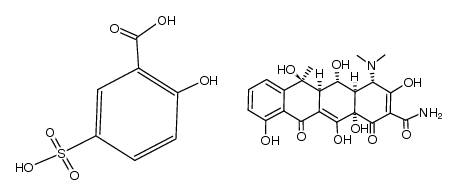
| Precursor 1 | |
|---|---|
| DownStream 0 | |
| HS Code | 3003209000 |
|---|
|
Development and validation of a liquid chromatographic/ tandem mass spectrometric method for determination of chlortetracycline, oxytetracycline, tetracycline, and doxycycline in animal feeds.
J. AOAC Int. 95(4) , 1010-5, (2012) A selective and accurate LC/MS/MS method for the simultaneous determination of chlortetracycline (CTC), oxytetracycline (OTC), tetracycline (TC), and doxycycline (DC) in animal feeds was developed. Sa... |
|
|
Heterologous expression and manipulation of three tetracycline biosynthetic pathways.
Angew. Chem. Int. Ed. Engl. 51(44) , 11136-40, (2012) A very accommodating host: Three tetracycline biosynthetic pathways were overexpressed and manipulated in the heterologous host Streptomyces lividans K4-114. Through the inactivation of various genes ... |
|
|
Topical steroids for chronic wounds displaying abnormal inflammation.
Ann. R. Coll. Surg. Engl. 95(4) , 291-6, (2013) Chronic, non-healing wounds are often characterised by an excessive, and detrimental, inflammatory response. We review our experience of using a combined topical steroid, antibiotic and antifungal pre... |
| engemycin |
| mepatar |
| Oxytetracycline Hydrochloride |
| MFCD00135815 |
| oxytetracyclin hydrochloride |
| (4S,4aR,5S,5aR,6S,12aS)-4-(dimethylamino)-1,4,4a,5,5a,6,11,12a-octahydro-3,5,6,10,12,12a-hexahydroxy-6-methyl-1,11-dioxo-2-naphthacenecarboxamide hydrochloride (1:1) |
| oxlopar |
| EINECS 218-161-2 |
| Oxytetracycline Hydrochloride,Can be Used as Secondary Standard |
| oxytetracycline HCl |
| Oxycline |
| terramycin hydrochloride |
| (4S,4aR,5S,5aR,6S,12aS)-4-dimethylamino-1,4,4a,5,5a,6,11,12a-octahydro-3,5,6,10,12,12a-hexahydroxy-6-methyl-1,11-dioxonaphthacene-2-carboxamide hydrochloride |
| otetryn |
| TOXINAL |
| GEOMYCIN |
| tm5 |
| OTC |