Contulakin G
Modify Date: 2025-08-25 14:57:55
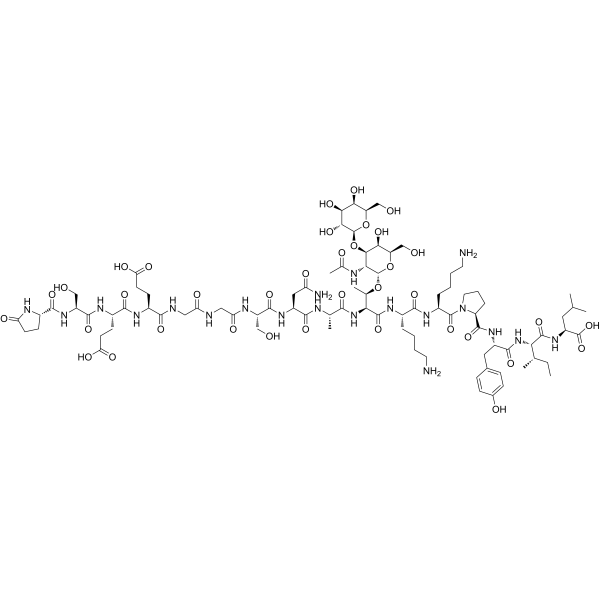
Contulakin G structure
|
Common Name | Contulakin G | ||
|---|---|---|---|---|
| CAS Number | 229180-41-0 | Molecular Weight | 2070.17 | |
| Density | N/A | Boiling Point | N/A | |
| Molecular Formula | C88H140N20O37 | Melting Point | N/A | |
| MSDS | N/A | Flash Point | N/A | |
Use of Contulakin GContulakin G is an O-glycosylated invertebrate neurotensin. Contulakin-G is a weaker agonist for the neurotensin receptor. Contulakin G is also a potent antinociceptive agent[1][2]. |
| Name | Contulakin G |
|---|
| Description | Contulakin G is an O-glycosylated invertebrate neurotensin. Contulakin-G is a weaker agonist for the neurotensin receptor. Contulakin G is also a potent antinociceptive agent[1][2]. |
|---|---|
| Related Catalog | |
| In Vivo | Contulakin G exhibits potent analgesic activity in three pain models in rats following intrathecal delivery, namely in tail-flick (acute pain), formalin test, and CFA-induced allodynia inflammatory pain[1]. Contulakin G (0-3 nmoL, Intrathecally) significantly decreases flinching behavior in rats[2]. Contulakin G (50-500 nmoL, Intrathecally) produces a dose-dependent increase in the thermally evoked skin twitch latency by 30 min after administration in dogs[2]. Animal Model: Male Holtzman rats (300-375 g)[2] Dosage: 0.03, 0.1, 0.3, and 3 nmol Administration: Intrathecally, administered as a 10-μL bolus followed by a 10-μL saline flush Result: Produced a significant decrease in flinching in all phases of the formalin test in rats. Animal Model: Purpose-bred beagle dogs (9-12 kg)[2] Dosage: 50, 150, or 500 nmol Administration: Intrathecally Result: Produced a dose-dependent increase in the thermally evoked skin twitch latency at 30 min after dosing in dogs, which reached statistical difference as compared to vehicle at 500 nmol. |
| Molecular Formula | C88H140N20O37 |
|---|---|
| Molecular Weight | 2070.17 |
| InChIKey | RMBUSFDUDIVELV-UHFFFAOYSA-N |
| SMILES | CCC(C)C(NC(=O)C(Cc1ccc(O)cc1)NC(=O)C1CCCN1C(=O)C(CCCCN)NC(=O)C(CCCCN)NC(=O)C(NC(=O)C(C)NC(=O)C(CC(N)=O)NC(=O)C(CO)NC(=O)CNC(=O)CNC(=O)C(CCC(=O)O)NC(=O)C(CCC(=O)O)NC(=O)C(CO)NC(=O)C1CCC(=O)N1)C(C)O)C(=O)NC(CC(C)C)C(=O)O |