Isoflurane
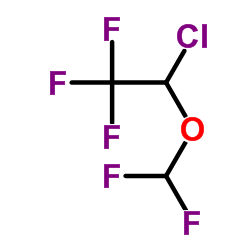
Isoflurane structure
|
Common Name | Isoflurane | ||
|---|---|---|---|---|
| CAS Number | 26675-46-7 | Molecular Weight | 184.492 | |
| Density | 1.5±0.1 g/cm3 | Boiling Point | 48.5±0.0 °C at 760 mmHg | |
| Molecular Formula | C3H2ClF5O | Melting Point | N/A | |
| MSDS | Chinese USA | Flash Point | -10.6±25.9 °C | |
| Symbol |


GHS07, GHS08 |
Signal Word | Warning | |
This table lists Chinese names, IUPAC names and various aliases of this chemical substance.
| Name | isoflurane |
|---|---|
| Synonym | More Synonyms |
This table shows physicochemical parameters including melting point, boiling point, density, solubility and optical rotation. Missing data is marked as N/A.
| Density | 1.5±0.1 g/cm3 |
|---|---|
| Boiling Point | 48.5±0.0 °C at 760 mmHg |
| Molecular Formula | C3H2ClF5O |
| Molecular Weight | 184.492 |
| Flash Point | -10.6±25.9 °C |
| Exact Mass | 183.971436 |
| PSA | 9.23000 |
| LogP | 2.33 |
| Vapour Pressure | 323.0±0.0 mmHg at 25°C |
| Index of Refraction | 1.301 |
| InChIKey | PIWKPBJCKXDKJR-UHFFFAOYSA-N |
| SMILES | FC(F)OC(Cl)C(F)(F)F |
| Stability | Stable. |
This table provides MSDS information including hazard classification, first‑aid, fire‑fighting, spill handling, operation and storage instructions.
This table summarizes toxicological test data, acute & chronic toxicity and ecological hazard parameters for this chemical.
CHEMICAL IDENTIFICATION
HEALTH HAZARD DATAACUTE TOXICITY DATA
|
This table covers safety warnings, protective measures, incompatible substances and disposal guidelines for this compound.
| Symbol |
GHS07, GHS08 |
|---|---|
| Signal Word | Warning |
| Hazard Statements | H336-H373 |
| Precautionary Statements | P260 |
| Target Organs | Cardio-vascular system, Central nervous system |
| Hazard Codes | F,T |
| Risk Phrases | R36/37/38:Irritating to eyes, respiratory system and skin . |
| Safety Phrases | S26-S36/37/39 |
| RIDADR | UN 3334 |
| RTECS | KN6799000 |
| HS Code | 3004909030 |
This table presents publicly reported synthetic routes, reaction conditions, reactants and product information of the compound.
|
~96%
Isoflurane CAS#:26675-46-7 |
| Literature: Journal of Fluorine Chemistry, , vol. 80, # 2 p. 101 - 104 |
|
~%
Isoflurane CAS#:26675-46-7 |
| Literature: Journal of medicinal chemistry, , vol. 15, # 6 p. 604 - 606 |
|
~%
Isoflurane CAS#:26675-46-7 |
| Literature: Journal of medicinal chemistry, , vol. 14, # 6 p. 517 - 519 |
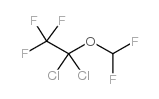
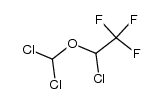
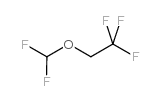
This table lists upstream starting materials and downstream derivative products related to this chemical.
| Precursor 3 | |
|---|---|
| DownStream 1 | |
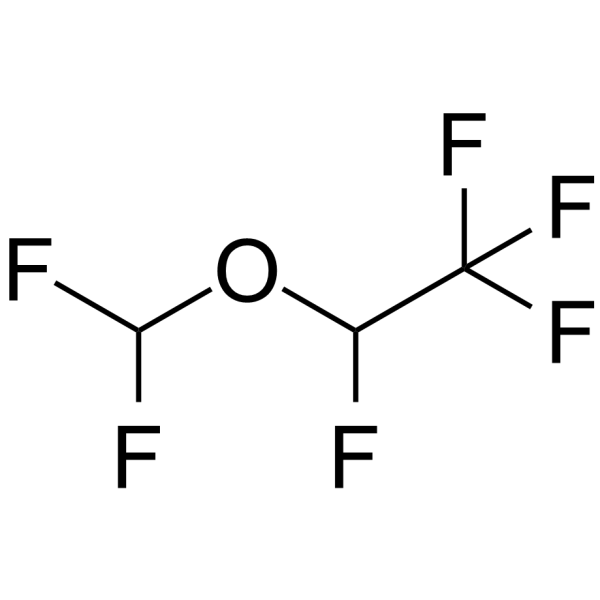 CAS#:57041-67-5
This table shows customs‑related data including HS‑code, tariff and regulatory conditions for import and export.
| HS Code | 2909199090 |
|---|---|
| Summary | 2909199090. other acyclic ethers and their halogenated, sulphonated, nitrated or nitrosated derivatives. VAT:17.0%. Tax rebate rate:13.0%. . MFN tariff:5.5%. General tariff:30.0% |
This table lists relevant public references with title, journal and publication metadata for this compound.
|
Imaging of a clinically relevant stroke model: glucose hypermetabolism revisited.
Stroke 46(3) , 835-42, (2015) Ischemic stroke has been shown to cause hypermetabolism of glucose in the ischemic penumbra. Experimental and clinical data indicate that infarct-related systemic hyperglycemia is a potential therapeu... |
|
|
Suppression of the HSF1-mediated proteotoxic stress response by the metabolic stress sensor AMPK.
EMBO J. 34(3) , 275-93, (2015) Numerous extrinsic and intrinsic insults trigger the HSF1-mediated proteotoxic stress response (PSR), an ancient transcriptional program that is essential to proteostasis and survival under such condi... |
|
|
Detailed characterization of a long-term rodent model of critical illness and recovery.
Crit. Care Med. 43(3) , e84-96, (2015) To characterize a long-term model of recovery from critical illness, with particular emphasis on cardiorespiratory, metabolic, and muscle function.Randomized controlled animal study.University researc... |
This table contains target information, in‑vitro & in‑vivo assay data for this compound.
This table collects all English aliases, systematic names and CAS‑related synonyms of the compound.
| 2-chloro-2-(difluoromethoxy)-1,1,1-trifluoro-ethane |
| Isoflurano |
| 1-Chloro-2,2,2-trifluoroethyl difluoromethyl ether |
| Forane |
| Compd 469 |
| Isoflurane |
| 1-Chlor-2,2,2-trifluorethyl-difluormethylether |
| 2-(difluoromethoxy)-1,1,1-trifluoro-2-chloroethane |
| 2-Chloro-2-(difluoromethoxy)-1,1,1-trifluoroethane |
| MFCD00066609 |
| Forene |
| EINECS 247-897-7 |
| Isofluranum |
| Compound 469 |
| IsoFlo |
| Aerrane |
This section contains frequently‑asked‑questions about this compound, including basic parameters, properties, storage conditions and corresponding answers.
| Q: What is the boiling point of isoflurane? |
| A: Boiling point of isoflurane is 48.5±0.0 °C at 760 mmHg. |
| Q: What is the polar surface area (PSA) of isoflurane? |
| A: Polar surface area (PSA) of isoflurane is 9.23000. |
| Q: What is the LogP of isoflurane? |
| A: LogP of isoflurane is 2.33. |
| Q: What is the InChIKey of isoflurane? |
| A: InChIKey of isoflurane is PIWKPBJCKXDKJR-UHFFFAOYSA-N. |
| Q: What English synonyms does isoflurane have? |
| A: English synonyms of isoflurane: 2-chloro-2-(difluoromethoxy)-1,1,1-trifluoro-ethane, Isoflurano, 1-Chloro-2,2,2-trifluoroethyl difluoromethyl ether, Forane, Compd 469, Isoflurane, 1-Chlor-2,2,2-trifluorethyl-difluormethylether, 2-(difluoromethoxy)-1,1,1-trifluoro-2-chloroethane, 2-Chloro-2-(difluoromethoxy)-1,1,1-trifluoroethane, MFCD00066609, Forene, EINECS 247-897-7, Isofluranum, Compound 469, IsoFlo, Aerrane. |
| Q: What are the upstream materials of isoflurane? |
| A: Related upstream materials(CAS) of isoflurane: 32778-07-7;26644-88-2;1885-48-9. |
| Q: What is the English name of isoflurane? |
| A: The English name of isoflurane is isoflurane. |
| Q: What are the downstream products of isoflurane? |
| A: Related downstream products(CAS) of isoflurane: 57041-67-5. |
| Q: What is the molecular weight of isoflurane? |
| A: Molecular weight of isoflurane is 184.492. |
| Q: What is the SMILES notation of isoflurane? |
| A: SMILES notation of isoflurane is FC(F)OC(Cl)C(F)(F)F. |
This table lists manufacturers and suppliers of this compound, including vendor names and product supply reference information.
| Shanghai Nianxing Industrial Co., Ltd |
| Henan Tianfu Chemical Co., Ltd. |