Licarbazepine
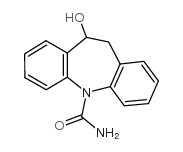
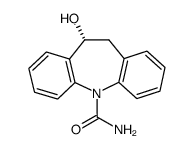
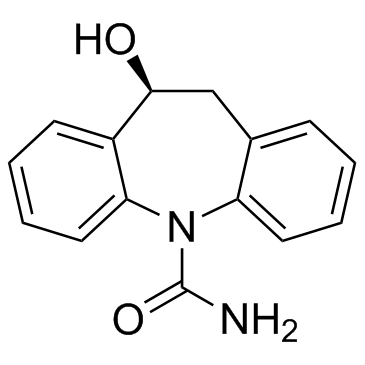
Licarbazepine structure
|
Common Name | Licarbazepine | ||
|---|---|---|---|---|
| CAS Number | 29331-92-8 | Molecular Weight | 254.28400 | |
| Density | 1.336g/cm3 | Boiling Point | 431.3ºC at 760mmHg | |
| Molecular Formula | C15H14N2O2 | Melting Point | 186-189ºC | |
| MSDS | Chinese | Flash Point | 214.6ºC | |
| Symbol |


GHS02, GHS07 |
Signal Word | Danger | |
Use of LicarbazepineLicarbazepine (BIA 2-005; GP 47779) is a voltage-gated sodium channel blocker with anticonvulsant and mood-stabilizing effects[1]. |
Summary: Licarbazepine, also known as BIA-2-005, GP-47779, LIC-477, or LIC-477D, is a voltage-gated sodium channel blocker with anticonvulsant and mood-stabilizing effects, related to oxcarbazepine. It is the active metabolite of oxcarbazepine. For research-use only, not for medical or clinical usage.
This table lists Chinese names, IUPAC names and various aliases of this chemical substance.
| Name | Licarbazepine |
|---|---|
| Synonym | More Synonyms |
This table contains bioactivity, target information and biological‑assay experimental data of this compound.
| Description | Licarbazepine (BIA 2-005; GP 47779) is a voltage-gated sodium channel blocker with anticonvulsant and mood-stabilizing effects[1]. |
|---|---|
| Related Catalog | |
| Target |
Sodium Channel[1] |
| In Vivo | Eslicarbazepine acetate (ESL) is an oral pro-drug that is rapidly and extensively metabolized by the liver via a hydrolytic first-pass metabolism into S-Licarbazepine, the biologically active drug. The plasma level of the prodrug remains below quantification[1]. ESL is a potent antiepileptic agent with a spectrum of action essentially limited to partial-onset and generalized tonic-clonic seizures. Its main mechanism of action is by blocking the voltage-gated sodium channel. ESL works by blocking the voltage-gated sodium channel, which play an essential role in the generation and propagation of the epileptic discharge. ESL is well absorbed after oral administration with a bio-availability about 16% higher than that observed after an equivalent dose of Oxcarbazepine (OXC)[1]. |
| References |
This table shows physicochemical parameters including melting point, boiling point, density, solubility and optical rotation. Missing data is marked as N/A.
| Density | 1.336g/cm3 |
|---|---|
| Boiling Point | 431.3ºC at 760mmHg |
| Melting Point | 186-189ºC |
| Molecular Formula | C15H14N2O2 |
| Molecular Weight | 254.28400 |
| Flash Point | 214.6ºC |
| Exact Mass | 254.10600 |
| PSA | 66.56000 |
| LogP | 3.25820 |
| Vapour Pressure | 3.33E-08mmHg at 25°C |
| Index of Refraction | 1.677 |
| InChIKey | BMPDWHIDQYTSHX-UHFFFAOYSA-N |
| SMILES | NC(=O)N1c2ccccc2CC(O)c2ccccc21 |
| Storage condition | Store at RT |
This table provides MSDS information including hazard classification, first‑aid, fire‑fighting, spill handling, operation and storage instructions.
This table covers safety warnings, protective measures, incompatible substances and disposal guidelines for this compound.
| Symbol |
GHS02, GHS07 |
|---|---|
| Signal Word | Danger |
| Hazard Statements | H225-H302 + H332-H319 |
| Precautionary Statements | P210-P305 + P351 + P338 |
| Hazard Codes | N,Xn,F |
| Risk Phrases | 51/53-36-20/21/22-11 |
| Safety Phrases | 61-36/37-26-16 |
| RIDADR | UN 3077 9 / PGIII |
| HS Code | 2933990090 |
This table presents publicly reported synthetic routes, reaction conditions, reactants and product information of the compound.
|
~90%
Licarbazepine CAS#:29331-92-8 |
| Literature: KANDULA, Mahesh Patent: WO2013/167985 A1, 2013 ; Location in patent: Paragraph 00102; 00103 ; |
|
~91%
Licarbazepine CAS#:29331-92-8 |
| Literature: Portela and Ca., S.A. Patent: EP1477480 A1, 2004 ; Location in patent: Page 6, 7 ; |
|
~91%
Licarbazepine CAS#:29331-92-8 |
| Literature: RANBAXY LABORATORIES LIMITED; HIRPARA, Ketan; KHANDURI, Chandra, Has; SHARMA, Mukesh, Kumar Patent: WO2013/8194 A2, 2013 ; Location in patent: Page/Page column 12; 13 ; |
|
~68%
Licarbazepine CAS#:29331-92-8 |
| Literature: Panunzio, Mauro; Campana, Eileen; Breviglieri, Gabriele Patent: US2008/221320 A1, 2008 ; Location in patent: Page/Page column 2 ; |
|
~%
Licarbazepine CAS#:29331-92-8 |
| Literature: Tian, Maoqun; Abdelrahman, Aliaa; Weinhausen, Stephanie; Hinz, Sonja; Weyer, Stefanie; Dosa, Stefan; El-Tayeb, Ali; Mueller, Christa E. Bioorganic and Medicinal Chemistry, 2014 , vol. 22, # 3 p. 1077 - 1088 |
|
~%
Licarbazepine CAS#:29331-92-8 |
| Literature: Kittelman, Matthias; Lattmann, Rene; Ghisalba, Preste Bioscience, Biotechnology, and Biochemistry, 1993 , vol. 57, # 9 p. 1589 - 1590 |
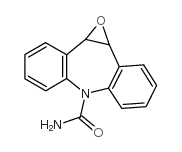


![5-Carbamoyl-5H-dibenz[b,f]azepinEN5-Cyano-10-hydroxy-10,11-dihydro-5H-dibenz[b,f]azepine structure](https://image.chemsrc.com/caspic/393/356760-08-2.png)
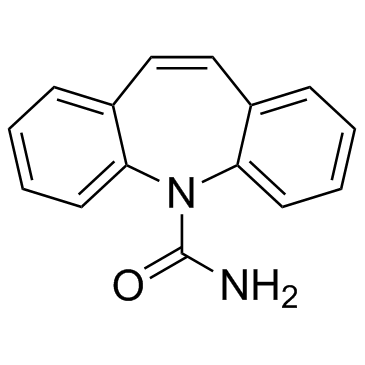
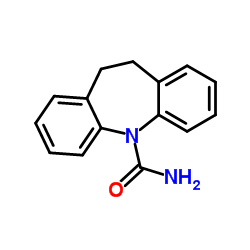
This table lists upstream starting materials and downstream derivative products related to this chemical.
| Precursor 6 | |
|---|---|
| DownStream 3 | |
 CAS#:104746-03-4
 CAS#:104746-04-5
This table shows customs‑related data including HS‑code, tariff and regulatory conditions for import and export.
| HS Code | 2933990090 |
|---|---|
| Summary | 2933990090. heterocyclic compounds with nitrogen hetero-atom(s) only. VAT:17.0%. Tax rebate rate:13.0%. . MFN tariff:6.5%. General tariff:20.0% |
This table lists relevant public references with title, journal and publication metadata for this compound.
|
First MEPS/HPLC assay for the simultaneous determination of venlafaxine and O-desmethylvenlafaxine in human plasma.
Bioanalysis 6(22) , 3025-38, (2014) A new high-performance liquid chromatography-fluorescence detection assay based on microextraction by packed sorbent as sample preparation approach is described to quantify venlafaxine (VEN) and its m... |
|
|
Evaluation of the matrix effect of different sample matrices for 33 pharmaceuticals by post-column infusion.
J. Chromatogr. B. Analyt. Technol. Biomed. Life Sci. 1000 , 84-94, (2015) Matrix effects that occur during quantitative measurement by liquid chromatography mass spectrometry specifically when using electrospray ionization are a widely recognized phenomenon. Sample matrix c... |
This table contains target information, in‑vitro & in‑vivo assay data for this compound.
This table collects all English aliases, systematic names and CAS‑related synonyms of the compound.
| 10,11-Dihydro-10-hydroxy-5H-dibenz[b,f]azepine-5-carboxamide,Licarbazepine |
| Licarbazepine,10,11-Dihydro-10-hydroxy-5H-dibenz(Z)[b,f]azepin-5-carboxamide |
| 10,11-Dihydro-10-hydroxy Carbamazepine |
| 10,11-Dihydro-10-hydroxycarbamazepine |
This section contains frequently‑asked‑questions about this compound, including basic parameters, properties, storage conditions and corresponding answers.
| Q: What are the uses of Licarbazepine? |
| A: Main uses of Licarbazepine: Licarbazepine (BIA 2-005; GP 47779) is a voltage-gated sodium channel blocker with anticonvulsant and mood-stabilizing effects[1]. |
| Q: What is the melting point of Licarbazepine? |
| A: Melting point of Licarbazepine is 186-189ºC. |
| Q: What are the upstream materials of Licarbazepine? |
| A: Related upstream materials(CAS) of Licarbazepine: 36507-30-9;791633-38-0;28721-07-5;356760-08-2;298-46-4;3564-73-6. |
| Q: What is the CAS number of Licarbazepine? |
| A: CAS number of Licarbazepine is 29331-92-8. |
| Q: What is the boiling point of Licarbazepine? |
| A: Boiling point of Licarbazepine is 431.3ºC at 760mmHg. |
| Q: What is the molecular formula of Licarbazepine? |
| A: Molecular formula of Licarbazepine is C15H14N2O2. |
| Q: What is the polar surface area (PSA) of Licarbazepine? |
| A: Polar surface area (PSA) of Licarbazepine is 66.56000. |
| Q: What is the English name of Licarbazepine? |
| A: The English name of Licarbazepine is Licarbazepine. |
| Q: What are the downstream products of Licarbazepine? |
| A: Related downstream products(CAS) of Licarbazepine: 28721-07-5;104746-03-4;104746-04-5. |
| Q: What is the SMILES notation of Licarbazepine? |
| A: SMILES notation of Licarbazepine is NC(=O)N1c2ccccc2CC(O)c2ccccc21. |
This table lists manufacturers and suppliers of this compound, including vendor names and product supply reference information.
| Shanghai Nianxing Industrial Co., Ltd |
| Dayang Chem (Hangzhou) Co., Ltd. |
| Henan Tianfu Chemical Co., Ltd. |