Octahydrocurcumin
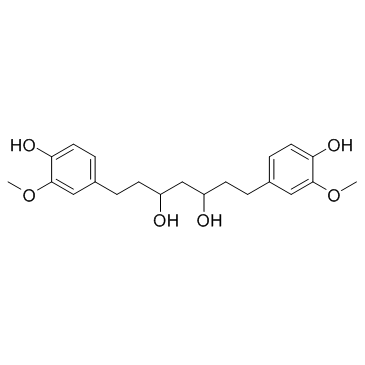
Octahydrocurcumin structure
|
Common Name | Octahydrocurcumin | ||
|---|---|---|---|---|
| CAS Number | 36062-07-4 | Molecular Weight | 376.443 | |
| Density | 1.2±0.1 g/cm3 | Boiling Point | 623.5±55.0 °C at 760 mmHg | |
| Molecular Formula | C21H28O6 | Melting Point | N/A | |
| MSDS | N/A | Flash Point | 330.9±31.5 °C | |
Use of OctahydrocurcuminOctahydrocurcumin is a hydrogenated derivatives of curcumin; metabolite of curcumin.IC50 value:Target: OKT3-induced PBMC proliferation was inhibited by octahydrocurcumin with IC50 of 82 uM. The investigated substances with the strongest effect on radical scavenging were tetrahydro-, hexahydro-, and octahydrocurcumin with IC50 values of 10.0, 11.7, and 12.3 microM, respectively [1]. curcumin and tetrahydrocurcumin significantly inhibited the release of prominent cytokines, including tumor necrosis factor?α (TNF?α) and interleukin?6 (IL?6); however, hexahydrocurcumin and octahydrocurcumin did not significantly alter cytokine release [2]. Hydrogenated derivatives of curcumin exhibited stronger DPPH scavenging activity compared to curcumin and a reference antioxidant, trolox. The scavenging activity significantly decreased in the order THC>HHC=OHC>trolox>curcumin>Dmc>>>Bdmc [3]. |
This table lists Chinese names, IUPAC names and various aliases of this chemical substance.
| Name | 1,7-Bis(4-hydroxy-3-methoxyphenyl)-3,5-heptanediol |
|---|---|
| Synonym | More Synonyms |
This table contains bioactivity, target information and biological‑assay experimental data of this compound.
| Description | Octahydrocurcumin is a hydrogenated derivatives of curcumin; metabolite of curcumin.IC50 value:Target: OKT3-induced PBMC proliferation was inhibited by octahydrocurcumin with IC50 of 82 uM. The investigated substances with the strongest effect on radical scavenging were tetrahydro-, hexahydro-, and octahydrocurcumin with IC50 values of 10.0, 11.7, and 12.3 microM, respectively [1]. curcumin and tetrahydrocurcumin significantly inhibited the release of prominent cytokines, including tumor necrosis factor?α (TNF?α) and interleukin?6 (IL?6); however, hexahydrocurcumin and octahydrocurcumin did not significantly alter cytokine release [2]. Hydrogenated derivatives of curcumin exhibited stronger DPPH scavenging activity compared to curcumin and a reference antioxidant, trolox. The scavenging activity significantly decreased in the order THC>HHC=OHC>trolox>curcumin>Dmc>>>Bdmc [3]. |
|---|---|
| Related Catalog | |
| References |
This table shows physicochemical parameters including melting point, boiling point, density, solubility and optical rotation. Missing data is marked as N/A.
| Density | 1.2±0.1 g/cm3 |
|---|---|
| Boiling Point | 623.5±55.0 °C at 760 mmHg |
| Molecular Formula | C21H28O6 |
| Molecular Weight | 376.443 |
| Flash Point | 330.9±31.5 °C |
| Exact Mass | 376.188599 |
| PSA | 99.38000 |
| LogP | 1.73 |
| Vapour Pressure | 0.0±1.9 mmHg at 25°C |
| Index of Refraction | 1.592 |
| InChIKey | OELMAFBLFOKZJD-UHFFFAOYSA-N |
| SMILES | COc1cc(CCC(O)CC(O)CCc2ccc(O)c(OC)c2)ccc1O |
| Storage condition | -20°C |
This table contains target information, in‑vitro & in‑vivo assay data for this compound.
This table collects all English aliases, systematic names and CAS‑related synonyms of the compound.
| 1,7-Bis(4-hydroxy-3-methoxyphenyl)heptane-3,5-diol |
| Curcumin bis-acetate |
| octahydrocurcumin |
| Curcumin 4,4'-diacetate |
| 1,6-Heptadiene-3,5-dione,1,7-bis(4-(acetyloxy)-3-methoxyphenyl) |
| 1,7-bis(4-acetoxy-3-methoxyphenyl)hepta-1,6-diene-3,5-dione |
| hexahydrocurcuminol |
| diacetyldiferuloylmethane |
| diacetylcurcumin |
| 1,7-Bis(4-hydroxy-3-methoxyphenyl)-3,5-heptanediol |
| curcumin acetic acid ester (diacetylated) |
| 1,7-bis(4-acetoxy-3-methoxyphenyl)-1,6-heptadiene-3,5-dione |
| 4,4'-Diacetylcurcumin |
| Di-O-Acetylcurcumin |
| Acetic acid,4-[7-(4-acetoxy-3-methoxy-phenyl)-3,5-dioxo-hepta-1,6-dienyl]-2-methoxy-phenyl ester |
| 1,7-bis-(4-hydroxy-3-methoxyphenyl)heptane-3,5-dione |
This section contains frequently‑asked‑questions about this compound, including basic parameters, properties, storage conditions and corresponding answers.
| Q: What is the English name of 1,7-Bis(4-hydroxy-3-methoxyphenyl)-3,5-heptanediol? |
| A: The English name of 1,7-Bis(4-hydroxy-3-methoxyphenyl)-3,5-heptanediol is 1,7-Bis(4-hydroxy-3-methoxyphenyl)-3,5-heptanediol. |
| Q: What is the molecular formula of 1,7-Bis(4-hydroxy-3-methoxyphenyl)-3,5-heptanediol? |
| A: Molecular formula of 1,7-Bis(4-hydroxy-3-methoxyphenyl)-3,5-heptanediol is C21H28O6. |
| Q: What is the polar surface area (PSA) of 1,7-Bis(4-hydroxy-3-methoxyphenyl)-3,5-heptanediol? |
| A: Polar surface area (PSA) of 1,7-Bis(4-hydroxy-3-methoxyphenyl)-3,5-heptanediol is 99.38000. |
| Q: What is the InChIKey of 1,7-Bis(4-hydroxy-3-methoxyphenyl)-3,5-heptanediol? |
| A: InChIKey of 1,7-Bis(4-hydroxy-3-methoxyphenyl)-3,5-heptanediol is OELMAFBLFOKZJD-UHFFFAOYSA-N. |
| Q: What is the molecular weight of 1,7-Bis(4-hydroxy-3-methoxyphenyl)-3,5-heptanediol? |
| A: Molecular weight of 1,7-Bis(4-hydroxy-3-methoxyphenyl)-3,5-heptanediol is 376.443. |
| Q: What is the LogP of 1,7-Bis(4-hydroxy-3-methoxyphenyl)-3,5-heptanediol? |
| A: LogP of 1,7-Bis(4-hydroxy-3-methoxyphenyl)-3,5-heptanediol is 1.73. |
| Q: What are the storage conditions for 1,7-Bis(4-hydroxy-3-methoxyphenyl)-3,5-heptanediol? |
| A: Storage conditions for 1,7-Bis(4-hydroxy-3-methoxyphenyl)-3,5-heptanediol: -20°C. |
| Q: What is the SMILES notation of 1,7-Bis(4-hydroxy-3-methoxyphenyl)-3,5-heptanediol? |
| A: SMILES notation of 1,7-Bis(4-hydroxy-3-methoxyphenyl)-3,5-heptanediol is COc1cc(CCC(O)CC(O)CCc2ccc(O)c(OC)c2)ccc1O. |
| Q: What is the boiling point of 1,7-Bis(4-hydroxy-3-methoxyphenyl)-3,5-heptanediol? |
| A: Boiling point of 1,7-Bis(4-hydroxy-3-methoxyphenyl)-3,5-heptanediol is 623.5±55.0 °C at 760 mmHg. |
| Q: What is the CAS number of 1,7-Bis(4-hydroxy-3-methoxyphenyl)-3,5-heptanediol? |
| A: CAS number of 1,7-Bis(4-hydroxy-3-methoxyphenyl)-3,5-heptanediol is 36062-07-4. |
This table lists manufacturers and suppliers of this compound, including vendor names and product supply reference information.
| Shanghai Nianxing Industrial Co., Ltd |
| Dayang Chem (Hangzhou) Co., Ltd. |
| naturewill |