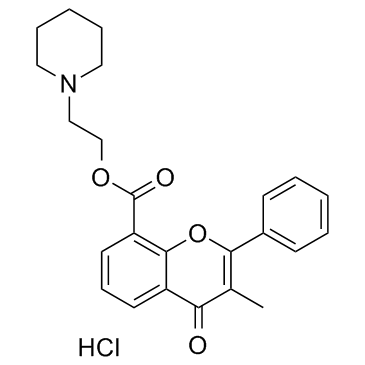
Flavoxate hydrochloride

Modify Date: 2025-08-21 16:42:06

Flavoxate hydrochloride Structure
Flavoxate hydrochloride structure
Common Name Flavoxate hydrochloride
CAS Number 3717-88-2 Molecular Weight 427.921
Density 1.203g/cm3 Boiling Point 564.1ºC at 760 mmHg
Molecular Formula C24H26ClNO4 Melting Point 232-234°C
MSDS Chinese USA Flash Point 294.9ºC
Symbol GHS07
GHS07
Signal Word Warning

 Use of Flavoxate hydrochloride


Flavoxate Hydrochloride(DW-61 Hydrochloride) is a muscarinic AChR antagonist used in various urinary syndromes and as an antispasmodic.Target: mAChRFlavoxate displaces [3H]nitrendipine on the Ca2+ channels binding sites with IC50 of 254 μM [1]. Flavoxate (>10 μM) suppresses carbachol-induced contractions in isolated rat detrusor strips with pD value of 4.55. Flavoxate (>10 μM) suppresses Ca2+-induced contractions in isolated rat detrusor strips with pIC50 value of 4.92 [2]. Flavoxate (0.01 μM ?10 μM) inhibits CAMP formation in a concentration-dependent manner in membranes from the rat striatum and cerebral cortex, an action which is completely abolished by pretreating the membranes with pertussis toxin (PTX) [3].Flavoxate (10mg/kg) suppresses both the an initial, rapidly rising phasic contraction (phase 1) and the tonic contraction (phase 2) contractions to the same extent in rats. Flavoxate (10mg/kg) abolishes the bladder contractions without causing any change in the amplitude of the contractions in rats. Flavoxate (3 mg/kg) abolishes the efferent neural activity and the associated bladder contractions for about 10 minutes without changing the baseline vesical pressure in rats. ICV-injected (50 to 200 μg/rat) or IT-injected (100 to 200 μg/rat) Flavoxate abolishes rhythmic bladder contractions during and after injection for five to 15 minutes in a dose-dependent manner in rats [2]. Flavoxate (3 mg/kg, i.v.) abolishes rhythmic bladder contractions and the maximal intervals of voiding contractions is 7.20 min [3].

 Names

Name flavoxate hydrochloride
Synonym More Synonyms

 Flavoxate hydrochloride Biological Activity

Description Flavoxate Hydrochloride(DW-61 Hydrochloride) is a muscarinic AChR antagonist used in various urinary syndromes and as an antispasmodic.Target: mAChRFlavoxate displaces [3H]nitrendipine on the Ca2+ channels binding sites with IC50 of 254 μM [1]. Flavoxate (>10 μM) suppresses carbachol-induced contractions in isolated rat detrusor strips with pD value of 4.55. Flavoxate (>10 μM) suppresses Ca2+-induced contractions in isolated rat detrusor strips with pIC50 value of 4.92 [2]. Flavoxate (0.01 μM ?10 μM) inhibits CAMP formation in a concentration-dependent manner in membranes from the rat striatum and cerebral cortex, an action which is completely abolished by pretreating the membranes with pertussis toxin (PTX) [3].Flavoxate (10mg/kg) suppresses both the an initial, rapidly rising phasic contraction (phase 1) and the tonic contraction (phase 2) contractions to the same extent in rats. Flavoxate (10mg/kg) abolishes the bladder contractions without causing any change in the amplitude of the contractions in rats. Flavoxate (3 mg/kg) abolishes the efferent neural activity and the associated bladder contractions for about 10 minutes without changing the baseline vesical pressure in rats. ICV-injected (50 to 200 μg/rat) or IT-injected (100 to 200 μg/rat) Flavoxate abolishes rhythmic bladder contractions during and after injection for five to 15 minutes in a dose-dependent manner in rats [2]. Flavoxate (3 mg/kg, i.v.) abolishes rhythmic bladder contractions and the maximal intervals of voiding contractions is 7.20 min [3].
Related Catalog
References

[1]. Dansette, P.M., M. Jaoen, and C. Pons, HMG-CoA reductase activity in human liver microsomes: comparative inhibition by statins. Exp Toxicol Pathol, 2000. 52(2): p. 145-8.

[2]. Kimura, Y., et al., Mechanisms of the suppression of the bladder activity by flavoxate. Int J Urol, 1996. 3(3): p. 218-27.

[3]. Oka, M., et al., Brain pertussis toxin-sensitive G proteins are involved in the flavoxate hydrochloride-induced suppression of the micturition reflex in rats. Brain Res, 1996. 727(1-2): p. 91-8.

 Chemical & Physical Properties

Density 1.203g/cm3
Boiling Point 564.1ºC at 760 mmHg
Melting Point 232-234°C
Molecular Formula C24H26ClNO4
Molecular Weight 427.921
Flash Point 294.9ºC
Exact Mass 427.155029
PSA 59.75000
LogP 5.15100
InChIKey XOEVKNFZUQEERE-UHFFFAOYSA-N
SMILES Cc1c(-c2ccccc2)oc2c(C(=O)OCCN3CCCCC3)cccc2c1=O.Cl
Storage condition Refrigerator
Water Solubility H2O: ~6.6 mg/mL

 Toxicological Information

CHEMICAL IDENTIFICATION

RTECS NUMBER :
DJ2450000
CHEMICAL NAME :
4H-1-Benzopyran-8-carboxylic acid, 3-methyl-4-oxo-2-phenyl-, 2-piperidinoethyl ester, hydrochloride
CAS REGISTRY NUMBER :
3717-88-2
LAST UPDATED :
199504
DATA ITEMS CITED :
18
MOLECULAR FORMULA :
C24-H25-N-O4.Cl-H
MOLECULAR WEIGHT :
427.96
WISWESSER LINE NOTATION :
T66 BO EVJ CR& D1 JVO2- AT6NTJ &GH

HEALTH HAZARD DATA

ACUTE TOXICITY DATA

TYPE OF TEST :
LD50 - Lethal dose, 50 percent kill
ROUTE OF EXPOSURE :
Oral
SPECIES OBSERVED :
Rodent - rat
DOSE/DURATION :
1040 mg/kg
TOXIC EFFECTS :
Behavioral - somnolence (general depressed activity) Lungs, Thorax, or Respiration - cyanosis Gastrointestinal - changes in structure or function of salivary glands
TYPE OF TEST :
LD50 - Lethal dose, 50 percent kill
ROUTE OF EXPOSURE :
Intraperitoneal
SPECIES OBSERVED :
Rodent - rat
DOSE/DURATION :
170 mg/kg
TOXIC EFFECTS :
Behavioral - somnolence (general depressed activity) Lungs, Thorax, or Respiration - cyanosis Gastrointestinal - changes in structure or function of salivary glands
TYPE OF TEST :
LD50 - Lethal dose, 50 percent kill
ROUTE OF EXPOSURE :
Subcutaneous
SPECIES OBSERVED :
Rodent - rat
DOSE/DURATION :
1010 mg/kg
TOXIC EFFECTS :
Details of toxic effects not reported other than lethal dose value
TYPE OF TEST :
LD50 - Lethal dose, 50 percent kill
ROUTE OF EXPOSURE :
Intravenous
SPECIES OBSERVED :
Rodent - rat
DOSE/DURATION :
25 mg/kg
TOXIC EFFECTS :
Details of toxic effects not reported other than lethal dose value
TYPE OF TEST :
LD50 - Lethal dose, 50 percent kill
ROUTE OF EXPOSURE :
Oral
SPECIES OBSERVED :
Rodent - mouse
DOSE/DURATION :
740 mg/kg
TOXIC EFFECTS :
Behavioral - altered sleep time (including change in righting reflex) Behavioral - excitement
TYPE OF TEST :
LD50 - Lethal dose, 50 percent kill
ROUTE OF EXPOSURE :
Intraperitoneal
SPECIES OBSERVED :
Rodent - mouse
DOSE/DURATION :
350 mg/kg
TOXIC EFFECTS :
Peripheral Nerve and Sensation - local anesthetic Autonomic Nervous System - smooth muscle relaxant (mechanism undefined, spasmolytic) Behavioral - analgesia
TYPE OF TEST :
LD50 - Lethal dose, 50 percent kill
ROUTE OF EXPOSURE :
Subcutaneous
SPECIES OBSERVED :
Rodent - mouse
DOSE/DURATION :
610 mg/kg
TOXIC EFFECTS :
Details of toxic effects not reported other than lethal dose value
TYPE OF TEST :
LD50 - Lethal dose, 50 percent kill
ROUTE OF EXPOSURE :
Intravenous
SPECIES OBSERVED :
Rodent - mouse
DOSE/DURATION :
28 mg/kg
TOXIC EFFECTS :
Details of toxic effects not reported other than lethal dose value
TYPE OF TEST :
LD50 - Lethal dose, 50 percent kill
ROUTE OF EXPOSURE :
Oral
SPECIES OBSERVED :
Rodent - rabbit
DOSE/DURATION :
>6 gm/kg
TOXIC EFFECTS :
Details of toxic effects not reported other than lethal dose value
TYPE OF TEST :
LD50 - Lethal dose, 50 percent kill
ROUTE OF EXPOSURE :
Intravenous
SPECIES OBSERVED :
Rodent - rabbit
DOSE/DURATION :
25 mg/kg
TOXIC EFFECTS :
Details of toxic effects not reported other than lethal dose value
TYPE OF TEST :
TDLo - Lowest published toxic dose
ROUTE OF EXPOSURE :
Oral
SPECIES OBSERVED :
Rodent - rat
DOSE/DURATION :
30 gm/kg/30D-C
TOXIC EFFECTS :
Liver - changes in liver weight Endocrine - changes in thymus weight Blood - pigmented or nucleated red blood cells
TYPE OF TEST :
TDLo - Lowest published toxic dose
ROUTE OF EXPOSURE :
Oral
DOSE :
4500 mg/kg
SEX/DURATION :
female 9-14 day(s) after conception
TOXIC EFFECTS :
Reproductive - Effects on Embryo or Fetus - fetotoxicity (except death, e.g., stunted fetus) Reproductive - Specific Developmental Abnormalities - musculoskeletal system
TYPE OF TEST :
TDLo - Lowest published toxic dose
ROUTE OF EXPOSURE :
Oral
DOSE :
3 gm/kg
SEX/DURATION :
female 9-14 day(s) after conception
TOXIC EFFECTS :
Reproductive - Effects on Embryo or Fetus - fetotoxicity (except death, e.g., stunted fetus)
TYPE OF TEST :
TDLo - Lowest published toxic dose
ROUTE OF EXPOSURE :
Oral
DOSE :
6 gm/kg
SEX/DURATION :
female 7-12 day(s) after conception
TOXIC EFFECTS :
Reproductive - Fertility - litter size (e.g. # fetuses per litter; measured before birth) Reproductive - Effects on Newborn - viability index (e.g., # alive at day 4 per # born alive) Reproductive - Effects on Newborn - weaning or lactation index (e.g., # alive at weaning per # alive at day 4)
TYPE OF TEST :
TDLo - Lowest published toxic dose
ROUTE OF EXPOSURE :
Oral
DOSE :
9 gm/kg
SEX/DURATION :
female 7-12 day(s) after conception
TOXIC EFFECTS :
Reproductive - Fertility - post-implantation mortality (e.g. dead and/or resorbed implants per total number of implants) Reproductive - Effects on Embryo or Fetus - fetotoxicity (except death, e.g., stunted fetus) Reproductive - Specific Developmental Abnormalities - musculoskeletal system
TYPE OF TEST :
TDLo - Lowest published toxic dose
ROUTE OF EXPOSURE :
Oral
DOSE :
1920 mg/kg
SEX/DURATION :
female 7-12 day(s) after conception
TOXIC EFFECTS :
Reproductive - Fertility - litter size (e.g. # fetuses per litter; measured before birth) Reproductive - Effects on Newborn - viability index (e.g., # alive at day 4 per # born alive)

MUTATION DATA

TYPE OF TEST :
Mutation in microorganisms
TEST SYSTEM :
Bacteria - Salmonella typhimurium
DOSE/DURATION :
79 ug/plate
REFERENCE :
YACHDS Yakuri to Chiryo. Pharmacology and Therapeutics. (Raifu Saiensu Shuppan K.K., 2-5-13, Yaesu, Chuo-ku, Tokyo 104, Japan) V.1- 1972- Volume(issue)/page/year: 19,773,1991 *** NIOSH STANDARDS DEVELOPMENT AND SURVEILLANCE DATA *** NIOSH OCCUPATIONAL EXPOSURE SURVEY DATA : NOES - National Occupational Exposure Survey (1983) NOES Hazard Code - X6121 No. of Facilities: 36 (estimated) No. of Industries: 1 No. of Occupations: 1 No. of Employees: 357 (estimated) No. of Female Employees: 187 (estimated)

 Safety Information

Symbol GHS07
GHS07
Signal Word Warning
Hazard Statements H302-H315-H319-H335
Precautionary Statements P301 + P312 + P330-P305 + P351 + P338
Personal Protective Equipment dust mask type N95 (US);Eyeshields;Gloves
Hazard Codes Xn:Harmful
Risk Phrases R22;R36/37/38
Safety Phrases S26
RIDADR NONH for all modes of transport
RTECS DJ2450000
HS Code 2934999090

 Customs

HS Code 2934999090
Summary 2934999090. other heterocyclic compounds. VAT:17.0%. Tax rebate rate:13.0%. . MFN tariff:6.5%. General tariff:20.0%

 Articles1

More Articles
A review of flavoxate hydrochloride in the treatment of urge incontinence.

J. Int. Med. Res. 16(5) , 317-30, (1988)

This article provides a review of the use of flavoxate hydrochloride in the treatment of urge incontinence. It outlines the pharmacology, mode of action, toxicology and pharmacokinetic studies which h...

 Flavoxate hydrochlorideBioassay

View more

Name: Primary qHTS assay for inhibitors of alpha-synuclein gene (SNCA) expression
Source: NCGC
External Id: SNCA-p-activity-luciferase
Name: Dicer-mediated maturation of pre-microRNA
Source: Center for Chemical Genomics, University of Michigan
Target: N/A
External Id: TargetID_659_CEMA
Name: p53 small molecule agonists, cell-based qHTS assay
Source: 824
External Id: P53344
Name: p53 small molecule agonists, cell-based qHTS assay with human liver microsomes
Source: 824
Target: tumor suppressor p53 [Homo sapiens]
External Id: P53MS233
Name: p53 small molecule agonists, cell-based qHTS assay with rat liver microsomes
Source: 824
Target: tumor suppressor p53 [Homo sapiens]
External Id: P53MS898
Total 274, Current Page 1 of 28
1
2
3
4
5

 Synonyms

4H-1-Benzopyran-8-carboxylic acid, 3-methyl-4-oxo-2-phenyl-, 2- (1-piperidinyl)ethyl ester, hydrochloride
4H-1-Benzopyran-8-carboxylic acid, 3-methyl-4-oxo-2-phenyl-, 2-piperidinoethyl ester, hydrochloride
2-(1-Piperidinyl)ethyl 3-methyl-4-oxo-2-phenyl-4H-chromene-8-carboxylate hydrochloride
2-(Piperidin-1-yl)ethyl 3-methyl-4-oxo-2-phenyl-4H-chromene-8-carboxylate hydrochloride
2-(Piperidin-1-yl)ethyl-3-methyl-4-oxo-2-phenyl-4H-chromen-8-carboxylathydrochlorid
2-Piperidinoethyl 3-methyl-4-oxo-2-phenyl-4H-1-benzopyran-8-carboxylate hydrochloride
2-piperidin-1-ylethyl 3-methyl-4-oxo-2-phenylchromene-8-carboxylate,hydrochloride
Spasuret hydrochloride
4H-1-Benzopyran-8-carboxylic acid, 3-methyl-4-oxo-2-phenyl-, 2-(1-piperidinyl)ethyl ester, hydrochloride (1:1)
2-(Piperidin-1-yl)ethyl 3-methyl-4-oxo-2-phenyl-4H-chromene-8-carboxylate hydrochloride (1:1)
2-Piperidin-1-ylethyl-3-methyl-4-oxo-2-phenyl-4H-chromen-8-carboxylathydrochlorid
4H-1-Benzopyran-8-carboxylic acid, 3-methyl-4-oxo-2-phenyl-, 2-(1-piperidinyl)ethyl ester, hydrochloride
2-(1-Piperidinyl)ethyl 3-methyl-4-oxo-2-phenyl-4H-chromene-8-carboxylate hydrochloride (1:1)
3-méthyl-4-oxo-2-phényl-4H-chromène-8-carboxylate de 2-pipéridin-1-yléthyle chlorhydrate
Flavoxate Hydrochloride
MFCD00072099
2-piperidin-1-ylethyl 3-methyl-4-oxo-2-phenyl-4H-chromene-8-carboxylate hydrochloride
EINECS 223-066-4
Flavoxate HCl
The content on this webpage is sourced from various professional data sources. If you have any questions or concerns regarding the content, please feel free to contact service1@chemsrc.com.
Top Suppliers:I want be here


Get all suppliers and price by the below link:

Flavoxate hydrochloride suppliers


Price: $79/10mM*1mLinDMSO

Reference only. check more Flavoxate hydrochloride price