| Description |
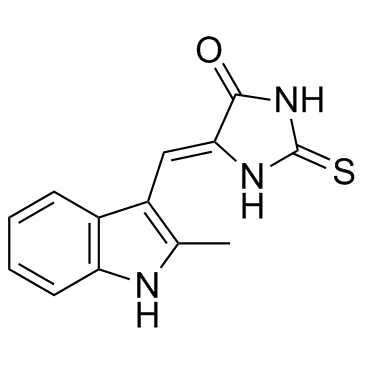
PKG drug G1 targets C42 of PKG Iα. PKG drug G1 can couple to vasodilation and blood pressure lowering by a C42 PKG Iα-independent mechanism.
|
| Related Catalog |
|
| Target |
PKG Iα[1]
|
| In Vivo |
PKG drug G1 induces vasodilation of isolated resistance blood vessels and blood pressure lowering in a mouse model of angiotensin II–induced hypertension. PKG drug G1 efficiently relaxes WT but not knockin (KI) vessels, which is then assessed in a murine model of hypertension. PKG drug G1 lowers blood pressure in hypertensive WT, but not KI, mice in vivo. PKG drug G1 is tested in vivo in healthy mice implanted with telemetric devices that allow blood pressure and heart rate to be constantly monitored. PKG drug G1 or vehicle control is administrated by intraperitoneal injection, and the acute impact on hemodynamics assessed. PKG drug G1 administered at 7.4 mg/kg does not decrease blood pressure, but there is a concomitant reflex tachycardia. When this is repeated using 14.8 mg/kg dose of PKG drug G1, again blood pressure is not altered-but this higher dose induces a potentiated increase in heart rate[1].
|
| Animal Admin |
Mice[1] Mice constitutively expressing PKG Iα Cys42Ser are generated on a pure C57BL/6 background. Age-matched and body weight–matched WT or PKG Iα Cys42Ser KI male mice are used in all studies. Blood pressure and heart rate are assessed by radio telemetry in conscious freely moving mice. Alzet osmotic mini-pumps are used to deliver angiotensin II at 1.1 mg/kg per day in some studies. PKG drug G1 is delivered intraperitoneally (3.7-14.8 mg/kg) or orally (20 mg/kg) in some studies. To deliver PKG drug G1 orally, without stress or risk of dislodging the telemetric probe catheter, it is provided suspended in water and set in gelatin flavored with sodium saccharin[1].
|
| References |
[1]. Burgoyne JR, et al. Proof of Principle for a Novel Class of Antihypertensives That Target the Oxidative Activation of PKG Iα (Protein Kinase G Iα). Hypertension. 2017 Sep;70(3):577-586.
|