Arenobufagin
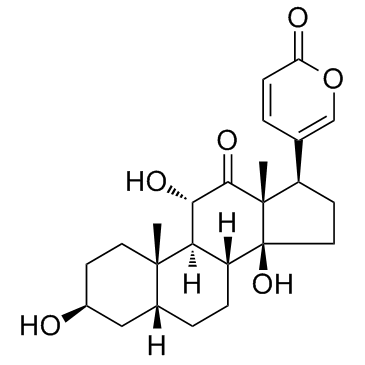
Arenobufagin structure
|
Common Name | Arenobufagin | ||
|---|---|---|---|---|
| CAS Number | 464-74-4 | Molecular Weight | 416.507 | |
| Density | 1.4±0.1 g/cm3 | Boiling Point | 637.2±55.0 °C at 760 mmHg | |
| Molecular Formula | C24H32O6 | Melting Point | N/A | |
| MSDS | N/A | Flash Point | 219.3±25.0 °C | |
Use of ArenobufaginArenobufagin is a natural bufadienolide from toad venom; has potent antineoplastic activity against HCC HepG2 cells as well as corresponding multidrug-resistant HepG2/ADM cells.IC50 value: Target: in vitro: arenobufagin induced mitochondria-mediated apoptosis in HCC cells, with decreasing mitochondrial potential, as well as increasing Bax/Bcl-2 expression ratio, Bax translocation from cytosol to mitochondria. Arenobufagin also induced autophagy in HepG2/ADM cells. Autophagy-specific inhibitors (3-methyladenine, chloroquine and bafilomycin A1) or Beclin1 and Atg 5 small interfering RNAs (siRNAs) enhanced arenobufagin-induced apoptosis, indicating that arenobufagin-mediated autophagy may protect HepG2/ADM cells from undergoing apoptotic cell death [1]. arenobufagin inhibited vascular endothelial growth factor (VEGF)-induced viability, migration, invasion and tube formation in human umbilical vein endothelial cells (HUVECs) in vitro [2]. Arenobufagin blocked the Na+/K+ pump current in a dose-dependent manner with a half-maximal concentration of 0.29 microM and a Hill coefficient of 1.1 [3].in vivo: arenobufagin inhibited the growth of HepG2/ADM xenograft tumors, which were associated with poly (ADP-ribose) polymerase cleavage, light chain 3-II activation and mTOR inhibition [1]. Arenobufagin also suppressed sprouting formation from VEGF-treated aortic rings in an ex vivo model [2]. |
This table lists Chinese names, IUPAC names and various aliases of this chemical substance.
| Name | arenobufagin |
|---|---|
| Synonym | More Synonyms |
This table contains bioactivity, target information and biological‑assay experimental data of this compound.
| Description | Arenobufagin is a natural bufadienolide from toad venom; has potent antineoplastic activity against HCC HepG2 cells as well as corresponding multidrug-resistant HepG2/ADM cells.IC50 value: Target: in vitro: arenobufagin induced mitochondria-mediated apoptosis in HCC cells, with decreasing mitochondrial potential, as well as increasing Bax/Bcl-2 expression ratio, Bax translocation from cytosol to mitochondria. Arenobufagin also induced autophagy in HepG2/ADM cells. Autophagy-specific inhibitors (3-methyladenine, chloroquine and bafilomycin A1) or Beclin1 and Atg 5 small interfering RNAs (siRNAs) enhanced arenobufagin-induced apoptosis, indicating that arenobufagin-mediated autophagy may protect HepG2/ADM cells from undergoing apoptotic cell death [1]. arenobufagin inhibited vascular endothelial growth factor (VEGF)-induced viability, migration, invasion and tube formation in human umbilical vein endothelial cells (HUVECs) in vitro [2]. Arenobufagin blocked the Na+/K+ pump current in a dose-dependent manner with a half-maximal concentration of 0.29 microM and a Hill coefficient of 1.1 [3].in vivo: arenobufagin inhibited the growth of HepG2/ADM xenograft tumors, which were associated with poly (ADP-ribose) polymerase cleavage, light chain 3-II activation and mTOR inhibition [1]. Arenobufagin also suppressed sprouting formation from VEGF-treated aortic rings in an ex vivo model [2]. |
|---|---|
| Related Catalog | |
| References |
This table shows physicochemical parameters including melting point, boiling point, density, solubility and optical rotation. Missing data is marked as N/A.
| Density | 1.4±0.1 g/cm3 |
|---|---|
| Boiling Point | 637.2±55.0 °C at 760 mmHg |
| Molecular Formula | C24H32O6 |
| Molecular Weight | 416.507 |
| Flash Point | 219.3±25.0 °C |
| Exact Mass | 416.219879 |
| PSA | 107.97000 |
| LogP | 0.80 |
| Vapour Pressure | 0.0±4.3 mmHg at 25°C |
| Index of Refraction | 1.622 |
| InChIKey | JGDCRWYOMWSTFC-AZGSIFHYSA-N |
| SMILES | CC12CCC(O)CC1CCC1C2C(O)C(=O)C2(C)C(c3ccc(=O)oc3)CCC12O |
| Storage condition | -20°C |
This table contains target information, in‑vitro & in‑vivo assay data for this compound.
This table collects all English aliases, systematic names and CAS‑related synonyms of the compound.
| Arenobufagin |
| (3β,5β,11α)-3,11,14-Trihydroxy-12-oxobufa-20,22-dienolide |
| ARENOBUFAGIN (REFERENCE GRADE) |
This section contains frequently‑asked‑questions about this compound, including basic parameters, properties, storage conditions and corresponding answers.
| Q: What is the CAS number of arenobufagin? |
| A: CAS number of arenobufagin is 464-74-4. |
| Q: What is the SMILES notation of arenobufagin? |
| A: SMILES notation of arenobufagin is CC12CCC(O)CC1CCC1C2C(O)C(=O)C2(C)C(c3ccc(=O)oc3)CCC12O. |
| Q: What is the boiling point of arenobufagin? |
| A: Boiling point of arenobufagin is 637.2±55.0 °C at 760 mmHg. |
| Q: What is the molecular formula of arenobufagin? |
| A: Molecular formula of arenobufagin is C24H32O6. |
| Q: What is the InChIKey of arenobufagin? |
| A: InChIKey of arenobufagin is JGDCRWYOMWSTFC-AZGSIFHYSA-N. |
| Q: What is the polar surface area (PSA) of arenobufagin? |
| A: Polar surface area (PSA) of arenobufagin is 107.97000. |
| Q: What is the English name of arenobufagin? |
| A: The English name of arenobufagin is arenobufagin. |
| Q: What is the molecular weight of arenobufagin? |
| A: Molecular weight of arenobufagin is 416.507. |
| Q: What are the storage conditions for arenobufagin? |
| A: Storage conditions for arenobufagin: -20°C. |
| Q: What is the LogP of arenobufagin? |
| A: LogP of arenobufagin is 0.80. |
This table lists manufacturers and suppliers of this compound, including vendor names and product supply reference information.
| Shanghai Nianxing Industrial Co., Ltd |
| BioBioPha |
| Dayang Chem (Hangzhou) Co., Ltd. |
| naturewill |