Cinanserin hydrochloride
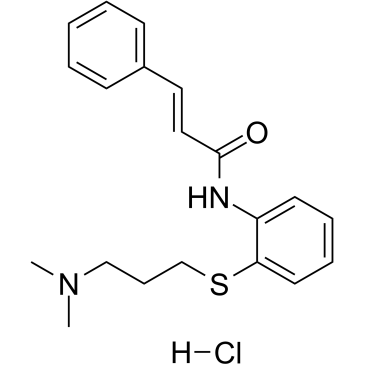
Cinanserin hydrochloride structure
|
Common Name | Cinanserin hydrochloride | ||
|---|---|---|---|---|
| CAS Number | 54-84-2 | Molecular Weight | 376.94300 | |
| Density | N/A | Boiling Point | 519.5ºC at 760mmHg | |
| Molecular Formula | C20H25ClN2OS | Melting Point | N/A | |
| MSDS | N/A | Flash Point | 268ºC | |
Use of Cinanserin hydrochlorideCinanserin hydrochloride (SQ 10643) is a potent, selective and highly affinity 5-HT2 receptor antagonist with a Ki of 41 nM. Cinanserin hydrochloride has a much higher binding affinity for the 5-HT2 than for the 5-HT1 receptor (Ki of 3500 nM). Cinanserin is also an inhibitor of 3C-like proteinase of severe acute respiratory syndrome coronavirus and strongly reduces virus replication in vitro[1][2][3]. |
This table lists Chinese names, IUPAC names and various aliases of this chemical substance.
| Name | cinanserin hydrochloride |
|---|---|
| Synonym | More Synonyms |
This table contains bioactivity, target information and biological‑assay experimental data of this compound.
| Description | Cinanserin hydrochloride (SQ 10643) is a potent, selective and highly affinity 5-HT2 receptor antagonist with a Ki of 41 nM. Cinanserin hydrochloride has a much higher binding affinity for the 5-HT2 than for the 5-HT1 receptor (Ki of 3500 nM). Cinanserin is also an inhibitor of 3C-like proteinase of severe acute respiratory syndrome coronavirus and strongly reduces virus replication in vitro[1][2][3]. |
|---|---|
| Related Catalog | |
| Target |
Ki: 41 nM (5-HT2 receptor)[3]; 3C-like proteinase[1] |
| In Vitro | Cinanserin/Cinanserin hydrochloride have binding affinity to SARS-CoV 3CLpro, HCoV-229E 3CLpro, with the KD values of 49.4 μM/78.0 μM for SARS-associated coronavirus (SARS-CoV) 3CLpro and 18.2 μM/36.6 μM for human coronavirus 229E (HCoV-229E) 3CLpro[1]. The IC50 values of Cinanserin and Cinanserin hydrochloride for inhibiting the catalytic activity of SARS-CoV 3CLpro are calculated as 4.92 μM and 5.05 μM, respectively, The corresponding IC50 values for HCoV-229E 3CLpro are 4.68 μM and 5.68 μM. None of the compounds have inhibitory activity against HRV-14 3Cpro at concentrations up to 200 μM[1]. |
| In Vivo | Cinanserin (5 mg/kg; intravenous injection; for 2 hours; male Wistar rats) treatment significantly reduces systemic burn edema to shamburn levels. Leukocyte-endothelial interactions are significantly reduced by administration of Cinanserin[2]. Animal Model: Male Wistar rats (250 g) underwent thermal injury[2] Dosage: 5 mg/kg Administration: Intravenous injection; for 2 hours Result: Significantly reduced systemic burn edema to shamburn levels.. |
| References |
This table shows physicochemical parameters including melting point, boiling point, density, solubility and optical rotation. Missing data is marked as N/A.
| Boiling Point | 519.5ºC at 760mmHg |
|---|---|
| Molecular Formula | C20H25ClN2OS |
| Molecular Weight | 376.94300 |
| Flash Point | 268ºC |
| Exact Mass | 376.13800 |
| PSA | 57.64000 |
| LogP | 5.25730 |
| InChIKey | LXGJPDKYMJJWRB-IERUDJENSA-N |
| SMILES | CN(C)CCCSc1ccccc1NC(=O)C=Cc1ccccc1.Cl |
This table summarizes toxicological test data, acute & chronic toxicity and ecological hazard parameters for this chemical.
CHEMICAL IDENTIFICATION
HEALTH HAZARD DATAACUTE TOXICITY DATA
|
This table collects all English aliases, systematic names and CAS‑related synonyms of the compound.
| maptc |
| Cinnanserin |
| sq10,643 |
| CINANSERIN |
| DPTC HYDROCHLORIDE |
| DPTC |
This section contains frequently‑asked‑questions about this compound, including basic parameters, properties, storage conditions and corresponding answers.
| Q: What is the boiling point of cinanserin hydrochloride? |
| A: Boiling point of cinanserin hydrochloride is 519.5ºC at 760mmHg. |
| Q: What is the molecular formula of cinanserin hydrochloride? |
| A: Molecular formula of cinanserin hydrochloride is C20H25ClN2OS. |
| Q: What is the CAS number of cinanserin hydrochloride? |
| A: CAS number of cinanserin hydrochloride is 54-84-2. |
| Q: What is the English name of cinanserin hydrochloride? |
| A: The English name of cinanserin hydrochloride is cinanserin hydrochloride. |
| Q: What is the polar surface area (PSA) of cinanserin hydrochloride? |
| A: Polar surface area (PSA) of cinanserin hydrochloride is 57.64000. |
| Q: What is the InChIKey of cinanserin hydrochloride? |
| A: InChIKey of cinanserin hydrochloride is LXGJPDKYMJJWRB-IERUDJENSA-N. |
| Q: What are the uses of cinanserin hydrochloride? |
| A: Main uses of cinanserin hydrochloride: Cinanserin hydrochloride (SQ 10643) is a potent, selective and highly affinity 5-HT2 receptor antagonist with a Ki of 41 nM. Cinanserin hydrochloride has a much higher binding affinity for the 5-HT2 than for the 5-HT1 receptor (Ki of 3500 nM). Cinanserin is also an inhibitor of 3C-like proteinase of severe acute respiratory syndrome coronavirus and strongly reduces virus replication in vitro[1][2][3]. |
| Q: What is the molecular weight of cinanserin hydrochloride? |
| A: Molecular weight of cinanserin hydrochloride is 376.94300. |
| Q: What is the Chinese name of 54-84-2? |
| A: Chinese name of 54-84-2 is Cinanserin hydrochloride. |
| Q: What is the SMILES notation of cinanserin hydrochloride? |
| A: SMILES notation of cinanserin hydrochloride is CN(C)CCCSc1ccccc1NC(=O)C=Cc1ccccc1.Cl. |
This table lists manufacturers and suppliers of this compound, including vendor names and product supply reference information.
| Shanghai Nianxing Industrial Co., Ltd |
| Dayang Chem (Hangzhou) Co., Ltd. |