Methyl protodioscin
Modify Date: 2026-07-01 17:19:19
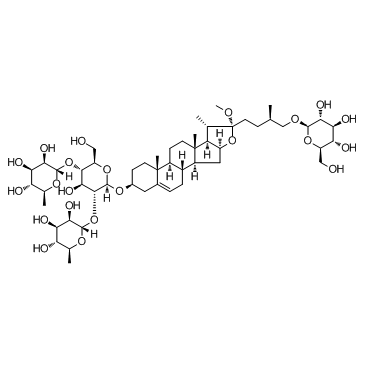
Methyl protodioscin structure
|
Common Name | Methyl protodioscin | ||
|---|---|---|---|---|
| CAS Number | 54522-52-0 | Molecular Weight | 1063.226 | |
| Density | 1.4±0.1 g/cm3 | Boiling Point | N/A | |
| Molecular Formula | C52H86O22 | Melting Point | N/A | |
| MSDS | N/A | Flash Point | N/A | |
Use of Methyl protodioscinMethyl protodioscin(NSC-698790) is a furostanol bisglycoside with antitumor properties; shows to reduce proliferation, cause cell cycle arrest.IC50 value:Target: in vitro: MPD showed growth inhibitory effects in A549 cells in a dose- and time-dependent manner. The significant G2/M cell cycle arrest and apoptotic effect were also seen in A549 cells treated with MPD. MPD-induced apoptosis was accompanied by a significant reduction of mitochondrial membrane potential, release of mitochondrial cytochrome c to cytosol, activation of caspase-3, downregulation of Bcl-2, p-Bad, and upregulation of Bax [1]. In THP-1 macrophages, MPD increases levels of ABCA1 mRNA and protein in dose- and time-dependent manners, and apoA-1-mediated cholesterol efflux. MPD also decreases the gene expressions of HMGCR, FAS and ACC for cholesterol and fatty acid synthesis [2]. |
| Name | Methylprotodioscin |
|---|---|
| Synonym | More Synonyms |
| Description | Methyl protodioscin(NSC-698790) is a furostanol bisglycoside with antitumor properties; shows to reduce proliferation, cause cell cycle arrest.IC50 value:Target: in vitro: MPD showed growth inhibitory effects in A549 cells in a dose- and time-dependent manner. The significant G2/M cell cycle arrest and apoptotic effect were also seen in A549 cells treated with MPD. MPD-induced apoptosis was accompanied by a significant reduction of mitochondrial membrane potential, release of mitochondrial cytochrome c to cytosol, activation of caspase-3, downregulation of Bcl-2, p-Bad, and upregulation of Bax [1]. In THP-1 macrophages, MPD increases levels of ABCA1 mRNA and protein in dose- and time-dependent manners, and apoA-1-mediated cholesterol efflux. MPD also decreases the gene expressions of HMGCR, FAS and ACC for cholesterol and fatty acid synthesis [2]. |
|---|---|
| Related Catalog | |
| References |
| Density | 1.4±0.1 g/cm3 |
|---|---|
| Molecular Formula | C52H86O22 |
| Molecular Weight | 1063.226 |
| Exact Mass | 1062.561035 |
| PSA | 335.06000 |
| LogP | 4.17 |
| Index of Refraction | 1.620 |
| InChIKey | HSSJYSJXBOCKQM-LXNCCRCLSA-N |
| SMILES | COC1(CCC(C)COC2OC(CO)C(O)C(O)C2O)OC2CC3C4CC=C5CC(OC6OC(CO)C(OC7OC(C)C(O)C(O)C7O)C(O)C6OC6OC(C)C(O)C(O)C6O)CCC5(C)C4CCC3(C)C2C1C |
| Storage condition | -20°C |
Total 37, Current Page 1 of 4
1
2
3
4
| (3β,22R,25R)-26-(β-D-Glucopyranosyloxy)-22-methoxyfurost-5-en-3-yl 6-deoxy-α-L-mannopyranosyl-(1->2)-[6-deoxy-α-L-mannopyranosyl-(1->4)]-β-D-glucopyranoside |
| methyl protoneodioscin |
| Methyl Protodioscin |