Dimethylselenide
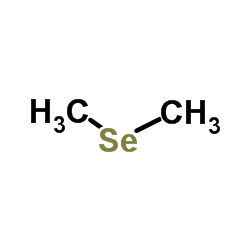
Dimethylselenide structure
|
Common Name | Dimethylselenide | ||
|---|---|---|---|---|
| CAS Number | 593-79-3 | Molecular Weight | 109.029 | |
| Density | 1.408 g/mL at 20 °C(lit.) | Boiling Point | 49.8±9.0 °C at 760 mmHg | |
| Molecular Formula | C2H6Se | Melting Point | N/A | |
| MSDS | USA | Flash Point | -16.1±18.7 °C | |
| Symbol |


GHS06, GHS08, GHS09 |
Signal Word | Danger | |
Use of Dimethylselenide(Methylselanyl)methane is a biochemical reagent that can be used as a biological material or organic compound for life science related research. |
Summary: Dimethylselenide, Chinese name: 二甲基硒 (CAS: 593-79-3), molecular formula: C2H6Se, molecular weight: 109.029, is a colorless liquid with an unpleasant odor, boiling point: 49.8±9.0 °C, density: 1.408 g/mL. For research-use only, not for medical or clinical usage.
This table lists Chinese names, IUPAC names and various aliases of this chemical substance.
| Name | dimethylselenide |
|---|---|
| Synonym | More Synonyms |
This table contains bioactivity, target information and biological‑assay experimental data of this compound.
| Description | (Methylselanyl)methane is a biochemical reagent that can be used as a biological material or organic compound for life science related research. |
|---|---|
| Related Catalog |
This table shows physicochemical parameters including melting point, boiling point, density, solubility and optical rotation. Missing data is marked as N/A.
| Density | 1.408 g/mL at 20 °C(lit.) |
|---|---|
| Boiling Point | 49.8±9.0 °C at 760 mmHg |
| Molecular Formula | C2H6Se |
| Molecular Weight | 109.029 |
| Flash Point | -16.1±18.7 °C |
| Exact Mass | 109.963470 |
| LogP | 0.30 |
| Vapour Pressure | 307.5±0.1 mmHg at 25°C |
| Index of Refraction | 1.49 |
| InChIKey | RVIXKDRPFPUUOO-UHFFFAOYSA-N |
| SMILES | C[Se]C |
| Storage condition | 2-8°C |
| Stability | Stable. Hydrolyzes in water. Reactions with acid or strong oxidizing agents are dangerous. |
This table provides MSDS information including hazard classification, first‑aid, fire‑fighting, spill handling, operation and storage instructions.
This table summarizes toxicological test data, acute & chronic toxicity and ecological hazard parameters for this chemical.
CHEMICAL IDENTIFICATION
HEALTH HAZARD DATAACUTE TOXICITY DATA
|
This table covers safety warnings, protective measures, incompatible substances and disposal guidelines for this compound.
| Symbol |
GHS06, GHS08, GHS09 |
|---|---|
| Signal Word | Danger |
| Hazard Statements | H301-H331-H373-H410 |
| Precautionary Statements | P261-P273-P301 + P310-P311-P501 |
| Personal Protective Equipment | Eyeshields;Faceshields;full-face respirator (US);Gloves;multi-purpose combination respirator cartridge (US) |
| Hazard Codes | T: Toxic;N: Dangerous for the environment; |
| Risk Phrases | R23/25 |
| Safety Phrases | S20/21-S28-S45-S60-S61 |
| RIDADR | UN 3282 6.1/PG 2 |
| WGK Germany | 3 |
| RTECS | VS6880000 |
| Packaging Group | III |
| Hazard Class | 3 |
This table presents publicly reported synthetic routes, reaction conditions, reactants and product information of the compound.
This table lists relevant public references with title, journal and publication metadata for this compound.
|
Quantification of methylated selenium, sulfur, and arsenic in the environment.
PLoS ONE 9(7) , e102906, (2014) Biomethylation and volatilization of trace elements may contribute to their redistribution in the environment. However, quantification of volatile, methylated species in the environment is complicated... |
|
|
Gas chromatography with atomic emission detection for dimethylselenide and dimethyldiselenide determination in waters and plant materials using a purge-and-trap preconcentration system.
J. Chromatogr. A. 1095(1-2) , 138-44, (2005) Dimethylselenide (DMSe) and dimethyldiselenide (DMDSe) were determined in plant and water samples by capillary gas chromatography using microwave induced-plasma atomic emission spectrometry for detect... |
|
|
Biotransformation of L-selenomethionine and selenite in rat gut contents.
Biol. Trace Elem. Res. 139(2) , 188-96, (2011) L-selenomethionine (SeMet) and sodium selenite are widely used selenium nutritional supplements with potential benefit in preventing cancer. However, supplementation is not without risks of toxicity i... |
This table collects all English aliases, systematic names and CAS‑related synonyms of the compound.
| dimethyl selenide |
| Methyl selenide (8CI) |
| (Methylselanyl)methane |
| Dimethylselenium |
| methylselanylmethane |
| MFCD00014848 |
| EINECS 209-807-4 |
| Dimethylselenide |
This section contains frequently‑asked‑questions about this compound, including basic parameters, properties, storage conditions and corresponding answers.
| Q: What is the SMILES notation of dimethylselenide? |
| A: SMILES notation of dimethylselenide is C[Se]C. |
| Q: What is the InChIKey of dimethylselenide? |
| A: InChIKey of dimethylselenide is RVIXKDRPFPUUOO-UHFFFAOYSA-N. |
| Q: What is the CAS number of dimethylselenide? |
| A: CAS number of dimethylselenide is 593-79-3. |
| Q: What is the molecular formula of dimethylselenide? |
| A: Molecular formula of dimethylselenide is C2H6Se. |
| Q: What is the molecular weight of dimethylselenide? |
| A: Molecular weight of dimethylselenide is 109.029. |
| Q: What is the boiling point of dimethylselenide? |
| A: Boiling point of dimethylselenide is 49.8±9.0 °C at 760 mmHg. |
| Q: What is the English name of dimethylselenide? |
| A: The English name of dimethylselenide is dimethylselenide. |
| Q: What is the LogP of dimethylselenide? |
| A: LogP of dimethylselenide is 0.30. |
| Q: What are the storage conditions for dimethylselenide? |
| A: Storage conditions for dimethylselenide: 2-8°C. |
| Q: What is the safety information for dimethylselenide? |
| A: Safety information for dimethylselenide: S20/21-S28-S45-S60-S61. |
This table lists manufacturers and suppliers of this compound, including vendor names and product supply reference information.
| Shanghai Nianxing Industrial Co., Ltd |
| Dayang Chem (Hangzhou) Co., Ltd. |