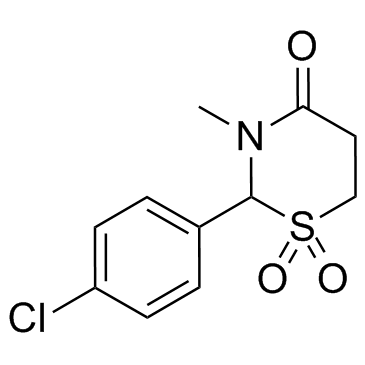
chlormezanone

Modify Date: 2026-07-03 17:24:08

chlormezanone Structure
chlormezanone structure
Common Name chlormezanone
CAS Number 80-77-3 Molecular Weight 273.736
Density 1.4±0.1 g/cm3 Boiling Point 534.5±50.0 °C at 760 mmHg
Molecular Formula C11H12ClNO3S Melting Point 114ºC
MSDS N/A Flash Point 277.1±30.1 °C

 Use of chlormezanone


Chlormezanone resembles benzodiazepine. The action of Chlormezanone is similar to benzodiazepine-type agents. Chlormezanone is used as an anxiolytic and a muscle relaxant.

 Names

This table lists Chinese names, IUPAC names and various aliases of this chemical substance.

Name chlormezanone
Synonym More Synonyms

 chlormezanone Biological Activity

This table contains bioactivity, target information and biological‑assay experimental data of this compound.

Description Chlormezanone resembles benzodiazepine. The action of Chlormezanone is similar to benzodiazepine-type agents. Chlormezanone is used as an anxiolytic and a muscle relaxant.
Related Catalog
Target

Benzodiazepine[1]

In Vivo Comparative results obtained with Chlormezanone in the dosage levels capable of producing more than 80% depression in the contralateral extensor[1].
Animal Admin Cats[1] Effects of various agents (e.g., Chlormezanone 300 mg/kg i.p.) are studied on linguomandibular, extensor and patellar reflexes in spinal cats.
References

[1]. Sukehiro CHIBA, et al. EFFECTS OF NEW s-TRIAZOLOBENZODIAZEPINE (D-4OTA) AND OTHER CENTRAL MUSCLE RELAXANTS ON SPINAL AND SUPRASPINAL REFLEXES IN CATS. Japan. J. Pharmacol, 23, 83-96 (1973).

 Chemical & Physical Properties

This table shows physicochemical parameters including melting point, boiling point, density, solubility and optical rotation. Missing data is marked as N/A.

Density 1.4±0.1 g/cm3
Boiling Point 534.5±50.0 °C at 760 mmHg
Melting Point 114ºC
Molecular Formula C11H12ClNO3S
Molecular Weight 273.736
Flash Point 277.1±30.1 °C
Exact Mass 273.022644
PSA 62.83000
LogP 0.86
Vapour Pressure 0.0±1.4 mmHg at 25°C
Index of Refraction 1.580
InChIKey WEQAYVWKMWHEJO-UHFFFAOYSA-N
SMILES CN1C(=O)CCS(=O)(=O)C1c1ccc(Cl)cc1
Storage condition Store at RT

 MSDS

This table provides MSDS information including hazard classification, first‑aid, fire‑fighting, spill handling, operation and storage instructions.

 Toxicological Information

This table summarizes toxicological test data, acute & chronic toxicity and ecological hazard parameters for this chemical.

CHEMICAL IDENTIFICATION

RTECS NUMBER :
XJ1050000
CHEMICAL NAME :
4H-1,3-Thiazin-4-one, 2-(p-chlorophenyl)tetrahydro-3-methyl-, 1,1,-dioxide
CAS REGISTRY NUMBER :
80-77-3
LAST UPDATED :
199606
DATA ITEMS CITED :
12
MOLECULAR FORMULA :
C11-H12-Cl-N-O3-S
MOLECULAR WEIGHT :
273.75
WISWESSER LINE NOTATION :
T6VN DSWTJ B1 CR DG

HEALTH HAZARD DATA

ACUTE TOXICITY DATA

TYPE OF TEST :
LDLo - Lowest published lethal dose
ROUTE OF EXPOSURE :
Oral
SPECIES OBSERVED :
Human - woman
DOSE/DURATION :
20 gm/kg
TOXIC EFFECTS :
Lungs, Thorax, or Respiration - emphysema Lungs, Thorax, or Respiration - acute pulmonary edema Lungs, Thorax, or Respiration - other changes
REFERENCE :
HOCHE8 Hochudoku. (Nippon Hochudoku Gakkai, c/o Kyushu Daigaku Igakubu Hoigaku Kyoshitsu, 3-1-1 Maidashi, Higashi-ku, Fukuoka, 812, Japan) V.8- 1990- Volume(issue)/page/year: 9,168,1991
TYPE OF TEST :
TDLo - Lowest published toxic dose
ROUTE OF EXPOSURE :
Oral
SPECIES OBSERVED :
Human - man
DOSE/DURATION :
157 mg/kg
TOXIC EFFECTS :
Sense Organs and Special Senses (Eye) - mydriasis (pupillary dilation) Behavioral - ataxia Behavioral - coma
REFERENCE :
BMJOAE British Medical Journal. (British Medical Assoc., BMA House, Tavistock Sq., London WC1H 9JR, UK) V.1- 1857- Volume(issue)/page/year: 292,732,1986
TYPE OF TEST :
TDLo - Lowest published toxic dose
ROUTE OF EXPOSURE :
Oral
SPECIES OBSERVED :
Human - woman
DOSE/DURATION :
140 mg/kg
TOXIC EFFECTS :
Behavioral - coma Vascular - BP lowering not characterized in autonomic section
REFERENCE :
BMJOAE British Medical Journal. (British Medical Assoc., BMA House, Tavistock Sq., London WC1H 9JR, UK) V.1- 1857- Volume(issue)/page/year: 286,845,1983
TYPE OF TEST :
LD50 - Lethal dose, 50 percent kill
ROUTE OF EXPOSURE :
Oral
SPECIES OBSERVED :
Rodent - rat
DOSE/DURATION :
605 mg/kg
TOXIC EFFECTS :
Behavioral - somnolence (general depressed activity) Behavioral - antipsychotic Lungs, Thorax, or Respiration - other changes
REFERENCE :
AIPTAK Archives Internationales de Pharmacodynamie et de Therapie. (Heymans Institute of Pharmacology, De Pintelaan 185, B-9000 Ghent, Belgium) V.4- 1898- Volume(issue)/page/year: 130,280,1961
TYPE OF TEST :
LD50 - Lethal dose, 50 percent kill
ROUTE OF EXPOSURE :
Intraperitoneal
SPECIES OBSERVED :
Rodent - rat
DOSE/DURATION :
370 mg/kg
TOXIC EFFECTS :
Details of toxic effects not reported other than lethal dose value
REFERENCE :
ARZNAD Arzneimittel-Forschung. Drug Research. (Editio Cantor Verlag, Postfach 1255, W-7960 Aulendorf, Fed. Rep. Ger.) V.1- 1951- Volume(issue)/page/year: 17,242,1967
TYPE OF TEST :
LD50 - Lethal dose, 50 percent kill
ROUTE OF EXPOSURE :
Oral
SPECIES OBSERVED :
Rodent - mouse
DOSE/DURATION :
600 mg/kg
TOXIC EFFECTS :
Details of toxic effects not reported other than lethal dose value
REFERENCE :
OYYAA2 Oyo Yakuri. Pharmacometrics. (Oyo Yakuri Kenkyukai, CPO Box 180, Sendai 980-91, Japan) V.1- 1967- Volume(issue)/page/year: 9,601,1975
TYPE OF TEST :
LD50 - Lethal dose, 50 percent kill
ROUTE OF EXPOSURE :
Intraperitoneal
SPECIES OBSERVED :
Rodent - mouse
DOSE/DURATION :
514 mg/kg
TOXIC EFFECTS :
Details of toxic effects not reported other than lethal dose value
REFERENCE :
AAREAV Anesthesie, Analgesie, Reanimation. (Paris, France) V.14-38, 1957-81. Volume(issue)/page/year: 19,603,1962
TYPE OF TEST :
LD50 - Lethal dose, 50 percent kill
ROUTE OF EXPOSURE :
Subcutaneous
SPECIES OBSERVED :
Rodent - mouse
DOSE/DURATION :
322 mg/kg
TOXIC EFFECTS :
Behavioral - anticonvulsant
REFERENCE :
APTOA6 Acta Pharmacologica et Toxicologica. (Copenhagen, Denmark) V.1-59, 1945-86. For publisher information, see PHTOEH Volume(issue)/page/year: 19,247,1962
TYPE OF TEST :
LD50 - Lethal dose, 50 percent kill
ROUTE OF EXPOSURE :
Oral
SPECIES OBSERVED :
Mammal - dog
DOSE/DURATION :
500 mg/kg
TOXIC EFFECTS :
Details of toxic effects not reported other than lethal dose value
REFERENCE :
TXAPA9 Toxicology and Applied Pharmacology. (Academic Press, Inc., 1 E. First St., Duluth, MN 55802) V.1- 1959- Volume(issue)/page/year: 1,168,1959
TYPE OF TEST :
LD50 - Lethal dose, 50 percent kill
ROUTE OF EXPOSURE :
Oral
SPECIES OBSERVED :
Mammal - cat
DOSE/DURATION :
>400 mg/kg
TOXIC EFFECTS :
Details of toxic effects not reported other than lethal dose value
REFERENCE :
TXAPA9 Toxicology and Applied Pharmacology. (Academic Press, Inc., 1 E. First St., Duluth, MN 55802) V.1- 1959- Volume(issue)/page/year: 1,168,1959
TYPE OF TEST :
LD50 - Lethal dose, 50 percent kill
ROUTE OF EXPOSURE :
Intraperitoneal
SPECIES OBSERVED :
Rodent - guinea pig
DOSE/DURATION :
600 mg/kg
TOXIC EFFECTS :
Details of toxic effects not reported other than lethal dose value
REFERENCE :
TXAPA9 Toxicology and Applied Pharmacology. (Academic Press, Inc., 1 E. First St., Duluth, MN 55802) V.1- 1959- Volume(issue)/page/year: 1,168,1959 ** OTHER MULTIPLE DOSE TOXICITY DATA **
TYPE OF TEST :
TDLo - Lowest published toxic dose
ROUTE OF EXPOSURE :
Oral
SPECIES OBSERVED :
Rodent - rat
DOSE/DURATION :
3975 mg/kg/5D-C
TOXIC EFFECTS :
Related to Chronic Data - death
REFERENCE :
TXAPA9 Toxicology and Applied Pharmacology. (Academic Press, Inc., 1 E. First St., Duluth, MN 55802) V.1- 1959- Volume(issue)/page/year: 1,168,1959

 Safety Information

This table covers safety warnings, protective measures, incompatible substances and disposal guidelines for this compound.

Hazard Codes Xn
RTECS XJ1050000

 Synonyms

This table collects all English aliases, systematic names and CAS‑related synonyms of the compound.

Suprotan
(±)-Chlormezanone
Transanate
2-(4-Chlorophenyl)tetrahydro-3-methyl-4H-1,3-thiazin-4-one 1,1-dioxide
UNII:GP568V9G19
2-(p-Chlorophenyl)perhydro-3-methyl-1,3-thiazin-4-one 1,1-Dioxide
2-(4-chlorophenyl)-3-methyl-1,1-dioxo-1,3-thiazinan-4-one
Lobak
MFCD00143951
chlormezanone
4H-1,3-Thiazin-4-one, 2-(4-chlorophenyl)tetrahydro-3-methyl-, 1,1-dioxide
2-(4-Chlorophenyl)-3-methyl-1,3-thiazinan-4-one 1,1-dioxide
Dichloromethazanone
UNII:C14WB33Y0S
2-(4-Chlorophenyl)-3-methyl-4-metathiazanone 1,1-Dioxide
4H-1,3-Thiazin-4-one, 2- (4-chlorophenyl)tetrahydro-3-methyl-, 1,1-dioxide
UNII:4BU37OM8KL
EINECS 201-307-4

 chlormezanone | FAQ

This section contains frequently‑asked‑questions about this compound, including basic parameters, properties, storage conditions and corresponding answers.

Q: What is the boiling point of chlormezanone?
A: Boiling point of chlormezanone is 534.5±50.0 °C at 760 mmHg.
Q: What is the melting point of chlormezanone?
A: Melting point of chlormezanone is 114ºC.
Q: What is the molecular weight of chlormezanone?
A: Molecular weight of chlormezanone is 273.736.
Q: What is the English name of chlormezanone?
A: The English name of chlormezanone is chlormezanone.
Q: What is the LogP of chlormezanone?
A: LogP of chlormezanone is 0.86.
Q: What are the uses of chlormezanone?
A: Main uses of chlormezanone: Chlormezanone resembles benzodiazepine. The action of Chlormezanone is similar to benzodiazepine-type agents. Chlormezanone is used as an anxiolytic and a muscle relaxant.
Q: What is the SMILES notation of chlormezanone?
A: SMILES notation of chlormezanone is CN1C(=O)CCS(=O)(=O)C1c1ccc(Cl)cc1.
Q: What is the polar surface area (PSA) of chlormezanone?
A: Polar surface area (PSA) of chlormezanone is 62.83000.
Q: What is the molecular formula of chlormezanone?
A: Molecular formula of chlormezanone is C11H12ClNO3S.
Q: What are the storage conditions for chlormezanone?
A: Storage conditions for chlormezanone: Store at RT.

 chlormezanonefactory

This table lists manufacturers and suppliers of this compound, including vendor names and product supply reference information.

Shanghai Nianxing Industrial Co., Ltd
Dayang Chem (Hangzhou) Co., Ltd.
The content on this webpage is sourced from various professional data sources. If you have any questions or concerns regarding the content, please feel free to contact service1@chemsrc.com.