Pemafibrate
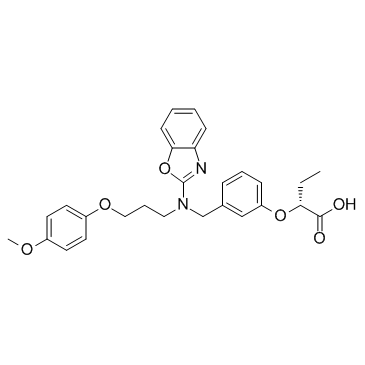
Pemafibrate structure
|
Common Name | Pemafibrate | ||
|---|---|---|---|---|
| CAS Number | 848259-27-8 | Molecular Weight | 490.54800 | |
| Density | N/A | Boiling Point | N/A | |
| Molecular Formula | C28H30N2O6 | Melting Point | N/A | |
| MSDS | N/A | Flash Point | N/A | |
Use of PemafibratePemafibrate is a potent PPARα agonist, with EC50s of 1 nM, 1.10 μM and 1.58 μM for h-PPARα, h-PPARγ and h-PPARδ, respectively, and possesses lipid-lowering effect. |
This table lists Chinese names, IUPAC names and various aliases of this chemical substance.
| Name | (2R)-2-[3-[[1,3-benzoxazol-2-yl-[3-(4-methoxyphenoxy)propyl]amino]methyl]phenoxy]butanoic acid |
|---|---|
| Synonym | More Synonyms |
This table contains bioactivity, target information and biological‑assay experimental data of this compound.
| Description | Pemafibrate is a potent PPARα agonist, with EC50s of 1 nM, 1.10 μM and 1.58 μM for h-PPARα, h-PPARγ and h-PPARδ, respectively, and possesses lipid-lowering effect. |
|---|---|
| Related Catalog | |
| Target |
h-PPARα:1 nM (EC50) h-PPARγ:1.1 μM (EC50) PPARδ:1.58 μM (EC50) |
| In Vitro | Pemafibrate is a potent PPARα agonist, with EC50s of 1 nM, 1.10 μM and 1.58 μM for h-PPARα, h-PPARγ and h-PPARδ, respectively. Pemafibrate is more than 1000 fold selective towards PPARα than PPARγ and PPARδ[1]. |
| In Vivo | Pemafibrate (3 mg/kg, p.o.) increases plasma h-apoA-I in human apoA-I (h-apoA-I) transgenic mice, and shows higher levels of plasma h-apoA-I than fenofibrate at 300 mg/kg[1]. Pemafibrate (0.03 mg/kg) decreases levels of triglycerides and aspartate aminotransferase (AST) in PEMA-L (db/db) mice. Pemafibrate (0.1 mg/kg) not only shows such effects but increases liver weight in PEMA-H (db/db) mice. Pemafibrate enhances the pathogenesis in a rodent model of nonalcoholic steatohepatitis (NASH). Pemafibrate significantlly reduces the grade of hepatocyte ballooning in PEMA-H mice. Furthermore, Pemafibrate modulates lipid turnover and induces uncoupling protein 3 (UCP 3) expression in the liver[2]. Pemafibrate (K-877, 0.0005%) contained in high-fat diet (HFD) inhibits the body weight gain in mice. Pemafibrate significantly decreases the abundance of triglyceride (TG)-rich lipoproteins, including remnants, in postprandial plasma of mice. Pemafibrate also decreases intestinal mRNA expression of ApoB and Npc1l1[3]. |
| Animal Admin | Mice are fasted for 12 h and fasting blood glucose measured. Nine-week-old db/db mice are used in the assay. After a 2-week acclimatization period, mice are divided into four groups: BD (db/db) mice (fed basal diet (BD) and treated with 0.5% aqueous methylcellulose solution (MC); MCD (db/db) mice (fed methionine choline-deficient (MCD) and treated with 0.5% MC); PEMA-L (db/db) mice (fed MCD and treated with 0.03 mg/kg Pemafibrate); PEMA-H (db/db) mice (fed MCD and treated with 0.1 mg/kg Pemafibrate). The drug-free solvent or the dosing solution is administered to animals (5 mL/kg body weight, p.o.) once daily (in the morning) for 4 consecutive weeks. After a 2-week acclimatization period, BD mice are fed a BD for 20 weeks. CTRL mice are fed D09100301 for 20 weeks. PEMA-L and PEMA-H mice are fed D09100301 for 12 weeks followed by D09100301 with 0.4 mg and 1.3 mg Pemafibrate/kg of the diet for 8 weeks, which corresponds to 0.03 mg/kg/day and 0.1 mg/kg/day, respectively. FENO mice are fed D09100301 for 12 weeks followed by D09100301 with 666.7 mg fenofibrate/kg of the diet for 8 weeks, which corresponds to 50 mg/kg/day. Pemafibrate and fenofibrate are incorporated into the AMLN diet. Animals are housed under conventional conditions with controlled temperature, humidity, and light (12-h light-dark cycle) and provided with food and water[2]. |
| References |
This table shows physicochemical parameters including melting point, boiling point, density, solubility and optical rotation. Missing data is marked as N/A.
| Molecular Formula | C28H30N2O6 |
|---|---|
| Molecular Weight | 490.54800 |
| Exact Mass | 490.21000 |
| PSA | 94.26000 |
| LogP | 5.55410 |
| InChIKey | ZHKNLJLMDFQVHJ-RUZDIDTESA-N |
| SMILES | CCC(Oc1cccc(CN(CCCOc2ccc(OC)cc2)c2nc3ccccc3o2)c1)C(=O)O |
| Storage condition | 2-8℃ |
This table contains target information, in‑vitro & in‑vivo assay data for this compound.
This table collects all English aliases, systematic names and CAS‑related synonyms of the compound.
| unii-17vgg92r23 |
| Pemafibrate |
This section contains frequently‑asked‑questions about this compound, including basic parameters, properties, storage conditions and corresponding answers.
| Q: What is the SMILES notation of (2R)-2-[3-[[1,3-benzoxazol-2-yl-[3-(4-methoxyphenoxy)propyl]amino]methyl]phenoxy]butanoic acid? |
| A: SMILES notation of (2R)-2-[3-[[1,3-benzoxazol-2-yl-[3-(4-methoxyphenoxy)propyl]amino]methyl]phenoxy]butanoic acid is CCC(Oc1cccc(CN(CCCOc2ccc(OC)cc2)c2nc3ccccc3o2)c1)C(=O)O. |
| Q: What is the molecular formula of (2R)-2-[3-[[1,3-benzoxazol-2-yl-[3-(4-methoxyphenoxy)propyl]amino]methyl]phenoxy]butanoic acid? |
| A: Molecular formula of (2R)-2-[3-[[1,3-benzoxazol-2-yl-[3-(4-methoxyphenoxy)propyl]amino]methyl]phenoxy]butanoic acid is C28H30N2O6. |
| Q: What is the Chinese name of 848259-27-8? |
| A: Chinese name of 848259-27-8 is Pemafibrate. |
| Q: What is the English name of (2R)-2-[3-[[1,3-benzoxazol-2-yl-[3-(4-methoxyphenoxy)propyl]amino]methyl]phenoxy]butanoic acid? |
| A: The English name of (2R)-2-[3-[[1,3-benzoxazol-2-yl-[3-(4-methoxyphenoxy)propyl]amino]methyl]phenoxy]butanoic acid is (2R)-2-[3-[[1,3-benzoxazol-2-yl-[3-(4-methoxyphenoxy)propyl]amino]methyl]phenoxy]butanoic acid. |
| Q: What are the uses of (2R)-2-[3-[[1,3-benzoxazol-2-yl-[3-(4-methoxyphenoxy)propyl]amino]methyl]phenoxy]butanoic acid? |
| A: Main uses of (2R)-2-[3-[[1,3-benzoxazol-2-yl-[3-(4-methoxyphenoxy)propyl]amino]methyl]phenoxy]butanoic acid: Pemafibrate is a potent PPARα agonist, with EC50s of 1 nM, 1.10 μM and 1.58 μM for h-PPARα, h-PPARγ and h-PPARδ, respectively, and possesses lipid-lowering effect. |
| Q: What English synonyms does (2R)-2-[3-[[1,3-benzoxazol-2-yl-[3-(4-methoxyphenoxy)propyl]amino]methyl]phenoxy]butanoic acid have? |
| A: English synonyms of (2R)-2-[3-[[1,3-benzoxazol-2-yl-[3-(4-methoxyphenoxy)propyl]amino]methyl]phenoxy]butanoic acid: unii-17vgg92r23, Pemafibrate. |
| Q: What is the molecular weight of (2R)-2-[3-[[1,3-benzoxazol-2-yl-[3-(4-methoxyphenoxy)propyl]amino]methyl]phenoxy]butanoic acid? |
| A: Molecular weight of (2R)-2-[3-[[1,3-benzoxazol-2-yl-[3-(4-methoxyphenoxy)propyl]amino]methyl]phenoxy]butanoic acid is 490.54800. |
| Q: What is the LogP of (2R)-2-[3-[[1,3-benzoxazol-2-yl-[3-(4-methoxyphenoxy)propyl]amino]methyl]phenoxy]butanoic acid? |
| A: LogP of (2R)-2-[3-[[1,3-benzoxazol-2-yl-[3-(4-methoxyphenoxy)propyl]amino]methyl]phenoxy]butanoic acid is 5.55410. |
| Q: What is the CAS number of (2R)-2-[3-[[1,3-benzoxazol-2-yl-[3-(4-methoxyphenoxy)propyl]amino]methyl]phenoxy]butanoic acid? |
| A: CAS number of (2R)-2-[3-[[1,3-benzoxazol-2-yl-[3-(4-methoxyphenoxy)propyl]amino]methyl]phenoxy]butanoic acid is 848259-27-8. |
| Q: What is the InChIKey of (2R)-2-[3-[[1,3-benzoxazol-2-yl-[3-(4-methoxyphenoxy)propyl]amino]methyl]phenoxy]butanoic acid? |
| A: InChIKey of (2R)-2-[3-[[1,3-benzoxazol-2-yl-[3-(4-methoxyphenoxy)propyl]amino]methyl]phenoxy]butanoic acid is ZHKNLJLMDFQVHJ-RUZDIDTESA-N. |
This table lists manufacturers and suppliers of this compound, including vendor names and product supply reference information.
| Shanghai Nianxing Industrial Co., Ltd |
| Dayang Chem (Hangzhou) Co., Ltd. |