9-Aminoacridine
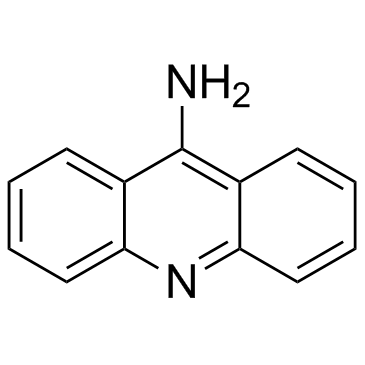
9-Aminoacridine structure
|
Common Name | 9-Aminoacridine | ||
|---|---|---|---|---|
| CAS Number | 90-45-9 | Molecular Weight | 194.23200 | |
| Density | 1.268g/cm3 | Boiling Point | 413.5ºC at 760 mmHg | |
| Molecular Formula | C13H10N2 | Melting Point | 241ºC | |
| MSDS | Chinese USA | Flash Point | 233.2ºC | |
| Symbol |

GHS07 |
Signal Word | Warning | |
Use of 9-Aminoacridine9-Aminoacridine is a highly fluorescent dye used clinically as a topical antiseptic and experimentally as a mutagen, an intracellular pH indicator. |
This table lists Chinese names, IUPAC names and various aliases of this chemical substance.
| Name | 9-aminoacridine |
|---|---|
| Synonym | More Synonyms |
This table contains bioactivity, target information and biological‑assay experimental data of this compound.
| Description | 9-Aminoacridine is a highly fluorescent dye used clinically as a topical antiseptic and experimentally as a mutagen, an intracellular pH indicator. |
|---|---|
| Related Catalog |
This table shows physicochemical parameters including melting point, boiling point, density, solubility and optical rotation. Missing data is marked as N/A.
| Density | 1.268g/cm3 |
|---|---|
| Boiling Point | 413.5ºC at 760 mmHg |
| Melting Point | 241ºC |
| Molecular Formula | C13H10N2 |
| Molecular Weight | 194.23200 |
| Flash Point | 233.2ºC |
| Exact Mass | 194.08400 |
| PSA | 38.91000 |
| LogP | 3.55140 |
| Index of Refraction | 1.78 |
| InChIKey | XJGFWWJLMVZSIG-UHFFFAOYSA-N |
| SMILES | Nc1c2ccccc2nc2ccccc12 |
| Stability | Stable. Incompatible with strong oxidizing agents. |
| Water Solubility | ethanol: hazy |
This table provides MSDS information including hazard classification, first‑aid, fire‑fighting, spill handling, operation and storage instructions.
This table summarizes toxicological test data, acute & chronic toxicity and ecological hazard parameters for this chemical.
CHEMICAL IDENTIFICATION
HEALTH HAZARD DATAACUTE TOXICITY DATA
MUTATION DATA
|
This table covers safety warnings, protective measures, incompatible substances and disposal guidelines for this compound.
| Symbol |
GHS07 |
|---|---|
| Signal Word | Warning |
| Hazard Statements | H315-H319-H335 |
| Precautionary Statements | P261-P305 + P351 + P338 |
| Hazard Codes | Xi: Irritant; |
| Risk Phrases | R36/37/38 |
| Safety Phrases | S26-S36 |
| RIDADR | 2811 |
| WGK Germany | 3 |
| RTECS | AR7300000 |
| Packaging Group | III |
| Hazard Class | 6.1(b) |
This table lists relevant public references with title, journal and publication metadata for this compound.
|
Genotoxicity testing of esterified propoxylated glycerol (EPG).
Regul Toxicol Pharmacol 70 Suppl 2 , S131-42, (2014) Four versions of esterified propoxylated glycerols (EPGs) were evaluated for potential genotoxicity using a range of in vitro and in vivo assays. H-EPG-05 HR/SO 9:1, H-EPG-05 soyate, and H-EPG-14 soya... |
|
|
Mutagenicity and DNA-damaging potential of clenbuterol and its metabolite 4-amino-3,5-dichlorobenzoic acid in vitro.
Food Chem. Toxicol. 77 , 82-92, (2015) The aim of this study was to evaluate in vitro toxicity of clenbuterol and its metabolite 4-amino-3,5-dichlorobenzoic acid. Cytotoxicity and pro-oxidative effect of both compounds were studied on huma... |
|
|
Renal sulfatides: sphingoid base-dependent localization and region-specific compensation of CerS2-dysfunction.
J. Lipid Res. 55(11) , 2354-69, (2014) Mammalian kidneys are rich in sulfatides. Papillary sulfatides, especially, contribute to renal adaptation to chronic metabolic acidosis. Due to differences in their cer-amide (Cer) anchors, the struc... |
This table collects all English aliases, systematic names and CAS‑related synonyms of the compound.
| MFCD00037839 |
| EINECS 201-995-6 |
| 9-Aminoacridine |
| 9-aminoacridiniun |
This section contains frequently‑asked‑questions about this compound, including basic parameters, properties, storage conditions and corresponding answers.
| Q: What are the uses of 9-aminoacridine? |
| A: Main uses of 9-aminoacridine: 9-Aminoacridine is a highly fluorescent dye used clinically as a topical antiseptic and experimentally as a mutagen, an intracellular pH indicator. |
| Q: What is the molecular formula of 9-aminoacridine? |
| A: Molecular formula of 9-aminoacridine is C13H10N2. |
| Q: What is the CAS number of 9-aminoacridine? |
| A: CAS number of 9-aminoacridine is 90-45-9. |
| Q: What English synonyms does 9-aminoacridine have? |
| A: English synonyms of 9-aminoacridine: MFCD00037839, EINECS 201-995-6, 9-Aminoacridine, 9-aminoacridiniun. |
| Q: What is the LogP of 9-aminoacridine? |
| A: LogP of 9-aminoacridine is 3.55140. |
| Q: What is the SMILES notation of 9-aminoacridine? |
| A: SMILES notation of 9-aminoacridine is Nc1c2ccccc2nc2ccccc12. |
| Q: What is the InChIKey of 9-aminoacridine? |
| A: InChIKey of 9-aminoacridine is XJGFWWJLMVZSIG-UHFFFAOYSA-N. |
| Q: What is the boiling point of 9-aminoacridine? |
| A: Boiling point of 9-aminoacridine is 413.5ºC at 760 mmHg. |
| Q: What is the melting point of 9-aminoacridine? |
| A: Melting point of 9-aminoacridine is 241ºC. |
| Q: What is the polar surface area (PSA) of 9-aminoacridine? |
| A: Polar surface area (PSA) of 9-aminoacridine is 38.91000. |
This table lists manufacturers and suppliers of this compound, including vendor names and product supply reference information.
| Shanghai Nianxing Industrial Co., Ltd |
| Dayang Chem (Hangzhou) Co., Ltd. |
| Henan Tianfu Chemical Co., Ltd. |