Adenosine amine congener
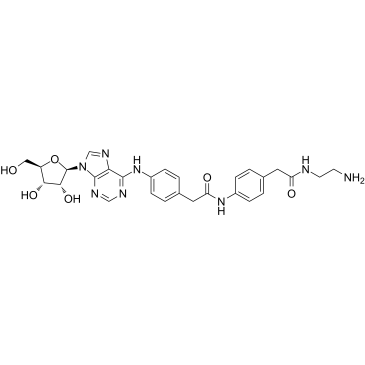
Adenosine amine congener structure
|
Common Name | Adenosine amine congener | ||
|---|---|---|---|---|
| CAS Number | 96760-69-9 | Molecular Weight | 576.60400 | |
| Density | N/A | Boiling Point | N/A | |
| Molecular Formula | C28H32N8O6 | Melting Point | N/A | |
| MSDS | Chinese USA | Flash Point | N/A | |
Use of Adenosine amine congenerAdenosine amine congener (ADAC) is a selective A1 adenosine receptor agonist, can ameliorate noise- and Cisplatin-induced cochlear injury. Adenosine amine congener also has neuroprotective effects[1][2]. |
This table lists Chinese names, IUPAC names and various aliases of this chemical substance.
| Name | [3h]-adac |
|---|---|
| Synonym | More Synonyms |
This table contains bioactivity, target information and biological‑assay experimental data of this compound.
| Description | Adenosine amine congener (ADAC) is a selective A1 adenosine receptor agonist, can ameliorate noise- and Cisplatin-induced cochlear injury. Adenosine amine congener also has neuroprotective effects[1][2]. |
|---|---|
| Related Catalog | |
| Target |
A1 adenosine receptor[1][2] |
| In Vitro | Adenosine amine congener can reduce oxidative stress in the noise-exposed cochlea, leading to protection of sensory hair cells. Adenosine amine congener also can reduce cisplatin-induced apoptosis in cochlear tissues, particularly in sensory hair cells and strial marginal cells. The mechanisms of otoprotection by Adenosine amine congener include inhibition of glutamate release via presynaptic A1 receptors and inhibition of voltage-gated Ca2+ channels, which can prevent activation of apoptotic and necrotic cell death pathways[1]. |
| In Vivo | Adenosine amine congener (25-300 μg/kg/day; intraperitoneal injection; daily; for 5 days; male Wistar rats) treatment is most effective in the first 24 hours after noise exposure at doses >50 μg/kg, providing up to 21 dB protection. Adenosine amine congener mitigates noise-induced hearing loss in a dose- and time-dependent manner[1]. Animal Model: Male Wistar rats (8-10 weeks old) treated with noise exposure[1] Dosage: 25 μg/kg/day, 50 μg/kg/day, 100 μg/kg/day, 200 μg/kg/day, and 300 μg/kg/day Administration: Intraperitoneal injection; daily; for 5 days Result: Most effective in the first 24 hours after noise exposure at doses >50 μg/kg, and provided up to 21 dB protection (averaged across 8-28 kHz). |
| References |
This table shows physicochemical parameters including melting point, boiling point, density, solubility and optical rotation. Missing data is marked as N/A.
| Molecular Formula | C28H32N8O6 |
|---|---|
| Molecular Weight | 576.60400 |
| Exact Mass | 576.24400 |
| PSA | 209.77000 |
| LogP | 1.21720 |
| InChIKey | JFRJCQJVFMHZOO-QZHHGCDDSA-N |
| SMILES | NCCNC(=O)Cc1ccc(NC(=O)Cc2ccc(Nc3ncnc4c3ncn4C3OC(CO)C(O)C3O)cc2)cc1 |
This table provides MSDS information including hazard classification, first‑aid, fire‑fighting, spill handling, operation and storage instructions.
This table presents publicly reported synthetic routes, reaction conditions, reactants and product information of the compound.
|
~%
Adenosine amine... CAS#:96760-69-9 |
| Literature: Jacobson; Kirk; Padgett; Daly Journal of Medicinal Chemistry, 1985 , vol. 28, # 9 p. 1341 - 1346 |
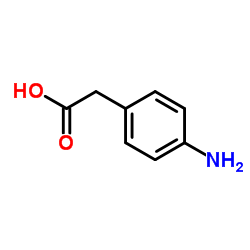
This table lists upstream starting materials and downstream derivative products related to this chemical.
| Precursor 1 | |
|---|---|
| DownStream 0 | |
This table contains target information, in‑vitro & in‑vivo assay data for this compound.
|
Name: Inhibition of neurosphere proliferation of mouse neural precursor cells by MTT assay
Source: ChEMBL
Target: N/A
External Id: CHEMBL1266185
|
This table collects all English aliases, systematic names and CAS‑related synonyms of the compound.
| Adenosine amine congener hydrate |
| Adenosine Amine Congener |
This section contains frequently‑asked‑questions about this compound, including basic parameters, properties, storage conditions and corresponding answers.
| Q: What is the InChIKey of [3h]-adac? |
| A: InChIKey of [3h]-adac is JFRJCQJVFMHZOO-QZHHGCDDSA-N. |
| Q: What is the molecular weight of [3h]-adac? |
| A: Molecular weight of [3h]-adac is 576.60400. |
| Q: What is the molecular formula of [3h]-adac? |
| A: Molecular formula of [3h]-adac is C28H32N8O6. |
| Q: What is the LogP of [3h]-adac? |
| A: LogP of [3h]-adac is 1.21720. |
| Q: What English synonyms does [3h]-adac have? |
| A: English synonyms of [3h]-adac: Adenosine amine congener hydrate, Adenosine Amine Congener. |
| Q: What is the English name of [3h]-adac? |
| A: The English name of [3h]-adac is [3h]-adac. |
| Q: What are the uses of [3h]-adac? |
| A: Main uses of [3h]-adac: Adenosine amine congener (ADAC) is a selective A1 adenosine receptor agonist, can ameliorate noise- and Cisplatin-induced cochlear injury. Adenosine amine congener also has neuroprotective effects[1][2]. |
| Q: What is the CAS number of [3h]-adac? |
| A: CAS number of [3h]-adac is 96760-69-9. |
| Q: What is the polar surface area (PSA) of [3h]-adac? |
| A: Polar surface area (PSA) of [3h]-adac is 209.77000. |
| Q: What are the upstream materials of [3h]-adac? |
| A: Related upstream materials(CAS) of [3h]-adac: 1197-55-3. |
This table lists manufacturers and suppliers of this compound, including vendor names and product supply reference information.
| Shanghai Nianxing Industrial Co., Ltd |