Quantitative determination of zolmitriptan in rat blood and cerebrospinal fluid by reversed phase HPLC-ESI-MS/MS analysis: application to in vivo preclinical pharmacokinetic study.
Alessandro Dalpiaz, Nicola Marchetti, Alberto Cavazzini, Luisa Pasti, Sitaram Velaga, Elisabetta Gavini, Sarah Beggiato, Luca Ferraro
Index: J. Chromatogr. B. Analyt. Technol. Biomed. Life Sci. 901 , 72-8, (2012)
Full Text: HTML
Abstract
A fast HPLC-ESI-MS/MS method has been developed and validated for the quantification of the potent and selective antimigraine zolmitriptan in rat blood and cerebrospinal fluid (CSF). The assay has been then applied for in vivo preclinical studies. The analytical determination has been used to obtain pharmacokinetics of zolmitriptan in the two biological matrices after its intravenous or nasal administration. Liquid-liquid extraction of zolmitriptan was performed from 100 μL rat blood samples in the presence of N(6)-cyclopentyladenosine (internal standard) with the employment of ethyl acetate. Calibration standards were prepared by using blood matrix and following the same liquid-liquid extraction procedure. CSF samples were analyzed without any pre-treatment steps and by using an external calibration method in pure water matrix. Chromatographic separation was performed under reversed phase and a gradient elution condition on a C18 packed column (100 × 2.0 mm, 2.5 μm particles diameter). The mobile phase was a mixture between acetonitrile, water and formic acid (0.1% v/v). The applied HPLC-MS/MS method allowed low limits of detection, as calculated from calibration curves, of 6.6 and 24.4 ng/mL for water matrix and rat blood extracts, respectively. Linearity of the calibration curves was established up to 5 μM (1.44 μg/mL), as well as good assay accuracy. The intravenous infusion of 20 μg zolmitriptan to male Sprague-Dawley rats produced blood concentrations ranging from 9.4±0.7 to 1.24±0.07 μg/mL within 10 h, with a terminal half-life of 3.4±0.2h. The nasal administration of a water suspension of 20 μg zolmitriptan produced blood concentrations ranging from 2.92±0.21 to 0.85±0.07 μg/mL within 6h. One hour after zolmitriptan intravenous infusion or nasal administration, its CSF concentrations were 0.0539±0.0016 and 0.0453±0.0012 μg/mL, respectively. This study determined the suitability of the herein proposed method to investigate the pharmacokinetics of zolmitriptan after its administration by means of novel formulations and, hence, to evaluate the efficacy of innovative nose-to-brain drug delivery in preclinical studies.Copyright © 2012 Elsevier B.V. All rights reserved.
Related Compounds
| Structure | Name/CAS No. | Molecular Formula | Articles |
|---|---|---|---|
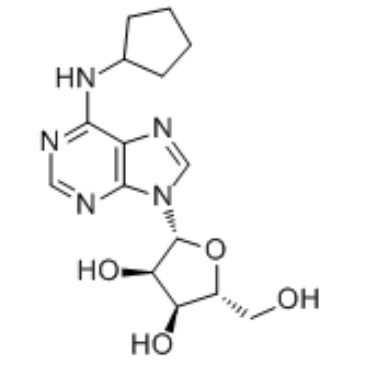 |
N6-Cyclopentyladenosine
CAS:41552-82-3 |
C15H21N5O4 | |
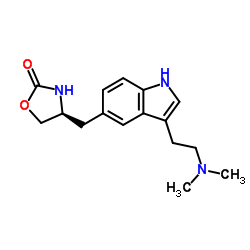 |
Zolmitriptan
CAS:139264-17-8 |
C16H21N3O2 |
|
The effect of pH and ion channel modulators on human placent...
2014-01-01 [PLoS ONE 9(12) , e114405, (2014)] |
|
Acid-sensing ion channel 3 decreases phosphorylation of extr...
2014-01-01 [Arthritis. Res. Ther. 16(3) , R121, (2014)] |
|
Chemoenzymatic Syntheses of Sialylated Oligosaccharides Cont...
2015-07-20 [Chemistry 21 , 10903-12, (2015)] |
|
Store-operated calcium entry compensates fast ER calcium los...
2015-08-01 [Cell Calcium 58 , 147-59, (2015)] |
|
Membranes as a possible pacemaker of metabolism in cyprinifo...
2015-08-01 [J. Exp. Biol. 218 , 2563-72, (2015)] |