Long-term effect of the beta2-receptor agonist procaterol on daily life performance and exercise capacity in patients with stable chronic obstructive pulmonary disease. Clinical study with special reference to health-related quality of life and activities of daily living.
Takanobu Shioya, Masahiro Satake, Kazuhiro Sato, Masa-aki Sano, Keiyu Sugawara, Hitomi Takahashi, Mitsunobu Honma
Index: Arzneimittelforschung 58(1) , 24-8, (2008)
Full Text: HTML
Abstract
The present study was undertaken to evaluate the long-term effect of procaterol hydrochloride (CAS 62929-91-3, Meptin), a third generation beta2-receptor agonist on lung function, exercise capacity, health-related quality of life (HRQOL) and activities of daily living (ALDs) in patients with stable chronic obstructive pulmonary disease (COPD). Twenty patients were randomly assigned to the procaterol group or to the control group, who received oxitropium bromide (CAS 30286-75-0), an anticholinergic agent. Procaterol was inhaled three times a day at a dose of 20 pg, while oxitropium was inhaled three times a day at a dose of 200 microg. The subjects were evaluated based on spirometry, exercise capacity, the Borg Scale, HRQOL, and ADLs before and after 12, 24 and 52 weeks of therapy. The values of forced expiratory volume in 1 second (FEV1), forced vital capacity (FVC), total lung capacity (TLC), functional residual capacity (FRC), residual volume (RV), maximal inspiratory pressure (PImax), and maximal expiratory pressure (PEmax) were significantly improved at 12, 24 and 52 weeks compared with baseline values in the procaterol group (p < 0.05, p < 0.01), while these values did not differ from baseline values at any point in the oxitropium group (p > 0.05). Additionally, 6-min walking distances and Borg Scale values showed significant improvement at 12, 24 and 52 weeks compared with baseline values in the procaterol group (p < 0.05, p < 0.01), but did not significantly differ from baseline values in the oxitropium group at any point (p > 0.05). Likewise, the scores for dyspnea, fatigue, emotional function, mastery, total scores and ADLs were significantly higher at 12, 24 and 52 weeks compared with the baseline values in the procaterol group (p < 0.05, p < 0.01), but did not differ at any point in the oxitropium group (p > 0.05). These results suggest the effectiveness of long-term regular bronchodilator therapy with the beta2-receptor agonist procaterol in patients with stable COPD.
Related Compounds
| Structure | Name/CAS No. | Molecular Formula | Articles |
|---|---|---|---|
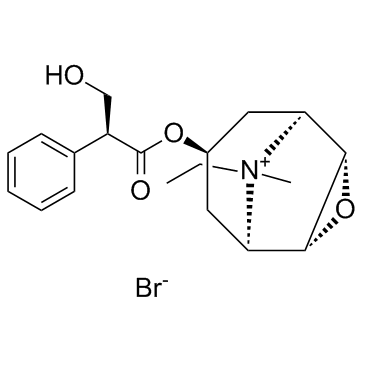 |
Oxitropium Bromide
CAS:30286-75-0 |
C19H26BrNO4 |
|
The development of anticholinergics in the management of COP...
2007-01-01 [Int. J. Chron. Obstruct. Pulmon. Dis. 2(1) , 33-40, (2007)] |
|
Anticholinergic therapy for acute asthma in children.
2012-01-01 [Cochrane Database Syst. Rev. 4 , CD003797, (2012)] |
|
Effect of resection of the posterior nasal nerve on function...
2008-01-01 [Acta Otolaryngol. 128(12) , 1337-41, (2008)] |
|
Effects of replacing oxitropium with tiotropium on pulmonary...
2007-03-01 [Respir. Med. 101(3) , 476-80, (2007)] |
|
High-resolution computed tomography evaluation of airway dis...
2008-02-01 [Radiol. Med. 113(1) , 43-55, (2008)] |