Oxitropium Bromide
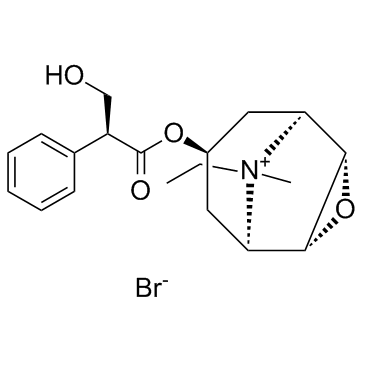
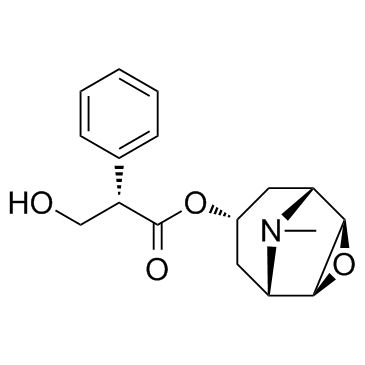
Oxitropium Bromide structure
|
Common Name | Oxitropium Bromide | ||
|---|---|---|---|---|
| CAS Number | 30286-75-0 | Molecular Weight | 412.31800 | |
| Density | N/A | Boiling Point | N/A | |
| Molecular Formula | C19H26BrNO4 | Melting Point | 203-204° (dec) | |
| MSDS | N/A | Flash Point | N/A | |
Use of Oxitropium BromideOxitropium bromide is an mAChR antagonist used as an anticholinergic bronchodilator drug for the treatment of asthma and chronic obstructive pulmonary disease. |
| Name | Tersigat |
|---|---|
| Synonym | More Synonyms |
| Description | Oxitropium bromide is an mAChR antagonist used as an anticholinergic bronchodilator drug for the treatment of asthma and chronic obstructive pulmonary disease. |
|---|---|
| Related Catalog | |
| Target |
mAChR[1] |
| In Vitro | Oxitropium bromide is a muscarinic antagonist which blocks musucarinic acetylcholine receptors (mAChR). Incubation with oxitropium bromide of untreated diaphragm muscle and diaphragm muscle injected with endotoxin does not increase the force-frequency curves dose-dependently in vitro; however, it causes both types of muscle to be fatigue resistant[1]. |
| In Vivo | Oxitropium bromide inhalation shifts force-frequency curves upward at 2 h after inhalation and inhibits the decrease of force-frequency curves due to endotoxin injection in vivo[1]. Oxitropium bromide strongly and persistently inhibits the acetylcholine (ACh)-induced resistance. The increase in resistance induced by histamine, serotonin, leukotriene D4 or antigen is prevented by oxitropium bromide oxitropium bromide[2]. Inhalation of the anticholinergic agent oxitropium bromide at doses of 1.5 μg and higher greatly attenuates the decrease in mucus score produced by intravenous histamine but not by inhaled histamine[3]. |
| Animal Admin | Mice: In the oxitropium bromide inhalation group, animals are given 2 puffs of inhalation from a oxitropium bromide MDI (metered dose inhaler) via a 75-mL spacer, and then diaphragm muscles are dissected and measured as to contractility immediately, 1 hour, 2 hours and 4 hours later (n=5 animals each). An animal is placed in a centrifugal tube (inner diameter=30 mm) with a round hole (diameter=10 mm) in the bottom, its nose and mouth being exposed through the hole to breath. An oxitropium bromide MDI (metered dose inhaler) releases 2 puffs into a spacer attached to the tube. Aerosols of oxitropium bromide are inhaled for about 10 seconds, while the animal is breathing spontaneously through the hole of the tube[1]. |
| References |
| Melting Point | 203-204° (dec) |
|---|---|
| Molecular Formula | C19H26BrNO4 |
| Molecular Weight | 412.31800 |
| Exact Mass | 411.10500 |
| PSA | 59.06000 |
| InChIKey | LCELQERNWLBPSY-BLYVRSIPSA-M |
| SMILES | CC[N+]1(C)C2CC(OC(=O)C(CO)c3ccccc3)CC1C1OC12.[Br-] |
CHEMICAL IDENTIFICATION
HEALTH HAZARD DATAACUTE TOXICITY DATA
|
|
~%
Oxitropium Bromide CAS#:30286-75-0 |
| Literature: Journal of the American Chemical Society, , vol. 78, p. 3448,3452 |
|
~84%
Oxitropium Bromide CAS#:30286-75-0 |
| Literature: Banholzer; Pook Arzneimittel-Forschung/Drug Research, 1985 , vol. 35, # 1 A p. 217 - 228 |
|
~%
Oxitropium Bromide CAS#:30286-75-0 |
| Literature: Arzneimittel-Forschung/Drug Research, , vol. 35, # 1 A p. 217 - 228 |
|
~%
Oxitropium Bromide CAS#:30286-75-0 |
| Literature: Arzneimittel-Forschung/Drug Research, , vol. 35, # 1 A p. 217 - 228 |


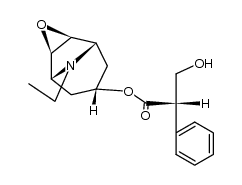
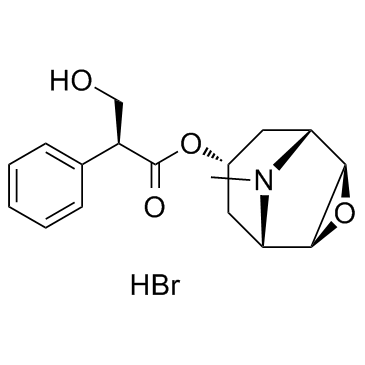
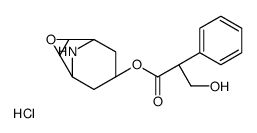
 CAS#:51-34-3
|
The development of anticholinergics in the management of COPD.
Int. J. Chron. Obstruct. Pulmon. Dis. 2(1) , 33-40, (2007) Anticholinergics have been used to treat obstructive respiratory disease for many years from historical preparations of the deadly nightshade genus, to the more recent developments ofipratropium, oxit... |
|
|
Anticholinergic therapy for acute asthma in children.
Cochrane Database Syst. Rev. 4 , CD003797, (2012) Inhaled anticholinergics as single agent bronchodilators (or in combination with beta(2)-agonists) are one of the several medications available for the treatment of acute asthma in children.To determi... |
|
|
Effect of resection of the posterior nasal nerve on functional and morphological changes in the inferior turbinate mucosa.
Acta Otolaryngol. 128(12) , 1337-41, (2008) The underlying pathophysiological mechanisms of the posterior nasal nerve (PNN) resection involved the suppression of the secretogogue motor and the inhibition of neurogenic inflammation induced by pa... |
|
Name: Literature-mined public compounds from Kruhlak et al phospholipidosis modelling datas...
Source: ChEMBL
Target: Phospholipidosis
External Id: CHEMBL1697855
|
| Oxivent |
| Oxitropium |
| Oxitropium bromide |
| Ba-253-BR-L |
| Ventilat |
| oxytropium bromide |
| Bromure d'oxitropium |