Ketorolac tromethamine
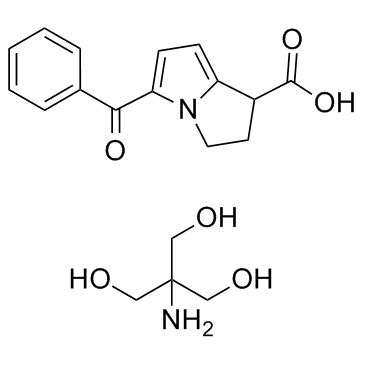
Ketorolac tromethamine structure
|
Common Name | Ketorolac tromethamine | ||
|---|---|---|---|---|
| CAS Number | 74103-07-4 | Molecular Weight | 376.404 | |
| Density | N/A | Boiling Point | 493.2ºC at 760 mmHg | |
| Molecular Formula | C19H24N2O6 | Melting Point | 160-161ºC | |
| MSDS | Chinese USA | Flash Point | 252.1ºC | |
| Symbol |

GHS06 |
Signal Word | Danger | |
Use of Ketorolac tromethamineKetorolac tromethamine salt is a non-steroidal anti-inflammatory agent, acting as a nonselective COX inhibitor, with IC50s of 20 nM for COX-1 and 120 nM for COX-2. |
This table lists Chinese names, IUPAC names and various aliases of this chemical substance.
| Name | ketorolac tromethamine |
|---|---|
| Synonym | More Synonyms |
This table contains bioactivity, target information and biological‑assay experimental data of this compound.
| Description | Ketorolac tromethamine salt is a non-steroidal anti-inflammatory agent, acting as a nonselective COX inhibitor, with IC50s of 20 nM for COX-1 and 120 nM for COX-2. |
|---|---|
| Related Catalog | |
| Target |
COX-1:20 nM (IC50) COX-2:120 nM (IC50) |
| In Vitro | Ketorolac is a non-steroidal anti-inflammatory agent, acting as a nonselective COX inhibitor, with IC50s of 20 nM for COX-1 and 120 nM for COX-2[1]. |
| In Vivo | Ketorolac tromethamine (0.4%) causes nearly complete inhibition on LPS endotoxin-induced increases in FITC-dextran in the anterior chamber, and increases in aqueous PGE2 concentrations in the aqueous humor in rabbits[1].Ketorolac (30 mg/kg, i.v.) rapidly reverses hyperalgesia in rats. Ketorolac also reduces carrageenan-induced hyperalgesia and paw PG production, and causes reduction in PGE2 levels in rats[1]. Ketorolac (4 mg/kg/day, p.o.) has no detrimental effect in the volume fraction of bone trabeculae formed inside the alveolar socket in rats[2]. Ketorolac (60 μg/10 μL) reduces the histological changes such as ischemic cell death, including cytoplasmic eosinophilia with disintegration of cytoarchitecture and nuclear pyknosis in rats. Ketorolac also effectively reduces neuronal death and improves hindlimb motor function, and the long-term survival is similar to that in the control group[3]. |
| Animal Admin | Rats[2] Treated rats receive oral doses of 1 mL aqueous solution of paracetamol (80 mg/kg/rat/day), Ketorolac (4 mg/kg/day) or etoricoxib (10 mg/kg/day) administered by gavage from the day of surgery until death, 2 weeks later. Control rats receive tap water (1 mL/day by gavage). The animals are housed under climate-controlled environment (12 h light/12 h dark, 20-24ºC) with free access to standard laboratory chow and tap water[2]. |
| References |
This table shows physicochemical parameters including melting point, boiling point, density, solubility and optical rotation. Missing data is marked as N/A.
| Boiling Point | 493.2ºC at 760 mmHg |
|---|---|
| Melting Point | 160-161ºC |
| Molecular Formula | C19H24N2O6 |
| Molecular Weight | 376.404 |
| Flash Point | 252.1ºC |
| Exact Mass | 376.163422 |
| PSA | 146.01000 |
| LogP | 0.65210 |
| InChIKey | BWHLPLXXIDYSNW-UHFFFAOYSA-N |
| SMILES | NC(CO)(CO)CO.O=C(c1ccccc1)c1ccc2n1CCC2C(=O)O |
| Storage condition | Hygroscopic, Refrigerator, Under Inert Atmosphere |
| Water Solubility | H2O: 15 mg/mL stable at least one month at −20 °C., soluble |
This table provides MSDS information including hazard classification, first‑aid, fire‑fighting, spill handling, operation and storage instructions.
This table summarizes toxicological test data, acute & chronic toxicity and ecological hazard parameters for this chemical.
CHEMICAL IDENTIFICATION
HEALTH HAZARD DATAACUTE TOXICITY DATA
|
This table covers safety warnings, protective measures, incompatible substances and disposal guidelines for this compound.
| Symbol |
GHS06 |
|---|---|
| Signal Word | Danger |
| Hazard Statements | H301-H315-H319-H335 |
| Precautionary Statements | P261-P301 + P310-P305 + P351 + P338 |
| Personal Protective Equipment | Eyeshields;Faceshields;Gloves;type P2 (EN 143) respirator cartridges |
| Hazard Codes | T:Toxic |
| Risk Phrases | R25;R36/37/38 |
| Safety Phrases | S26-S45 |
| RIDADR | UN 2811 |
| WGK Germany | 3 |
| RTECS | UY7759900 |
| Packaging Group | II |
| Hazard Class | 6.1(a) |
| HS Code | 2942000000 |
This table shows customs‑related data including HS‑code, tariff and regulatory conditions for import and export.
| HS Code | 2942000000 |
|---|
This table lists relevant public references with title, journal and publication metadata for this compound.
|
Topical cyclosporine a 1% for the treatment of chronic ocular surface inflammation.
Eye Contact Lens 40(5) , 283-8, (2014) To evaluate the use of topical cyclosporine A (CsA) 1% emulsion in the treatment of chronic ocular surface inflammation (OSI).We conducted a retrospective chart review of patients with various forms o... |
|
|
Ketorolac eye drops reduce inflammation and delay re-epithelization in response to corneal alkali burn in rabbits, without affecting iNOS or MMP-9.
Arq. Bras. Oftalmol. 78 , 67-72, (2015) To assess the effects of 0.5% ketorolac tromethamine without preservatives on the expression of iNOS and MMP-9 in alkali burn ulcers.Twelve eyes of 120-day-old male rabbits were treated (TG) every 6 h... |
|
|
Ketorolac tromethamine pharmacokinetics and metabolism after intravenous, intramuscular, and oral administration in humans and animals.
Pharmacotherapy 10(6 ( Pt 2)) , 33S-39S, (1990) In humans, ketorolac is completely bioavailable and its kinetics are linear. It is absorbed rapidly (half-life for absorption 3.8 min) after oral (fasting) and intramuscular administration; food delay... |
This table contains target information, in‑vitro & in‑vivo assay data for this compound.
|
Name: Inhibition of neurosphere proliferation of mouse neural precursor cells by MTT assay
Source: ChEMBL
Target: N/A
External Id: CHEMBL1266185
|
|
Name: Primary qHTS assay for inhibitors of alpha-synuclein gene (SNCA) expression
Source: NCGC
External Id: SNCA-p-activity-luciferase
|
|
Name: Fluorescence-based cell-based primary high throughput screening assay to identify ago...
Source: The Scripps Research Institute Molecular Screening Center
Target: muscarinic acetylcholine receptor M1 [Homo sapiens]
External Id: CHRM1_AG_FLUO8_1536_1X%ACT PRUN
|
|
Name: Cytochrome P450 Family 1 Subfamily A Member 2 (CYP1A2) small molecule antagonists: lu...
Source: 824
External Id: CYP273
|
|
Name: Increase the activity of the Burkholderia fixLJ 2-component system
Source: ICCB-Longwood/NSRB Screening Facility, Harvard Medical School
Target: Burkholderia multivorans
External Id: HMS1625
|
|
Name: Fluorescence-based cell-based primary high throughput screening assay to identify pos...
Source: The Scripps Research Institute Molecular Screening Center
Target: muscarinic acetylcholine receptor M1 [Homo sapiens]
External Id: CHRM1_PAM_FLUO8_1536_1X%ACT PRUN
|
|
Name: qHTS Assay for Small Molecule Inhibitors of the Human hERG Channel Activity
Source: NCGC
External Id: HERG01
|
|
Name: qHTS for Inhibitors of TGF-b: Cytotox Counterscreen
Source: NCGC
Target: N/A
External Id: SMAD3201
|
|
Name: uHTS identification of cystic fibrosis induced NFkb Inhibitors in a fluoresence assay
Source: Burnham Center for Chemical Genomics
Target: cystic fibrosis transmembrane conductance regulator [Homo sapiens]
External Id: SBCCG-A764-CF-PAF-Primary-Assay
|
|
Name: Fluorescence-based cell-based primary high throughput screening assay to identify ant...
Source: The Scripps Research Institute Molecular Screening Center
Target: muscarinic acetylcholine receptor M1 [Homo sapiens]
External Id: CHRM1_ANT_FLUO8_1536_1X%INH PRUN
|
This table collects all English aliases, systematic names and CAS‑related synonyms of the compound.
| Ketorolac tromethamine |
| 5-Benzoyl-2,3-dihydro-1H-pyrrolizine-1-carboxylic acid - 2-amino-2-(hydroxymethyl)propane-1,3-diol (1:1) |
| 2-amino-2-(hydroxymethyl)propane-1,3-diol,5-benzoyl-2,3-dihydro-1H-pyrrolizine-1-carboxylic acid |
| 5-(phenylcarbonyl)-2,3-dihydro-1H-pyrrolizine-1-carboxylic acid - 2-amino-2-(hydroxymethyl)propane-1,3-diol (1:1) |
| 1H-Pyrrolizine-1-carboxylic acid, 5-benzoyl-2,3-dihydro-, compd. with 2-amino-2-(hydroxymethyl)-1,3-propanediol (1:1) |
| Ketorolac tris salt |
| rac Ketorolac Tromethamine Salt |
| (±)-Ketorolac Tromethamine Salt |
| MFCD00887595 |
| 5-(Phenylcarbonyl)-2,3-dihydro-1H-pyrrolizin-1-carbonsäure--2-amino-2-(hydroxymethyl)propan-1,3-diol(1:1) |
| 5-Benzoyl-2,3-dihydro-1H-pyrrolizine-1-carboxylic acid - 2-amino-2-(hydroxymethyl)-1,3-propanediol (1:1) |
| 1,3-Dihydroxy-2-(hydroxymethyl)propan-2-aminium 5-benzoyl-2,3-dihydro-1H-pyrrolizine-1-carboxylate |
| Ketorolac (tromethamine salt) |
This section contains frequently‑asked‑questions about this compound, including basic parameters, properties, storage conditions and corresponding answers.
| Q: What is the molecular formula of ketorolac tromethamine? |
| A: Molecular formula of ketorolac tromethamine is C19H24N2O6. |
| Q: What are the storage conditions for ketorolac tromethamine? |
| A: Storage conditions for ketorolac tromethamine: Hygroscopic, Refrigerator, Under Inert Atmosphere. |
| Q: What are the uses of ketorolac tromethamine? |
| A: Main uses of ketorolac tromethamine: Ketorolac tromethamine salt is a non-steroidal anti-inflammatory agent, acting as a nonselective COX inhibitor, with IC50s of 20 nM for COX-1 and 120 nM for COX-2. |
| Q: What is the English name of ketorolac tromethamine? |
| A: The English name of ketorolac tromethamine is ketorolac tromethamine. |
| Q: What is the LogP of ketorolac tromethamine? |
| A: LogP of ketorolac tromethamine is 0.65210. |
| Q: What is the InChIKey of ketorolac tromethamine? |
| A: InChIKey of ketorolac tromethamine is BWHLPLXXIDYSNW-UHFFFAOYSA-N. |
| Q: What is the molecular weight of ketorolac tromethamine? |
| A: Molecular weight of ketorolac tromethamine is 376.404. |
| Q: What is the SMILES notation of ketorolac tromethamine? |
| A: SMILES notation of ketorolac tromethamine is NC(CO)(CO)CO.O=C(c1ccccc1)c1ccc2n1CCC2C(=O)O. |
| Q: What is the CAS number of ketorolac tromethamine? |
| A: CAS number of ketorolac tromethamine is 74103-07-4. |
| Q: What is the boiling point of ketorolac tromethamine? |
| A: Boiling point of ketorolac tromethamine is 493.2ºC at 760 mmHg. |
This table lists manufacturers and suppliers of this compound, including vendor names and product supply reference information.
| Shanghai Nianxing Industrial Co., Ltd |
| Dayang Chem (Hangzhou) Co., Ltd. |
| Henan Tianfu Chemical Co., Ltd. |