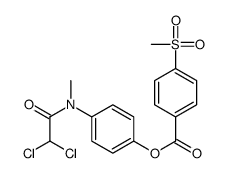
579-38-4
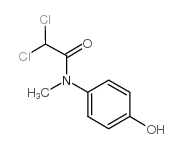
579-38-4 structure
- Name: Diloxanide
- Chemical Name: 2,2-dichloro-N-(4-hydroxyphenyl)-N-methylacetamide
- CAS Number: 579-38-4
- Molecular Formula: C9H9Cl2NO2
- Molecular Weight: 234.07900
- Catalog: API Antiparasitic drug Anti-amebiasis and anti-trichomoniasis drugs
- Create Date: 2018-07-23 17:42:05
- Modify Date: 2026-07-01 14:45:10
-
Diloxanide is an anti-protozoal agent and can be used for the research of asymptomatic-intestinal amebiasis caused by Entamoeba histolytica or some other protozoal infections. Diloxanide is an active luminal amebicide and hydrolyzed in the gastrointestinal tract from its prodrug Diloxanide furoate (HY-B1147)[1].
| Name | 2,2-dichloro-N-(4-hydroxyphenyl)-N-methylacetamide |
|---|---|
| Synonyms |
Diloxanidum [INN-Latin]
2,2-dichloro-N-(4-hydroxyphenyl)-N-methyl-ethanamide Diloxanid α,α-Dichloro-4'-hydroxy-N-methylacetanilide diloxanide //BP Diloxanide, 10 mM in DMSO diloxanide Entamide EINECS 209-439-4 Amebamida 2,2-dichloro-N-(4-hydroxyphenyl)-N-methyl-acetamide Acetamide, 2,2-dichloro-N-(4-hydroxyphenyl)-N-methyl Acetamide,2,2-dichloro-N-(4-hydroxyphenyl)-N-methyl RD 3803 Ame-boots RD3803 RD-3803 infection,inhibit,Entamoeba histolytica,anti-protozoal,Pasite,amoebic colitis,Diloxanide,Inhibitor,luminal amebicide Diloxanida [INN-Spanish] Diloxanida |
| Description | Diloxanide is an anti-protozoal agent and can be used for the research of asymptomatic-intestinal amebiasis caused by Entamoeba histolytica or some other protozoal infections. Diloxanide is an active luminal amebicide and hydrolyzed in the gastrointestinal tract from its prodrug Diloxanide furoate (HY-B1147)[1]. |
|---|---|
| Related Catalog | |
| In Vivo | Diloxanide is hydrolyzed in the gastrointestinal tract from its prodrug Diloxanide furoate[1]. Diloxanide furoate (oral administraion; 75-200 mg/kg; 3 days; once daily) is effective at different dose of dayin weanling rats. At 200 mg/kg, 100% of the treated rats are cured and no amoebic lesions are observed in the caecum. Besides, 85%,77%, and 44.4% of the treated rats are cured at the dose 150 mg/kg, 100 mg/kg, and 75 mg/kg, respectively. The ED50 value is 77.9 mg/kg for this agent in rats[2]. |
| References |
[1]. DB08792 |
| Density | 1.439g/cm3 |
|---|---|
| Boiling Point | 356.2ºC at 760 mmHg |
| Melting Point | 175° |
| Molecular Formula | C9H9Cl2NO2 |
| Molecular Weight | 234.07900 |
| Flash Point | 169.2ºC |
| Exact Mass | 233.00100 |
| PSA | 40.54000 |
| LogP | 2.15870 |
| Index of Refraction | 1.615 |
CHEMICAL IDENTIFICATION
HEALTH HAZARD DATAACUTE TOXICITY DATA
|
| Precursor 0 | |
|---|---|
| DownStream 1 | |