1401223-22-0
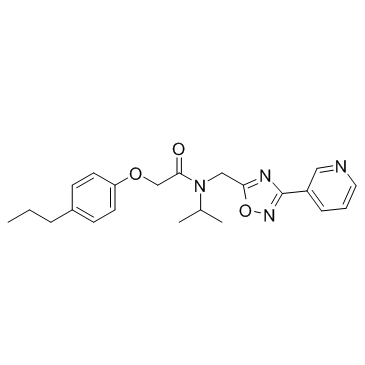
1401223-22-0 structure
- Name: PI 1840
- Chemical Name: N-isopropyl-2-(4-propylphenoxy)-N-(((3-pyridin-3-yl)-1,2,4-oxadiazol-5-yl)methyl)acetamide
- CAS Number: 1401223-22-0
- Molecular Formula: C22H26N4O3
- Molecular Weight: 394.46700
- Catalog: Biochemical Inhibitor Proteases Proteasome inhibitor
- Create Date: 2016-06-28 13:44:11
- Modify Date: 2026-07-02 00:49:50
-
PI-1840 is a potent and selective inhibitor for chymotrypsin-like (CT-L) (IC50 value = 27 ± 0.14 nM) over trypsin-like and peptidylglutamyl peptide hydrolyzing (IC50 values >100 μM) activities of the proteasome. IC50 value: 27 nM(CT-L activities of the proteasome) [1]Target: CT-L inhibitorin vitro: PI-1840 is over 100-fold more selective for the constitutive proteasome over the immunoproteasome. Mass spectrometry and dialysis studies demonstrate that PI-1840 is a noncovalent and rapidly reversible CT-L inhibitor. In intact cancer cells, PI-1840 inhibits CT-L activity, induces the accumulation of proteasome substrates p27, Bax, and IκB-α, inhibits survival pathways and viability, and induces apoptosis. Furthermore, PI-1840 sensitizes human cancer cells to the mdm2/p53 disruptor, nutlin, and to the pan-Bcl-2 antagonist BH3-M6 [1].in vivo: PI-1840 but not bortezomib suppresses the growth in nude mice of human breast tumor xenografts [1].
| Name | N-isopropyl-2-(4-propylphenoxy)-N-(((3-pyridin-3-yl)-1,2,4-oxadiazol-5-yl)methyl)acetamide |
|---|---|
| Synonyms |
Acetamide, N-(1-methylethyl)-2-(4-propylphenoxy)-N-[[3-(3-pyridinyl)-1,2,4-oxadiazol-5-yl]methyl]
PI-1840 N-isopropyl-2-(4-propylphenoxy)-N-((3-(pyridin-3-yl)-1,2,4-oxadiazol-5-yl)methyl)acetamide cell proliferation,Proteasome,Caspase,proteasome substrates,poly ADP ribose polymerase,inhibit,NF-κB,Autophagy,cell cycle,anticancer,PI-1840,Apoptosis,Bcl-2 Family,MG-63 cells,Nuclefactor-kappaB,Inhibitor,U2-OS cells,PP,PI1840,Nuclefactor-κB N-(1-methylethyl)-2-(4-propylphenoxy)-N-[[3-(3-pyridinyl)-1,2,4-oxadiazol-5-yl]methyl]-acetamide PI 1840;PI PI-1840, 10 mM in DMSO |
| Description | PI-1840 is a potent and selective inhibitor for chymotrypsin-like (CT-L) (IC50 value = 27 ± 0.14 nM) over trypsin-like and peptidylglutamyl peptide hydrolyzing (IC50 values >100 μM) activities of the proteasome. IC50 value: 27 nM(CT-L activities of the proteasome) [1]Target: CT-L inhibitorin vitro: PI-1840 is over 100-fold more selective for the constitutive proteasome over the immunoproteasome. Mass spectrometry and dialysis studies demonstrate that PI-1840 is a noncovalent and rapidly reversible CT-L inhibitor. In intact cancer cells, PI-1840 inhibits CT-L activity, induces the accumulation of proteasome substrates p27, Bax, and IκB-α, inhibits survival pathways and viability, and induces apoptosis. Furthermore, PI-1840 sensitizes human cancer cells to the mdm2/p53 disruptor, nutlin, and to the pan-Bcl-2 antagonist BH3-M6 [1].in vivo: PI-1840 but not bortezomib suppresses the growth in nude mice of human breast tumor xenografts [1]. |
|---|---|
| Related Catalog | |
| References |
| Molecular Formula | C22H26N4O3 |
|---|---|
| Molecular Weight | 394.46700 |
| Exact Mass | 394.20000 |
| PSA | 81.35000 |
| LogP | 3.90010 |
| Storage condition | -20℃ |