Top Suppliers:I want be here

80-49-9

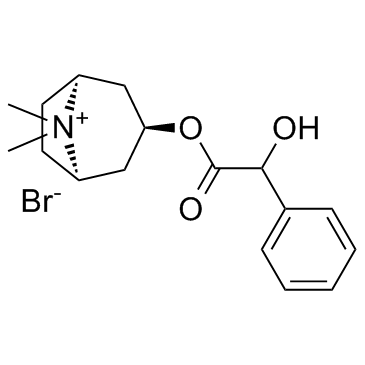
80-49-9 structure
80-49-9 structure
  • Name: Homatropine Methylbromide
  • Chemical Name: homatropine methylbromide
  • CAS Number: 80-49-9
  • Molecular Formula: C17H24BrNO3
  • Molecular Weight: 370.281
  • Catalog: API Nervous system medication Cholinergic
  • Create Date: 2018-08-29 18:25:37
  • Modify Date: 2026-07-07 10:41:01
  • Homatropine Methylbromide is muscarinic AChR antagonist, inhibits endothelial and smooth muscle muscarinic receptors of WKY-E and SHR-E with IC50 of 162.5 nM and 170.3 nM, respectively.target: mAChRIC 50: WKY-E(162.5 nM), SHR-E(170.4nM )In vitro: Homatropine (20 μM) alone produces a dose ratio of 259 in atrium from guinea-pigs. Homatropine (20 μM) produces a dose ratio of only 95.0 when combined with hexamethonium in atrium from guinea-pigs.In vivo: : Pre-treatment with homatropine (20 mg/kg) was comparable with atropine (10 mg/kg) in preventing lethality in this rat model of acute OC poisoning. All rats pre-treated with normal saline, atropine 5 mg/kg, and homatropine 10 mg/kg died. Survival in the homatropine (20 mg/kg) and atropine (10 mg/kg) groups was 30% and 40% respectively.

Name homatropine methylbromide
Synonyms Homatropine Methylbromide, 10 mM in DMSO
ESOPIN
8-Methylhomatropininium
Homatropine Methylbromide (Homatropine methobromide)
Malcotran
EINECS 201-284-0
dl-methylbromide
Homatropine methylbromide CRS
camatropine
Homatropine MethylbromideQ: What is Homatropine Methylbromide Q: What is the CAS Number of Homatropine Methylbromide Q: What is the storage condition of Homatropine Methylbromide Q: What e the applications of Homatropine Methylbromide
HOMATROPINE METHYL BROMIDE
HoMatropinMethylbroMide
Homatropine methylbromide a muscinic AChR antagonist
Sethyl
HOMOLONE
Mesopin
Homatropine methylbromide for system suitability CRS
sed-tems
N-Methylhomatropinium
Equipin (tn)
Homotropine methylbromide
2-hydroxy-2-phenylacetic acid [(1S,5R)-8,8-dimethyl-8-azoniabicyclo[3.2.1]octan-3-yl] ester bromide
8-methyl-homatropiniubromide
homatropine methobromide
8-METHYLHOMATROPINIUM BROMIDE
novatrin
novatrine
methylhomatropinebromide
DL-HOMATROPINE METHYL BROMIDE
Equipin
malcotran
Novatrin
Homatropine (methylbromide)
N-METHYLHOMATROPINIUM BROMIDE
HoMatropineMeBr
KITROPIN
methylhomatropine
8-Azoniabicyclo[3.2.1]octane, 3-[[(2R)-2-hydroxy-2-phenylacetyl]oxy]-8,8-dimethyl-, bromide, (3-endo) (1:1)
homapin
3-((hydroxyphenylacetyl)oxy)-8,8-dimethyl-8-azoniabicyclo(3.2.1)octanbro
D02070
mesopin
3-[(hydroxyphenylacetyl)oxy]-8,8-dimethyl-8-azoniabicyclo[3.2.1]octanbromi
TROPINIUM METHOBROMIDE MANDELATE
novatropine
Homatropine methylbromide for system suitability
Methyl Bromide Homatropine
Novatropine
sethyl
HOMATROPINE METHYL BROMIDE //BP
Homapin
Arkitropin
8-Azoniabicyclo[3.2.1]octane, 3-[(2-hydroxy-2-phenylacetyl)oxy]-8,8-dimethyl-, bromide (1:1), (3-endo)
3-alpha-hydroxy-8-methyl-1-alpha-h,5-alpha-h-tropaniumbromidemandelate
MFCD00050292
homatromide
endo-mid
Homatropinmethylbromid
(3-endo)-3-{[(2R)-2-Hydroxy-2-phenylacetyl]oxy}-8,8-dimethyl-8-azoniabicyclo[3.2.1]octane bromide
Homatropine methyl
UNII-68JRS2HC1C
Description Homatropine Methylbromide is muscarinic AChR antagonist, inhibits endothelial and smooth muscle muscarinic receptors of WKY-E and SHR-E with IC50 of 162.5 nM and 170.3 nM, respectively.target: mAChRIC 50: WKY-E(162.5 nM), SHR-E(170.4nM )In vitro: Homatropine (20 μM) alone produces a dose ratio of 259 in atrium from guinea-pigs. Homatropine (20 μM) produces a dose ratio of only 95.0 when combined with hexamethonium in atrium from guinea-pigs.In vivo: : Pre-treatment with homatropine (20 mg/kg) was comparable with atropine (10 mg/kg) in preventing lethality in this rat model of acute OC poisoning. All rats pre-treated with normal saline, atropine 5 mg/kg, and homatropine 10 mg/kg died. Survival in the homatropine (20 mg/kg) and atropine (10 mg/kg) groups was 30% and 40% respectively.
Related Catalog
References

[1]. Sim MK et al. Muscarinic receptors in the aortae of normo- and hypertensive rats: a binding study. Clin Exp Hypertens. 1993 Mar;15(2):409-21.

[2]. Bryant SM et al. Intramuscular ophthalmic homatropine vs. atropine to prevent lethality in rates with dichlorvos poisoning. J Med Toxicol. 2006 Dec;2(4):156-9.

[3]. Leung E et al. Modification by hexamethonium of the muscarinic receptors blocking activity of pancuronium and homatropine in isolated tissues of the guinea-pig. Eur J Pharmacol. 1982 May 7;80(1):11-7.

Density 1.21g/cm3
Boiling Point 403.3ºC at 760 mmHg
Melting Point 192°C
Molecular Formula C17H24BrNO3
Molecular Weight 370.281
Flash Point 197.7ºC
Exact Mass 369.093964
PSA 46.53000
Index of Refraction 1.588

CHEMICAL IDENTIFICATION

RTECS NUMBER :
MS9000000
CHEMICAL NAME :
Homatropinium, 8-methyl-, bromide
CAS REGISTRY NUMBER :
80-49-9
LAST UPDATED :
199712
DATA ITEMS CITED :
13
MOLECULAR FORMULA :
C17-H24-N-O3.Br
MOLECULAR WEIGHT :
370.33
WISWESSER LINE NOTATION :
T56 A AKTJ A1 A1 GOVYQR &Q &E

HEALTH HAZARD DATA

ACUTE TOXICITY DATA

TYPE OF TEST :
LD50 - Lethal dose, 50 percent kill
ROUTE OF EXPOSURE :
Oral
SPECIES OBSERVED :
Rodent - rat
DOSE/DURATION :
1200 mg/kg
TOXIC EFFECTS :
Details of toxic effects not reported other than lethal dose value
REFERENCE :
JPETAB Journal of Pharmacology and Experimental Therapeutics. (Williams & Wilkins Co., 428 E. Preston St., Baltimore, MD 21202) V.1- 1909/10- Volume(issue)/page/year: 105,166,1952
TYPE OF TEST :
LD50 - Lethal dose, 50 percent kill
ROUTE OF EXPOSURE :
Intraperitoneal
SPECIES OBSERVED :
Rodent - rat
DOSE/DURATION :
82 mg/kg
TOXIC EFFECTS :
Details of toxic effects not reported other than lethal dose value
REFERENCE :
JPETAB Journal of Pharmacology and Experimental Therapeutics. (Williams & Wilkins Co., 428 E. Preston St., Baltimore, MD 21202) V.1- 1909/10- Volume(issue)/page/year: 105,166,1952
TYPE OF TEST :
LD50 - Lethal dose, 50 percent kill
ROUTE OF EXPOSURE :
Subcutaneous
SPECIES OBSERVED :
Rodent - rat
DOSE/DURATION :
800 mg/kg
TOXIC EFFECTS :
Details of toxic effects not reported other than lethal dose value
REFERENCE :
JPETAB Journal of Pharmacology and Experimental Therapeutics. (Williams & Wilkins Co., 428 E. Preston St., Baltimore, MD 21202) V.1- 1909/10- Volume(issue)/page/year: 105,166,1952
TYPE OF TEST :
LD50 - Lethal dose, 50 percent kill
ROUTE OF EXPOSURE :
Intravenous
SPECIES OBSERVED :
Rodent - rat
DOSE/DURATION :
12 mg/kg
TOXIC EFFECTS :
Details of toxic effects not reported other than lethal dose value
REFERENCE :
AEPPAE Naunyn-Schmiedeberg's Archiv fuer Experimentelle Pathologie und Pharmakologie. (Berlin, Ger.) V.110-253, 1925-66. For publisher information, see NSAPCC. Volume(issue)/page/year: 236,149,1959
TYPE OF TEST :
LD50 - Lethal dose, 50 percent kill
ROUTE OF EXPOSURE :
Oral
SPECIES OBSERVED :
Rodent - mouse
DOSE/DURATION :
1400 mg/kg
TOXIC EFFECTS :
Details of toxic effects not reported other than lethal dose value
REFERENCE :
JPETAB Journal of Pharmacology and Experimental Therapeutics. (Williams & Wilkins Co., 428 E. Preston St., Baltimore, MD 21202) V.1- 1909/10- Volume(issue)/page/year: 105,166,1952
TYPE OF TEST :
LD50 - Lethal dose, 50 percent kill
ROUTE OF EXPOSURE :
Intraperitoneal
SPECIES OBSERVED :
Rodent - mouse
DOSE/DURATION :
60 mg/kg
TOXIC EFFECTS :
Details of toxic effects not reported other than lethal dose value
REFERENCE :
JPETAB Journal of Pharmacology and Experimental Therapeutics. (Williams & Wilkins Co., 428 E. Preston St., Baltimore, MD 21202) V.1- 1909/10- Volume(issue)/page/year: 105,166,1952
TYPE OF TEST :
LD50 - Lethal dose, 50 percent kill
ROUTE OF EXPOSURE :
Subcutaneous
SPECIES OBSERVED :
Rodent - mouse
DOSE/DURATION :
130 mg/kg
TOXIC EFFECTS :
Details of toxic effects not reported other than lethal dose value
REFERENCE :
FRXXBL French Demande Patent Document. (U.S. Patent and Trademark Office, Foreign Patents, Washington, DC 20231) Volume(issue)/page/year: #2035763
TYPE OF TEST :
LD50 - Lethal dose, 50 percent kill
ROUTE OF EXPOSURE :
Oral
SPECIES OBSERVED :
Rodent - guinea pig
DOSE/DURATION :
1 gm/kg
TOXIC EFFECTS :
Details of toxic effects not reported other than lethal dose value
REFERENCE :
JPETAB Journal of Pharmacology and Experimental Therapeutics. (Williams & Wilkins Co., 428 E. Preston St., Baltimore, MD 21202) V.1- 1909/10- Volume(issue)/page/year: 105,166,1952
TYPE OF TEST :
LD50 - Lethal dose, 50 percent kill
ROUTE OF EXPOSURE :
Intraperitoneal
SPECIES OBSERVED :
Rodent - guinea pig
DOSE/DURATION :
120 mg/kg
TOXIC EFFECTS :
Details of toxic effects not reported other than lethal dose value
REFERENCE :
JPETAB Journal of Pharmacology and Experimental Therapeutics. (Williams & Wilkins Co., 428 E. Preston St., Baltimore, MD 21202) V.1- 1909/10- Volume(issue)/page/year: 105,166,1952
TYPE OF TEST :
LD50 - Lethal dose, 50 percent kill
ROUTE OF EXPOSURE :
Subcutaneous
SPECIES OBSERVED :
Rodent - guinea pig
DOSE/DURATION :
75 mg/kg
TOXIC EFFECTS :
Details of toxic effects not reported other than lethal dose value
REFERENCE :
AIPTAK Archives Internationales de Pharmacodynamie et de Therapie. (Heymans Institute of Pharmacology, De Pintelaan 185, B-9000 Ghent, Belgium) V.4- 1898- Volume(issue)/page/year: 137,375,1962 *** NIOSH STANDARDS DEVELOPMENT AND SURVEILLANCE DATA *** NIOSH OCCUPATIONAL EXPOSURE SURVEY DATA : NOHS - National Occupational Hazard Survey (1974) NOHS Hazard Code - 37820 No. of Facilities: 1158 (estimated) No. of Industries: 3 No. of Occupations: 8 No. of Employees: 11782 (estimated) NOES - National Occupational Exposure Survey (1983) NOES Hazard Code - 37820 No. of Facilities: 136 (estimated) No. of Industries: 1 No. of Occupations: 2 No. of Employees: 2137 (estimated) No. of Female Employees: 1126 (estimated)
Hazard Codes Xn
Risk Phrases R20/21/22
Safety Phrases S22-S26-S36
RIDADR 1544
RTECS MS9000000
Hazard Class 6.1
The content on this webpage is sourced from various professional data sources. If you have any questions or concerns regarding the content, please feel free to contact service1@chemsrc.com.