23094-71-5
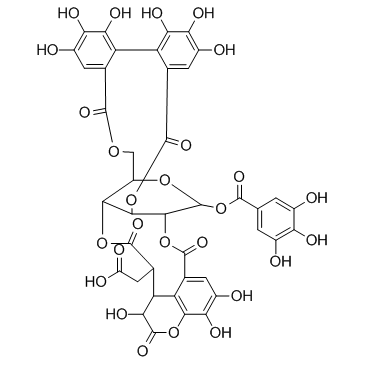
23094-71-5 structure
- Name: Chebulagic acid
- Chemical Name: 1-O-galloyl-2,4-O-chebuloyl-3,6-O-HHDP-β-D-glucose
- CAS Number: 23094-71-5
- Molecular Formula: C41H30O27
- Molecular Weight: 954.661
- Catalog: Biochemical Plant extracts
- Create Date: 2018-05-25 08:00:00
- Modify Date: 2026-07-04 00:22:00
-
Chebulagic acid is a COX-LOX dual inhibitor isolated from the fruits of Terminalia chebula Retz, on angiogenesis.target: COX-LOX [1]In vitro: Chebulagic acid can enhance the autophagy. Chebulagic acid exert anti-inflammatory and anti-infective effects. [1] [2] Chebulagic acid also show a protective effect against 1-methyl-4-phenylpyridinium (MPP+) - induce cytotoxicity which mimics the pathological symptom of Parkinson's disease. Chebulagic acid inhibit the LPS-induced upregulation of TNF-α and IL-1β in a dose- and time-dependent manner. Furthermore, LPS-activated MAPK signaling is inhibited by CA treatment in the EA.hy926 cells. [3]
| Name | 1-O-galloyl-2,4-O-chebuloyl-3,6-O-HHDP-β-D-glucose |
|---|---|
| Synonyms |
b-D-Glucopyranose, cyclic3,6-[(1R)-4,4',5,5',6,6'-hexahydroxy[1,1'-biphenyl]-2,2'-dicboxylate]1-(3,4,5-trihydroxybenzoate), cyclic 2®
β-D-Glucopyranose, cyclic 3,6-[(1R)-4,4',5,5',6,6'-hexahydroxy[1,1'-biphenyl]-2,2'-dicboxylate] 1-(3,4,5-trihydroxybenzoate), cyclic 2→2:4→1-ester with (2S)-2-[(3S,4S)-5-cboxy-3,4-dihydro-3,7,8-trihydroxy-2-oxo-2H-1-benzopyran-4-yl]butanedioic acid Chebulagic acid (6CI, 7CI) [(4R,5S,7R,25S,26R,29S,30S,31S)-13,14,15,18,19,20,31,35,36-Nonahydroxy-2,10,23,28,32-pentaoxo-5-[(3,4,5-trihydroxybenzoyl)oxy]-3,6,9,24,27,33-hexaoxaheptacyclo[28.7.1.0.0.0.0 .0]octatriaconta-1(38),11,13,15,17,19,21,34,36-nonaen-29-yl]acetic acid 5:4® 1-ester with(2S)-[(3S,4S)-5-cboxy-3,4-dihydro-3,7,8-trihydroxy-2-oxo-2H-1-benzopyran-4-yl]butanedioicacid b-D-Glucopyranose, cyclic3,6-[(1R)-4,4',5,5',6,6'-hexahydroxy[1,1'-biphenyl]-2,2'-dicboxylate]1-(3,4,5-trihydroxybenzoate), cyclic 25:41-ester with(2S)-[(3S,4S)-5-cboxy-3,4-dihydro-3,7,8-trihydroxy-2-oxo-2H-1-benzopyran-4-yl]butanedioicacid, stereoi Jorellic acid 2-((53S,53aS,54S,57R,58R,510S,511R,517R)-14,15,16,24,25,26,53,515,516-Nonahydroxy-52,55,513,3,8-pentaoxo-510-((3,4,5-trihydroxybenzoyl)oxy)-52,53,53a,54,55,57,58,510,511,513-decahydro-4,7-dioxa-5(17,8)-7,11-methano[1,4,7]trioxacyclotridecino[11,10,9-de]chromena-1,2(1,2)-dibenzenacyclooctaphane-54-yl)acetic acid Chebulagic Acid (25 mg) Chebulagic acid-RM Chebulagic acid, 10 mM in DMSO chebulagic acid CHEBULAGIC ACID(RG) |
| Description | Chebulagic acid is a COX-LOX dual inhibitor isolated from the fruits of Terminalia chebula Retz, on angiogenesis.target: COX-LOX [1]In vitro: Chebulagic acid can enhance the autophagy. Chebulagic acid exert anti-inflammatory and anti-infective effects. [1] [2] Chebulagic acid also show a protective effect against 1-methyl-4-phenylpyridinium (MPP+) - induce cytotoxicity which mimics the pathological symptom of Parkinson's disease. Chebulagic acid inhibit the LPS-induced upregulation of TNF-α and IL-1β in a dose- and time-dependent manner. Furthermore, LPS-activated MAPK signaling is inhibited by CA treatment in the EA.hy926 cells. [3] |
|---|---|
| Related Catalog | |
| References |
| Density | 2.1±0.1 g/cm3 |
|---|---|
| Boiling Point | 1610.6±65.0 °C at 760 mmHg |
| Melting Point | >300℃ |
| Molecular Formula | C41H30O27 |
| Molecular Weight | 954.661 |
| Flash Point | 480.0±27.8 °C |
| Exact Mass | 954.097473 |
| PSA | 447.09000 |
| LogP | 2.25 |
| Vapour Pressure | 0.0±0.3 mmHg at 25°C |
| Index of Refraction | 1.876 |
| Storage condition | -20°C |
| RIDADR | NONH for all modes of transport |
|---|
| Precursor 0 | |
|---|---|
| DownStream 1 | |