610318-03-1
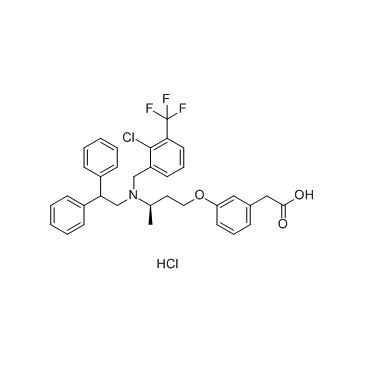
610318-03-1 structure
- Name: RGX-104
- Chemical Name: RGX-104
- CAS Number: 610318-03-1
- Molecular Formula: C34H34Cl2F3NO3
- Molecular Weight: 632.54
- Catalog: Signaling Pathways Metabolic Enzyme/Protease LXR
- Create Date: 2018-05-21 08:00:00
- Modify Date: 2026-07-15 18:43:41
-
RGX-104 is a small-molecule LXR agonist that modulates innate immunity via transcriptional activation of the ApoE gene.
| Name | RGX-104 |
|---|---|
| Synonyms |
RGX-104 (HCl)
RGX-104;RGX 104;RGX RGX-104 hydrochloride, 10 mM in DMSO Abequolixron (RGX-104) HCl RX-104 hydrochloride RGX-104 HCI inhibit,RGX 104,RGX104,Inhibitor,RGX-104,LXR,Liver X rector,RGX 104 hydrochloride,RGX104 hydrochloride RGX-104 hydrochloride 2-[3-[(3R)-3-[[2-chloro-3-(trifluoromethyl)phenyl]methyl-(2,2-diphenylethyl)amino]butoxy]phenyl]acetic acid RGX 104;RGX104;D D1632 Abequolixron (RGX-104) ,S8689 |
| Description | RGX-104 is a small-molecule LXR agonist that modulates innate immunity via transcriptional activation of the ApoE gene. |
|---|---|
| Related Catalog | |
| Target |
LXR[1] |
| In Vivo | Oral administration of GW3965 or RGX-104 to animals bearing palpable tumors significantly suppresses the growth of multiple cancer types. Strong tumor growth suppression is also observed in animals bearing large tumors. In some instances, the treatment causes partial or complete tumor regression. Responses are seen across a wide spectrum of malignancies, including lung cancer, melanoma, glioblastoma, and ovarian, renal cell, triple-negative breast, and colon cancer[1]. |
| Cell Assay | Bone marrow cells are cultured with B16F10 melanoma cells and GM-CSF for 6 days. On day 3, RGX-104 (2 μM) is added to the culture. The mean number of Gr-1high CD11b+ cells per 50 mL of culture solution is assessed by flow cytometry on day 6[1]. |
| Animal Admin | Mice[1] B16F10 cancer cells are subcutaneously injected into C57BL/6 mice. Following tumor growth to 5-10 mm3 in volume, mice are fed either control chow, chow supplemented with GW3965 (100 mg/kg), or chow supplemented with RGX-104 (100 mg/kg)[1]. |
| References |
| Molecular Formula | C34H34Cl2F3NO3 |
|---|---|
| Molecular Weight | 632.54 |
| Storage condition | 2 years -20°C Powder, 2 weeks4°C in DMSO,6 months-80°C in DMSO |