173904-50-2
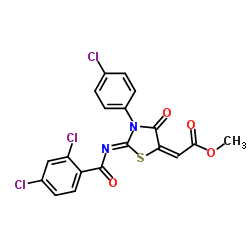
173904-50-2 structure
- Name: FR 171113
- Chemical Name: Methyl (2E)-{(2Z)-3-(4-chlorophenyl)-2-[(2,4-dichlorobenzoyl)imino]-4-oxo-1,3-thiazolidin-5-ylidene}acetate
- CAS Number: 173904-50-2
- Molecular Formula: C19H11Cl3N2O4S
- Molecular Weight: 469.73
- Catalog: Signaling Pathways GPCR/G Protein Protease-Activated Receptor (PAR)
- Create Date: 2018-07-05 07:41:20
- Modify Date: 2026-07-08 16:53:30
-
FR171113 is a specific and non-peptide thrombin receptor antagonist. FR171113 exhibits the antithrombotic effects of a PAR1 antagonist. FR171113 inhibits thrombin-induced platelet aggregation with an IC50 of 0.29 μM.[1][2][3][4].
| Name | Methyl (2E)-{(2Z)-3-(4-chlorophenyl)-2-[(2,4-dichlorobenzoyl)imino]-4-oxo-1,3-thiazolidin-5-ylidene}acetate |
|---|---|
| Synonyms |
Acetic acid, 2-[3-(4-chlorophenyl)-2-[(2,4-dichlorobenzoyl)imino]-4-oxo-5-thiazolidinylidene]-, methyl ester
FR171113,FR FR-171113 >= (HPLC) 2-[3-(4-Chlorophenyl)-2-[(2,4-dichlorobenzoyl)imino]-4-oxo-5-thiazolidinylidene]-aceticacidmethylester |
| Description | FR171113 is a specific and non-peptide thrombin receptor antagonist. FR171113 exhibits the antithrombotic effects of a PAR1 antagonist. FR171113 inhibits thrombin-induced platelet aggregation with an IC50 of 0.29 μM.[1][2][3][4]. |
|---|---|
| Related Catalog | |
| In Vitro | FR171113 shows antiplatelet effect on the aggregation of guinea pig platelets induced by PAR1 agonist peptide and thrombin in vitro with IC50s of 1.5 and 0.35 μM, respectively[2]. FR171113 (0.032-1 μM) dose-dependently inhibits platelet aggregation induced by both thrombin and TRAP-6[1]. FR171113 significantly prevents the plasma-elicited up-regulation of RAGE, MCP-1 and ICAM-1 mRNA levels in HUVECs[2]. FR171113 (1 μM; pretreatment for 30 minutes) inhibits thrombin- and SFLLRN (human PAR1 agonist peptide)-induced ERK activation, but not factor Xa- or SLIGKV (PAR2 agonist peptide)-induced ERK activation, indicating that activation of ERK by factor Xa is specifically mediated by PAR2 in mesangial cells[3]. Cell Viability Assay[1] Cell Line: Human washed platelets Concentration: 0.001, 0.01, 0.1, 1, 10, 100 μM Incubation Time: Result: The IC50 value for thrombin-induced platelet aggregation was 0.29 μM. The IC50 value for TRAP-6-induced platelet aggregation was 0.15 μM. RT-PCR[2] Cell Line: human umbilical vein endothelial cells (HUVECs) Concentration: 1 μM Incubation Time: 4 hours Result: 3% citrated human plasma-evoked ROS generation, RAGE, MCP-1 and ICAM-1 gene induction was significantly blocked. Western Blot Analysis[3] Cell Line: Mesangial cells Concentration: 1 μM Incubation Time: Pretreatment for 30 minutes Result: Pretreatment inhibited thrombin (10 nM; for 5 minutes)- and SFLLRN(100 μM for 5 minutes)-induced ERK activation. |
| In Vivo | FR171113 suppresses occlusive thrombosis dose dependently and causes significant prolongation at 1 mg/kg s.c. in the carotid artery thrombosis model.FR171113 shows antiplatelet and antithrombotic effects in vivo. FR171113 is a useful agent for investigating antithrombotic actions via PAR1 in vivo[4]. Animal Model: Male Hartley guinea pigs (650–950 g) were anesthetized with urethane (1.25 g/kg, i.p.)[4] Dosage: 0.32, 1.0, and 3.2 mg/kg Administration: Administered subcutaneously (s.c.) Result: Pretreatment with FR171113 prolonged this parameter in a dose-dependent manner. The time to thrombotic occlusion for 0.32, 1.0 and 3.2 mg/kg of FR171113 was 30.7±5.36, 44.7±8.41 and 92.6±9.79, respectively. |
| References |
| Density | 1.5±0.1 g/cm3 |
|---|---|
| Boiling Point | 608.3±65.0 °C at 760 mmHg |
| Molecular Formula | C19H11Cl3N2O4S |
| Molecular Weight | 469.73 |
| Flash Point | 321.7±34.3 °C |
| Exact Mass | 467.950500 |
| LogP | 4.70 |
| Vapour Pressure | 0.0±1.7 mmHg at 25°C |
| Index of Refraction | 1.668 |
| Symbol |

GHS09 |
|---|---|
| Signal Word | Warning |
| Hazard Statements | H410 |
| Precautionary Statements | P273-P501 |
| RIDADR | UN 3077 9 / PGIII |