1179347-65-9
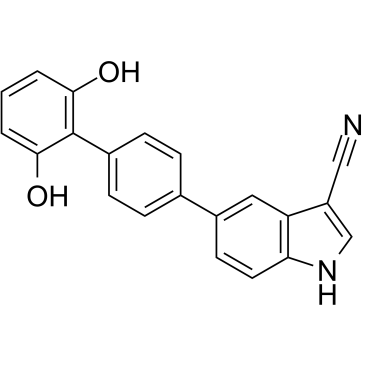
1179347-65-9 structure
- Name: MT6378
- Chemical Name: MT 63-78
- CAS Number: 1179347-65-9
- Molecular Formula: C21H14N2O2
- Molecular Weight: 326.35
- Catalog: Signaling Pathways Apoptosis Apoptosis
- Create Date: 2020-06-01 21:23:07
- Modify Date: 2026-07-09 13:34:00
-
MT 63-78 is a specific and potent direct AMPK activator with an EC50 of 25 μM. MT 63–78 also induces cell mitotic arrest and apoptosis. MT 63-78 blocks prostate cancer growth by inhibiting the lipogenesis and mTORC1 pathways. MT 63-78 has antitumor effects[1].
| Name | MT 63-78 |
|---|---|
| Synonyms |
1H-Indole-3-carbonitrile, 5-(2',6'-dihydroxy[1,1'-biphenyl]-4-yl)
5-[4-(2,6-dihydroxyphenyl)phenyl]-1H-indole-3-carbonitrile MT , 10 mM in DMSO Raptor,mitotic,Mammalian tget of Rapamycin,direct,antitumor,MT ,mTOR,Thr172,rest,dhosphorylation,Inhibitor,AMP-activated protein kinase,Mcl-1,mTORC1,Apoptosis,AMPK,MT 63 78,lipogenesis,BH3,MT 6378,p53,inhibit 5-{2',6'-dihydroxy-[1,1'-biphenyl]-4-yl}-1H-indole-3-carbonitrile |
| Description | MT 63-78 is a specific and potent direct AMPK activator with an EC50 of 25 μM. MT 63–78 also induces cell mitotic arrest and apoptosis. MT 63-78 blocks prostate cancer growth by inhibiting the lipogenesis and mTORC1 pathways. MT 63-78 has antitumor effects[1]. |
|---|---|
| Related Catalog | |
| Target |
AMPK:25 μM (EC50) mTORC1 |
| In Vitro | MT 63-78 (0-50 μM; 4 days; LNCaP and PC3 cells) treatment shows a dose-dependent decrease in cell number, and concomitant to the activation of AMPK signaling[1]. MT 63-78 (25 μM; 24 hours; LNCaP and CRPC cells) treatment induces a significant enrichement in the G2/M population[1]. MT 63-78 (0-50 μM; 24 hours; LNCaP, PC3, C4-4, C4-2B, CL1and 22RV1cells) treatment induces reduction of anti-apoptotic Mcl-1 in concert with accumulation of the pro-apoptotic BH3-only protein Puma[1]. MT 63-78 (0-50 μM; 30 minutes; LNCaP and PC3 cells) treatment shows a dose-dependent phosphorylation of the two major AMPK targets Acetyl-CoA Carboxylase (ACC) on Ser79 and of Raptor on Ser792. And also increases Thr172 phosphorylation on the AMPK α subunit[1]. Cell Viability Assay[1] Cell Line: LNCaP and PC3 cells Concentration: 0 μM, 1 μM, 5 μM, 10 μM, 25 μM, 50 μM Incubation Time: 4 days Result: A dose-dependent decrease in cell number, concomitant to the activation of AMPK signaling was observed. Cell Cycle Analysis[1] Cell Line: LNCaP and CRPC cells Concentration: 25 μM Incubation Time: 24 hours Result: Induced a significant enrichement in the G2/M population in both androgen sensitive and CRPC cell models. Apoptosis Analysis[1] Cell Line: LNCaP, PC3, C4-4, C4-2B, CL1and 22RV1cells Concentration: 0 μM, 10 μM, 25 μM, 50 μM Incubation Time: 24 hours Result: Induced reduction of anti-apoptotic Mcl-1 in concert with accumulation of the pro-apoptotic BH3-only protein Puma in all PCa cells. Western Blot Analysis[1] Cell Line: LNCaP and PC3 cells Concentration: 0 μM, 0.25 μM, 0.5 μM, 1 μM, 5 μM, 25 μM, 50 μM Incubation Time: 30 minutes Result: Observed a dose-dependent phosphorylation of the two major AMPK targets Acetyl-CoA Carboxylase (ACC) on Ser79 and of Raptor on Ser792. A corresponding increase in Thr172 phosphorylation on the AMPK α subunit was also observed. |
| In Vivo | MT 63-78 (30 mg/kg; intraperitoneal injection; daily; for 14 days; C57 BL/6 male mice) treatment leads to a 33% inhibition of tumor growth[1]. Animal Model: C57 BL/6 male mice bearing LNCaP tumors[1] Dosage: 30 mg/kg Administration: Intraperitoneal injection; daily; for 14 days Result: Led to a 33% inhibition of tumor growth. |
| References |
| Molecular Formula | C21H14N2O2 |
|---|---|
| Molecular Weight | 326.35 |