1011528-58-7
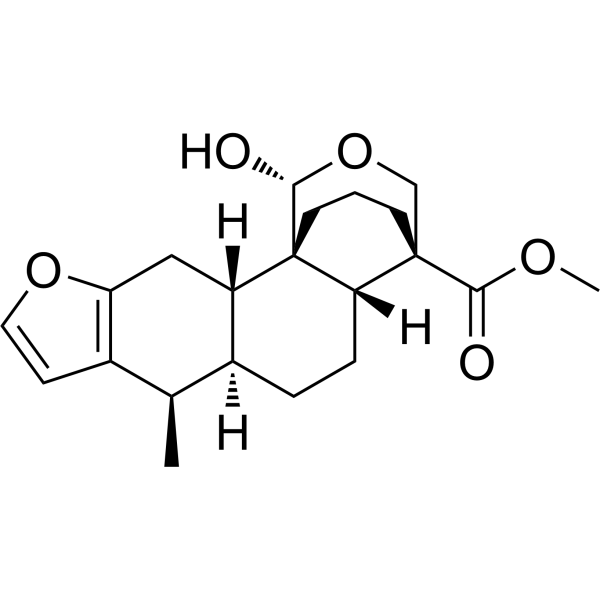
1011528-58-7 structure
- Name: Phanginin A
- Chemical Name: Phanginin A
- CAS Number: 1011528-58-7
- Molecular Formula: C21H28O5
- Molecular Weight: 360.44
- Catalog: Signaling Pathways Immunology/Inflammation Salt-inducible Kinase (SIK)
- Create Date: 2023-04-04 16:25:14
- Modify Date: 2026-07-15 16:35:53
-
Phanginin A is a potent and orally active SIK1 (salt-induced kinase 1) activator. Phanginin A inhibited gluconeogenesis. Phanginin A increases the expression of p-SIK1 and decreases the expression of p-CREB. Phanginin A reduces blood glucose levels and improves glucose tolerance and dyslipidemia. Phanginin A has the potential for the research of type 2 diabetes[1].
| Name | Phanginin A |
|---|---|
| Synonyms | 3H-4,11b-Propano-1H-furo[3',2':6,7]naphtho[1,2-c]pyran-4(4aH)-cboxylic acid, 5,6,6a,7,11,11a-hexahydro-1-hydroxy-7-methyl-, methyl ester, (1R,4R,4,6aS,7R,11aS,11bS) |
| Description | Phanginin A is a potent and orally active SIK1 (salt-induced kinase 1) activator. Phanginin A inhibited gluconeogenesis. Phanginin A increases the expression of p-SIK1 and decreases the expression of p-CREB. Phanginin A reduces blood glucose levels and improves glucose tolerance and dyslipidemia. Phanginin A has the potential for the research of type 2 diabetes[1]. |
|---|---|
| Related Catalog | |
| Target |
SIK1 |
| In Vitro | Phanginin A (2.5, 5, 10 µM) 以剂量依赖性方式抑制原代小鼠肝细胞中的糖异生[1]。 Phanginin A (5, 10 µM) 降低 G6P 和 PEPCK 的 mRNA 表达,并减少细胞内 cAMP 的积累[1]。 Phanginin A (5, 10 µM; 0-120 min) 以时间和剂量依赖的方式抑制原代小鼠肝细胞中 CREB 磷酸化的表达[1]。 Phanginin A (2.5, 5, 10 µM; 0-120 min) 以时间和剂量依赖的方式增加原代小鼠肝细胞中 p-SIK1 的表达[1]。 Phanginin A (5, 10 µM) 增加 PDE4 活性[1]。 RT-PCR[1] Cell Line: Primary mouse hepatocytes Concentration: 5, 10 µM Incubation Time: Result: Significantly decreased PEPCK mRNA expression by 25% and 43% under basal conditions and 45% and 67% under forskolin-stimulated conditions, The G6P mRNA expression was also significantly reduced, with 5 and 10 μM of phanginin A resulting in a decrease of 30% and 46% under basal conditions and 38% and 57% under forskolin-stimulated conditions, respectively. Western Blot Analysis[1] Cell Line: Primary mouse hepatocytes Concentration: 0-120 min Incubation Time: Result: Inhibited CREB phosphorylation in a time and dose-dependent manner. |
| In Vivo | Phanginin A (100 mg/kg; p.o.; once) 在 2 型糖尿病 ob/ob 小鼠中表现出抗糖异生活性[1]。 Phanginin A (100 mg/kg; p.o.; once daily for 26 days) 改善 ob/ob 小鼠的代谢紊乱[1]。 Animal Model: Type 2 diabetic ob/ob mice[1] Dosage: 100 mg/kg Administration: P.o.; once Result: Significantly reduced the blood glucose, increased the phosphorylation of SIK1 in the liver by 119%, PDE4 activity in the liver was elevated by 74%, decreased in the cAMP concentration along with a 46% decrease in the CREB phosphorylation level in the liver, decreased the mRNA levels of PEPCK and G6P. Animal Model: Male ob/ob mice[1] Dosage: 100 mg/kg Administration: P.o.; once daily for 26 days Result: Showed an average reduction rate of 29% and 32% in random and fast blood glucose, exhibited a marked improvement in glucose tolerance, significantly reduced by 20% in HbA1c level, showed no effect on food intake and body weight. |
| References |
| Molecular Formula | C21H28O5 |
|---|---|
| Molecular Weight | 360.44 |