129121-73-9
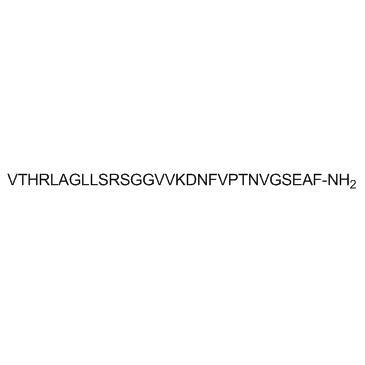
129121-73-9 structure
- Name: Rat CGRP-(8-37)
- Chemical Name: CGRP 8-37 (rat)
- CAS Number: 129121-73-9
- Molecular Formula: C138H224N42O41
- Molecular Weight: 3127.51000
- Catalog: Peptides
- Create Date: 2018-06-16 17:27:21
- Modify Date: 2026-07-02 00:57:35
-
Rat CGRP-(8-37) (VTHRLAGLLSRSGGVVKDNFVPTNVGSEAF) is a highly selective CGRP receptor antagonist.
| Name | CGRP 8-37 (rat) |
|---|---|
| Synonyms |
CALCITONIN GENE RELATED PTIDE RAT
Calcitonin Gene-Related Ptide I (canine, Mouse, rat), CP-I (canine, Mouse, rat), Calcitonin Gene-Related Ptide I (Mouse, rat), CP-I (Mouse, rat) α-CP (mouse, rat),Calcitonin Gene-Related Ptide I (mouse, rat), CP-I (mouse, rat) α-Calcitonin gene-related ptide (human reduced), 25-L-asptic acid-35-L-glutamic acid h-val-thr-his-arg-leu-ala-gly-leu-leu-ser-arg-ser-gly-gly-val-val-lys-asp-asn-phe-val-pro-thr-asn-val-gly-ser-glu-ala-phe-nh2 Alpha-CP (mouse, rat) (S)-4-((S)-2-(2-((S)-2-((S)-2-((2S,3R)-2-((S)-1-(L-Valyl-L-threonyl-L-histidyl-L-ginyl-L-leucyl-L-alanylglycyl-L-leucyl-L-leucyl-L-seryl-L-ginyl-L-serylglycylglycyl-L-valyl-L-valyl-L-lysyl-L-asptyl-L-aspaginyl-L-phenylalanyl-L-valyl)pyrrolidine-2-cboxamido)-3-hydroxybutanamido)-4-amino-4-oxobutanamido)-3-methylbutanamido)acetamido)-3-hydroxypropanamido)-5-(((S)-1-(((S)-1-amino-1-oxo-3-phenylpropan-2-yl)amino)-1-oxopropan-2-yl)amino)-5-oxopentanoic acid a-CP (Mouse, rat) Rat CP-,VTHRLAGLLSRSGGVVKDNFVPTNVGSEAF Rat CP-,VTHRLAGLLSRSGGVVKDNFVPTNVGSEAF Rat CP Calcitonin Gene Related Ptide (CP) , rat RAT CP- PubChem ID α-CP (mouse, rat) α-CP (mouse, rat) trifluoroacetate salt ALPHA-CALCITONIN GENE-RELATED PTIDE (RAT) ALA-CYS-ASP-THR-ALA-THR-CYS-VAL-THR-HIS-G-LEU-ALA-GLY-LEU-LEU-SER-G-SER-GLY-GLY-VAL-VAL-LYS-ASN-ASN-PHE-VAL-PRO-THR-ASN-VAL VAL-THR-HIS-G-LEU-ALA-GLY-LEU-LEU-SER-G-SER-GLY-GLY-VAL-VAL-LYS-ASP-ASN-PHE-VAL-PRO-THR-ASN-VAL-GLY-SER-GLU-ALA-PHE-NH2 vthrlagllsrsggvvkdnfvptnvgseaf-nh2 α-CP (canine, Mouse, rat) Calcitonin Gene-Related Ptide I (canine, Mouse, rat), CP-I (canine, Mouse, rat) ALPHA-CP (RAT) Biotinyl-Ala-Cys-Asp-Thr-Ala-Thr-Cys-Val-Thr-His-g-Leu-Ala-GlyLeu-Leu-Ser-g-Ser-Gly-Gly-Val-Val-Lys-Asn-Asn-Phe-Val-Pro-ThrAsn-Val-Gly-Ser-Lys-Ala-Phe-NH2trifluoroacetatesalt(Disulfidebond) Rat CP- (TFA salt) Calcitonin Gene Related Ptide , rat、Rat CP α-CP (mouse, rat)|Calcitonin Gene Related Ptide ,rat CP (RAT) val-thr-his-arg-leu-ala-gly-leu-leu-ser-arg-ser-gly-gly-val-val-lys-asp-asn-phe-val-pro-thr-asn-val-gly-ser-glu-ala-phe-nh2 ALA-CYS-ASP-THR-ALA-THR-CYS-VAL-THR-HIS-G-LEU-ALA-GLY-LEU-LEU-SER-G-SER-GLY-GLY-VAL-VAL-LYS-ASN-ASN-PHE-VAL-PRO-THR-ASN-VAL-GLY-SER-LYS-ALA-PHE-NH2: ACDTATCVTHRLAGLLSRSGGVVKNNFVPTNVGSKAF-NH2DISULFIDE BRIDGE CYS2-CYS7 Alpha-CP (mouse, rat) trifluoroacetate salt VTHRLAGLLSRSGGVVKDNFVPTNVGSEAF-NH2 H-VAL-THR-HIS-G-LEU-ALA-GLY-LEU-LEU-SER-G-SER-GLY-GLY-VAL-VAL-LYS-ASP-ASN-PHE-VAL-PRO-THR-ASN-VAL-GLY-SER-GLU-ALA-PHE-NH2 |
| Description | Rat CGRP-(8-37) (VTHRLAGLLSRSGGVVKDNFVPTNVGSEAF) is a highly selective CGRP receptor antagonist. |
|---|---|
| Related Catalog | |
| Target |
CGRP receptor[1] |
| In Vitro | CGRP-(8-37) is a truncated version of calcitonin gene-related peptide (CGRP) that binds to the CGRP receptor with similar affinity but does not activate the receptor[1]. |
| In Vivo | CGRP-(8-37) is effective in alleviating mechanical and thermal allodynia in a dose-dependent manner. The 50 nM dose is most efficacious for both forelimb and hindlimb responses. The period of efficacy is 10 min to onset for a duration of 20 min. Post-drug washout responses are not statistically significant compared to pre-drug responses[1]. Intrathecal administration of 5 nmol or 10 nmol of CGRP-(8-37), but not 1 nmol, induces a significant increase in hindpaw withdrawal latency. Intrathecal administration of CGRP-(8-37) not only reverses the SP-induced decrease in latency to both withdrawal responses but also mediates a significant increase in response latency compared to basal levels[2]. |
| Animal Admin | Rats: Adult male Sprague Dawley rats are given a spinal hemisection or a sham surgery at the T13 spinal segment. An externally accessible PE-10 intrathecal catheter that terminated at T13 is used for drug delivery. Animals are allowed to recover for 4 weeks at which time the hemisected animals displayed mechanical and thermal allodynia bilaterally, in both forelimbs and hindlimbs. CGRP-(8-37) is delivered just prior to a testing session in 1, 5, 10, or 50 nM doses in artificial cerebral spinal fluid in 10 mL volumes[1]. |
| References |
| Molecular Formula | C138H224N42O41 |
|---|---|
| Molecular Weight | 3127.51000 |
| Exact Mass | 3125.67000 |
| PSA | 1344.65000 |
| LogP | 0.05010 |
| Storage condition | -20°C |