13478-18-7
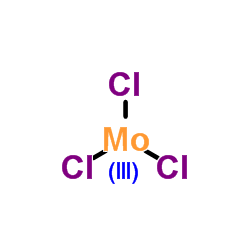
13478-18-7 structure
- Name: Molybdenum(III) chloride
- Chemical Name: molybdenum trichloride
- CAS Number: 13478-18-7
- Molecular Formula: Cl3Mo
- Molecular Weight: 202.299
- Catalog: Inorganic chemical industry Inorganic salt Metal halides and halides Metal chlorides and salts
- Create Date: 2018-08-24 15:17:47
- Modify Date: 2026-07-08 08:37:45
| Name | molybdenum trichloride |
|---|---|
| Synonyms |
ybdenum(III) chL
Molybdenum(III) chloride, trace MFCD00014214 MOLYBDENUM CHLORIDE MOLYBDENUM (III) CHLORIDE MOLYBDENUM TRICHLORIDE molybdenumchloride(mocl3) MolybdenuM(III) chloride trace Metals basis MOLYBDENUM CHLORIDE (III) MOLYBDENUM (III) CHLORIDE, MOLYBDENUM (III) CHLORIDE, MOLYBDENUM (III) CHLORIDE trichloromolybdenum Molybdenum(III)chloride Molybdenum(III)chloride(-Mo) MoCl3 EINECS 236-775-9 Molybdenum(3+) trichloride MOLYBDENUM (III) CHL MOLYBDENUM(III) CHLORIDE Einecs -9 trichloridomolybdenum |
| Density | 3.58 g/mL at 25 °C(lit.) |
|---|---|
| Melting Point | 1027°C |
| Molecular Formula | Cl3Mo |
| Molecular Weight | 202.299 |
| Exact Mass | 202.811966 |
| LogP | 2.06850 |
| Appearance | Powder | Dark red |
| Vapour Pressure | 33900mmHg at 25°C |
| Water Solubility | H2O: insoluble(lit.) | Soluble in nitric acid and sulfuric acid. Insoluble in water and dilute hydrochloric acid. Slightly soluble in ethanol and diethyl ether. |
|
Section 1: Product Identification Chemical Name:Molybdenum(III) chloride (99.5%-Mo) CAS Registry Number:13478-18-7 Formula:MoCl3 EINECS Number:236-775-9 Chemical Family:metal halide Synonym:Molybdenum trichloride
Section 2: Composition and Information on Ingredients IngredientCAS NumberPercentACGIH (TWA)OSHA (PEL) Title Compound13478-18-7100%0.5mg/m35mg/m3 Section 3: Hazards Identification Emergency Overview:Corrosive to skin, eyes and respiratory tract. Inhalation of dust leads to burning of the respiratory tract. Primary Routes of Exposure:Contact with skin and eyes. Inhalation of dust. Eye Contact:Corrosive to the eyes. Skin Contact:Causes burns to the skin. Inhalation:Inhalation of dust leads to chemical burns of the respiratory tract. Ingestion:No information is available on the physiological effects of ingestion. Acute Health Affects:Corrosive to skin, eyes and respiratory tract. Chronic Health Affects:No information available on long-term chronic effects. NTP:No IARC:No OSHA:No SECTION 4: First Aid Measures Immediately flush the eyes with copious amounts of water for at least 10-15 minutes. A victim may need Eye Exposure: assistance in keeping their eye lids open. Get immediate medical attention. Wash the affected area with water. Remove contaminated clothes if necessary. Seek medical assistance if Skin Exposure: irritation persists. Remove the victim to fresh air. Closely monitor the victim for signs of respiratory problems, such as difficulty Inhalation: in breathing, coughing, wheezing, or pain. In such cases seek immediate medical assistance. Seek medical attention immediately. Keep the victim calm. Give the victim water (only if conscious). Induce Ingestion: vomiting only if directed by medical personnel. SECTION 5: Fire Fighting Measures Flash Point:not applicable Autoignition Temperature:none Explosion Limits:none Extinguishing Medium:none required If involved in a fire, fire fighters should be equipped with a NIOSH approved positive pressure self-contained Special Fire Fighting Procedures: breathing apparatus and full protective clothing. Hazardous Combustion andnone Decomposion Products: Unusual Fire or Explosion Hazards: No unusual fire or explosion hazards. SECTION 6: Accidental Release Measures Small spills can be neutralized with powdered sodium bicarbonate, lime, or calcium carbonate and swept up. Spill and Leak Procedures:Large spills in areas not adequately ventilated will require an evacuation of site. Emergency response teams will require self-contained breathing apparatus. SECTION 7: Handling and Storage Handling and Storage:Store material in a tightly sealed container under an inert atmosphere of nitrogen or argon. SECTION 8: Exposure Controls and Personal Protection Eye Protection:Always wear approved safety glasses when handling a chemical substance in the laboratory. Skin Protection:Wear protective clothing gloves. Consult glove manufacturer to determine the proper type of glove. Ventilation:If possible, handle the material in an efficient fume hood. If in form of fine dust and ventilation is not available a respirator should be worn. The use of respirators Respirator: requires a Respirator Protection Program to be in compliance with 29 CFR 1910.134. Ventilation:If possible, handle the material in an efficient fume hood. Additional Protection:No additional protection required. SECTION 9: Physical and Chemical Properties Color and Form:-100 mesh purple xtl. Molecular Weight:202.32 Melting Point:dec. Boiling Point:no data Vapor Pressure:no data Specific Gravity:3.59 Odor:none Solubility in Water:reacts with water SECTION 10: Stability and Reactivity Stability:air sensitive, moisture sensitive Hazardous Polymerization:no hazardous polymerization Conditions to Avoid:contact with moisture Incompatibility:active metals Decomposition Products:none SECTION 11: Toxicological Information RTECS Data:Oral (insect-Drosophila melanogaster); Specific locus test: 10nmol/L. Carcinogenic Effects:no data Mutagenic Effects:Mutagen Tetratogenic Effects:no data SECTION 12: Ecological Information Ecological Information:No information available SECTION 13: Disposal Considerations Disposal:Dispose of according to local, state and federal regulations. SECTION 14: Transportation Shipping Name (CFR):Corrosive solids, N.O.S. Hazard Class (CFR):8 Additional Hazard Class (CFR):NA Packaging Group (CFR):II UN ID Number (CFR):UN# 1759 Shipping Name (IATA):Corrosive solid, N.O.S. Hazard Class (IATA):8 Additional Hazard Class (IATA):NA Packaging Group (IATA):II UN ID Number (IATA):UN# 1759 SECTION 15: Regulatory Information TSCA:Listed in the TSCA inventory. SARA (Title 313):Title compound not listed Second Ingredient:none SECTION 16 - ADDITIONAL INFORMATION N/A |
CHEMICAL IDENTIFICATION
HEALTH HAZARD DATAACUTE TOXICITY DATAMUTATION DATA
|
| Symbol |

GHS07 |
|---|---|
| Signal Word | Warning |
| Hazard Statements | H315-H319-H335 |
| Precautionary Statements | P261-P305 + P351 + P338 |
| Personal Protective Equipment | dust mask type N95 (US);Eyeshields;Gloves |
| Hazard Codes | Xi: Irritant; |
| Risk Phrases | R36/37/38 |
| Safety Phrases | S26;S37/S39 |
| RIDADR | UN3260 |
| WGK Germany | 3 |
| RTECS | QA4681400 |
| Packaging Group | III |
| Hazard Class | 8 |
|
~%
13478-18-7 |
| Literature: Ullmanns Encykl. Tech. Chem. 4th Ed., , vol. 17, p. 23 - 50 Mo: SVol.A3, 2.4.6.2, page 62 - 63 |
|
~%
13478-18-7 |
| Literature: Journal fuer Praktische Chemie (Leipzig), , vol. 71, p. 453 - 453 |
|
~%
13478-18-7 |
| Literature: Mo: SVol.A3, 2.7.27, page 182 - 183 |
|
~%
13478-18-7 |
| Literature: Chemiker-Zeitung, , vol. 12, p. 5 - 5 Mo: MVol., 56, page 162 - 164 |
|
~%
13478-18-7 |
| Literature: Journal of the Chemical Society, Dalton Transactions: Inorganic Chemistry (1972-1999), , p. 1197 - 1198 |
|
~%
13478-18-7 |
| Literature: European Journal of Inorganic Chemistry, , # 10 p. 2699 - 2703 |






| Precursor 6 | |
|---|---|
| DownStream 1 | |