211096-49-0
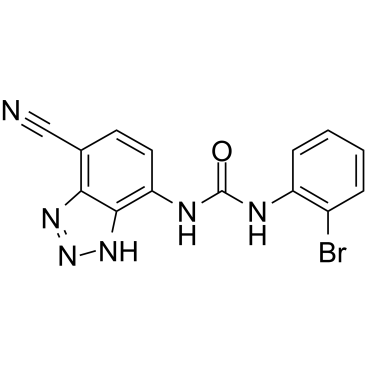
211096-49-0 structure
- Name: SB 265610
- Chemical Name: 1-(2-bromophenyl)-3-(7-cyano-2H-benzotriazol-4-yl)urea
- CAS Number: 211096-49-0
- Molecular Formula: C14H9BrN6O
- Molecular Weight: 357.16500
- Catalog: Signaling Pathways GPCR/G Protein CXCR
- Create Date: 2016-03-11 18:08:03
- Modify Date: 2026-07-02 08:01:38
-
SB-265610 is a selective, competitive, nonpeptide and allosteric CXCR2 antagonist. SB-265610 blocks rat cytokine-induced neutrophil chemoattractant-1 (CINC-1)-induced calcium mobilization and neutrophil chemotaxis with IC50s of 3.7 nM and 70 nM, respectively[1][2].
| Name | 1-(2-bromophenyl)-3-(7-cyano-2H-benzotriazol-4-yl)urea |
|---|---|
| Synonyms |
SB 265610 ,S9516
GSK-CXCR2 SB-265610, 10 mM in DMSO 1-(2-Bromophenyl)-3-(4-cyano-1H-benzo[d] [1,2,3]triazol-7-yl)urea Urea, N-(2-bromophenyl)-N'-(4-cyano-1H-benzotriazol-7-yl) CXCR,nonptide,inhibit,Inhibitor,SB-265610,inflammation,recruitment,Delay,SB 265610,healing,neutrophil,SB265610,wound,CXC chemokine rectors N-(2-Bromophenyl)-N'-(7-cyano-1H-benzotriazol-4-yl)urea SB265610 >= (HPLC) |
| Description | SB-265610 is a selective, competitive, nonpeptide and allosteric CXCR2 antagonist. SB-265610 blocks rat cytokine-induced neutrophil chemoattractant-1 (CINC-1)-induced calcium mobilization and neutrophil chemotaxis with IC50s of 3.7 nM and 70 nM, respectively[1][2]. |
|---|---|
| Related Catalog | |
| Target |
CXCR2 |
| In Vitro | In vitro, SB-265610 antagonizes rat cytokine-induced neutrophil chemoattractant-1 (CINC-1)-induced calcium mobilization, IC50 of 3.7 nM, and rat neutrophil chemotaxis in a concentration-dependent manner, IC50 of 70 nM. SB-265610 reduces the antiapoptotic effect of CINC-1 to the levels of those untreated with CINC-1[1]. |
| In Vivo | SB-265610 (100 mg/kg/day; oral administration; daily; for 5 days; CXCR2 wild type mice) treatment during the wound repair process markedly delays healing parameters in CXCR2 wild type mice[2]. Animal Model: Wild type mice with nitrogen mustard[2] Dosage: 100 mg/kg/day Administration: Oral administration; daily; for 5 days Result: Markedly impaired the wound healing process. |
| References |
| Density | 1.779 g/cm3 |
|---|---|
| Boiling Point | 527ºC at 760 mmHg |
| Molecular Formula | C14H9BrN6O |
| Molecular Weight | 357.16500 |
| Flash Point | 272.5ºC |
| Exact Mass | 356.00200 |
| PSA | 106.49000 |
| LogP | 3.38208 |
