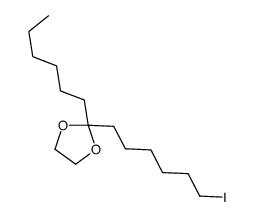
35891-70-4
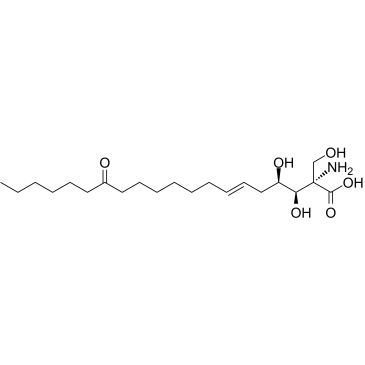
35891-70-4 structure
- Name: Myriocin
- Chemical Name: myriocin
- CAS Number: 35891-70-4
- Molecular Formula: C21H39NO6
- Molecular Weight: 401.538
- Catalog: Research Areas Others
- Create Date: 2018-08-28 19:07:10
- Modify Date: 2026-07-02 10:01:24
-
Myriocin, a fungal metabolite isolated from Myriococcum albomyces, Isaria sinclairi and Mycelia sterilia, is a potent inhibitor of serine-palmitoyl-transferase (SPT) and a key enzyme in de novo synthesis of sphingolipids[1]. Myriocin strongly suppresses replication of both the subgenomic HCV-1b replicon and the JFH-1 strain of genotype 2a infectious HCV[2], with an IC50 of 3.5 µg/mL for inhibiting HCV infection[3].
| Name | myriocin |
|---|---|
| Synonyms |
MYRIOCIN
6e))-4s (2S,3R,4R,6E)-2-Amino-3,4-dihydroxy-2-(hydroxymethyl)-14-oxo-6-icosenoic acid ISP-I (2S,3R,4R)-(E)-2-Amino-3,4-dihydroxy-2-hydroxyMethyl-14-oxoeicos-6-enoic Acid [2S,3R,4R]-(E)-2-AMINO-3,4-DIHYDROXY-2-[HYDROXYMETHYL]-14-OXO-6-EICOSENOIC ACID ISP-I, Thermozymocidin, (2S,3R,4R,6E)-2-Amino-3,4-dihydroxy-2-(hydroxymethyl)-14-oxo-6-eicosenoic acid 2S-amino-3R,4R-dihydroxy-2-(hydroxymethyl)-14-oxo-6E-eicosenoic acid [2S,3R,4R,6E]-2-AMINO-3,4-DIHYDROXY-2-[HYDROXYMETHYL]-14-OXO-6-EICOSENOIC ACID Thermozymocidin, ISP-I, (2S,3R,4R,6E)-2-Amino-3,4-dihydroxy-2-(hydroxymethyl)-14-oxo-6-eicosenoic acid Myriocin,Mycelia sterilia Myriocin, Mycelia sterilia - - Calbiochem (E,2S,3R,4R)-2-amino-3,4-dihydroxy-2-(hydroxymethyl)-14-oxoicos-6-enoic acid Isp-1 suppressant THERMOZYMOCIDIN (2S,3R,4R,E)-2-amino-3,4-dihydroxy-2-(hydroxyMethyl)-14-oxoicos-6-enoic acid ISP-I NSC 177379 Myriocin Thermozymocidin Myriocin (ISP-1) 6-Eicosenoic acid, 2-amino-3,4-dihydroxy-2-(hydroxymethyl)-14-oxo-, (2S,3R,4R,6E) Thermozymocidin ISP-1 2-Amino-2-hydroxymethyl-3,4-dihydroxy-14- oxoeicos-6-enoic acid Myriocin (ISP-I), serine palmitoyltransferase inhibitor TherMozyMocidin, ISP 1 6-eicosenoicacid,2-amino-3,4-dihydroxy-2-(hydroxymethyl)-14-oxo-,(2s-(2r*,3s ISP-I|||Thermozymocidin Myriocin from Mycelia sterilia MFCD01632772 C001996 Spi-1 inhibitor MYRIOCIN, MYCELIA STERILIA antibiotic ISP-I 2-[(1R,2R,4E)-1,2-Dihydroxy-12-oxo-4-octadecen-1-yl]-D-serine [2S-(2R*,3S*,4S*,6E)]-2-Amino-3,4-dihydroxy-2-(hydroxyMethyl)-14-oxo-6-eicosenoic Acid Myriocin (Thermozymocidin) MYRIOCIN FROM MYCELIA STERILIA |
| Description | Myriocin, a fungal metabolite isolated from Myriococcum albomyces, Isaria sinclairi and Mycelia sterilia, is a potent inhibitor of serine-palmitoyl-transferase (SPT) and a key enzyme in de novo synthesis of sphingolipids[1]. Myriocin strongly suppresses replication of both the subgenomic HCV-1b replicon and the JFH-1 strain of genotype 2a infectious HCV[2], with an IC50 of 3.5 µg/mL for inhibiting HCV infection[3]. |
|---|---|
| Related Catalog | |
| Target |
Serine-palmitoyl-transferase (SPT)[1] |
| References |
| Density | 1.1±0.1 g/cm3 |
|---|---|
| Boiling Point | 636.7±55.0 °C at 760 mmHg |
| Molecular Formula | C21H39NO6 |
| Molecular Weight | 401.538 |
| Flash Point | 338.8±31.5 °C |
| Exact Mass | 401.277740 |
| PSA | 141.08000 |
| LogP | 4.21 |
| Vapour Pressure | 0.0±4.3 mmHg at 25°C |
| Index of Refraction | 1.522 |
| Storage condition | -20℃ |
CHEMICAL IDENTIFICATION
HEALTH HAZARD DATAACUTE TOXICITY DATA
|
| Symbol |

GHS06 |
|---|---|
| Signal Word | Danger |
| Hazard Statements | H301 |
| Precautionary Statements | P301 + P310 |
| Personal Protective Equipment | dust mask type N95 (US);Eyeshields;Faceshields;Gloves |
| Hazard Codes | Xi; Xn |
| Risk Phrases | 22 |
| RIDADR | UN 2811 6.1/PG 3 |
| WGK Germany | 3.0 |
| RTECS | JX3890000 |
| Hazard Class | 6.1 |
| Precursor 8 | |
|---|---|
| DownStream 1 | |