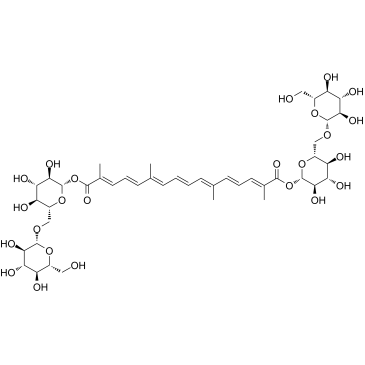
27876-94-4
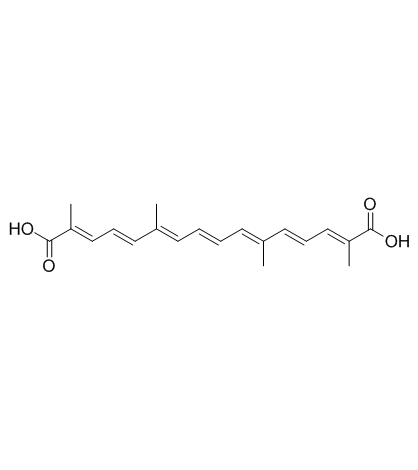
27876-94-4 structure
- Name: Croceic acid
- Chemical Name: Crocetin
- CAS Number: 27876-94-4
- Molecular Formula: C20H24O4
- Molecular Weight: 328.402
- Catalog: Biochemical Plant extracts
- Create Date: 2018-08-21 12:15:37
- Modify Date: 2026-06-30 18:06:00
-
Transcrocetin (trans-Crocetin), extracted from saffron (Crocus sativus L.), acts as an NMDA receptor antagonist with high affinity.
| Name | Crocetin |
|---|---|
| Synonyms |
2,4,6,8,10,12,14-Hexadecahtaenedioic acid, 2,6,11,15-tetramethyl-, (all-E)- (8CI)
8,8'-Diapo-y,y-carotenedioic Acid Crocetin (6CI) 8,8'-diapo-psi,psi-cotenedioic acid EINECS 248-708-0 trans-Crocetin roceic acid Stable crocetin Crocetin(stable) (2E,4E,6E,8E,10E,12E,14E)-2,6,11,15-Tetramethyl-2,4,6,8,10,12,14-hexadecaheptaenedioic acid Crocetin,trans-Crocetin TIANFU-8,8'-DIAPOCOTENEDIOIC ACID CROCETIN 2,6,11,15-TETRAMETHYLHEXADECA-2,4,6,8,10,12,14-HTAENEDOIC ACID (2E,4E,6E,8E,10E,12E,14E)-2,6,11,15-Tetramethylhexadeca-2,4,6,8,10,12,14-heptaenedioic acid 8,8'-Diapo-8,8'-carotenedioic acid 2,4,6,8,10,12,14-Hexadecahtaenedioic acid, 2,6,11,15-tetramethyl-, (2E,4E,6E,8E,10E,12E,14E) NSC407300 (2Z,4E,6Z,8E,10E,12E,14Z)-2,6,11,15-tetramethylhexadeca-2,4,6,8,10,12,14-htaenedioic acid 8,8'-Diapo-y,y-cotenedioic acid 8,8'-Diapo-ψ,ψ-cotene-8,8'-dioic acid CROCETIN, TRANS transcrocetin 8,8'-DIAPOCOTENEDIOIC trans-Crocetine α-Crocetin Alpha-Crocetin Transcrocetin (Synonyms: trans-Crocetin) carotenoid dicarboxylic acid 8,8'-Diapocarotene-8,8'-dioic acid all-trans-8,8'-diapocarotene-8,8'-dioic acid 8,8'-DIAPOCOTENEDIOIC ACID Natural yellow 6 8,8'-Diapocarotenedioic acid a-Crocetin FEMA 2998 |
| Description | Transcrocetin (trans-Crocetin), extracted from saffron (Crocus sativus L.), acts as an NMDA receptor antagonist with high affinity. |
|---|---|
| Related Catalog | |
| Target |
NMDA receptor[1] |
| In Vitro | Transcrocetin (trans-Crocetin), a saffron metabolite originating from the crocin apocarotenoids, has been shown to exert strong NMDA receptor affinity and is thought to be responsible for the CNS activity of saffron.To ensure unchanged viability of Caco-2 cells throughout the transport experiments, cellular mitochondrial dehydrogenase activity of Caco-2 cells is measured by MTT assay after a 24 h incubation period with the test compounds: Hydroalcoholic saffron extract saffron extract (SE, 0.5-1 mg/mL) and crocin-1 (250-1000 µM) reveal no negative significant changes in cellular viability. Transcrocetin at 10 µM level does not change viability while higher concentrations (40-160 µM) reduces significantly cellular viability[1]. |
| Cell Assay | Cytotoxicity of test compounds is determined by MTT assay using Caco-2 cells in 96 well plates at a density of 20.000 cells per well in 200 µl FBS-free medium, grown for 96 h and followed by 24 h contact time with the test compounds (100 µL of serum-free media containing SE 0.5, 1, and 2 mg/mL; trans-crocin-1 250, 500, and 1000 µM; Transcrocetin 10, 40, 80, and 160 µM) and incubation at 37°C/5% CO2. The incubation solutions are aspirated, each well is washed twice with 150 µL of PBS and 50 µL of MTT solution are added (2.5 mg/mL in PBS). Supernatants are discarded and the formed formazan is dissolved in 50 µL of DMSO. The absorption of the resulting solution is determined at λ=492 nm against reference wavelength λ=690 nm[1]. |
| References |
| Density | 1.1±0.1 g/cm3 |
|---|---|
| Boiling Point | 585.1±23.0 °C at 760 mmHg |
| Melting Point | 285° |
| Molecular Formula | C20H24O4 |
| Molecular Weight | 328.402 |
| Flash Point | 321.7±19.1 °C |
| Exact Mass | 328.167450 |
| PSA | 74.60000 |
| LogP | 4.72 |
| Vapour Pressure | 0.0±3.5 mmHg at 25°C |
| Index of Refraction | 1.559 |
| Storage condition | -20℃ |
|
~%
27876-94-4 |
| Literature: RIKEN VITAMIN CO., LTD. Patent: WO2004/78695 A1, 2004 ; Location in patent: Page 16 ; |
|
~%
27876-94-4 |
| Literature: Schwieter,U. et al. Helvetica Chimica Acta, 1971 , vol. 54, p. 2447 - 2459 |