107097-80-3
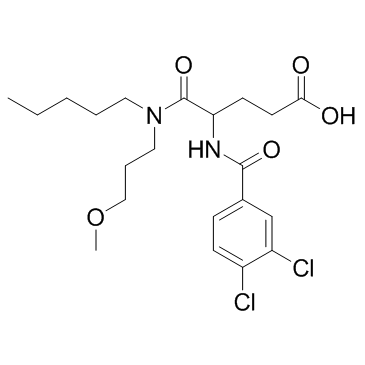
107097-80-3 structure
- Name: Loxiglumide
- Chemical Name: 4-[(3,4-dichlorobenzoyl)amino]-5-[3-methoxypropyl(pentyl)amino]-5-oxopentanoic acid
- CAS Number: 107097-80-3
- Molecular Formula: C21H30Cl2N2O5
- Molecular Weight: 461.37900
- Catalog: Signaling Pathways GPCR/G Protein Cholecystokinin Receptor
- Create Date: 2018-03-25 08:00:00
- Modify Date: 2026-07-01 17:06:35
-
Loxiglumide is a cholecystokinin (CCK-1) receptor antagonist.
| Name | 4-[(3,4-dichlorobenzoyl)amino]-5-[3-methoxypropyl(pentyl)amino]-5-oxopentanoic acid |
|---|---|
| Synonyms |
4-(3,4-Dichlorobenzamido)-5-((3-methoxypropyl)(pentyl)amino)-5-oxopentanoicacid
Pentanoic acid, 4-[(3,4-dichlorobenzoyl)amino]-5-[(3-methoxypropyl)pentylamino]-5-oxo pentanoicacid,4-((3,4-dichlorobenzoyl)amino)-5-((3-methoxypropyl)pentylamino) CR-1505 anoicacid 4-[(3,4-dichlorophenyl)cbonylamino]-5-[3-methoxypropyl(pentyl)amino]-5-oxo-pentanoic acid ntanoicacid 5-[amyl(3-methoxypropyl)amino]-4-[(3,4-dichlorobenzoyl)amino]-5-keto-valeric acid LoxigluMide (CR1505) (+-)-4-((3,4-dichlorobenzoyl)amino)-5-((3-methoxypropyl)pentylamino)-5-oxope cr1505 (+-)-5-oxo Loxiglumide >= (HPLC) 4-[(3,4-dichlorophenyl)formamido]-4-[(3-methoxypropyl)(pentyl)cbamoyl]butanoic acid Loxiglumide, 10 mM in DMSO Loxizin d,l-4-(3,4-dichlorobenzoylamino)-5-(n-3-methoxypropylpentylamino)-5-oxo-pent CR1505,CR 1505,CCK Rector,Inhibitor,Loxiglumide,inhibit,Cholecystokinin Rector LOXIGLUMIDE |
| Description | Loxiglumide is a cholecystokinin (CCK-1) receptor antagonist. |
|---|---|
| Related Catalog | |
| Target |
CCK-1 receptor[1] |
| In Vivo | The effects of pancreatic rest by oral administration of CCK-1 receptor antagonist Loxiglumide and pancreas stimulation are investigated via endogenous CCK release induced by po protease inhibitor camostat on the recovery of pancreatic secretory function, and biochemical and histological changes of the pancreas after acute hemorrhagic pancreatitis. Oral administration of CCK-1 receptor antagonist Loxiglumide with a dose of 50 mg/kg body weight inhibits pancreatic exocrine secretion for more than 12 h. Thus, every 12-h administration of Loxiglumide might have completely blocks the effect of endogenously released CCK on the pancreas (pancreatic rest)[1]. |
| Animal Admin | Rats[1] At 24 h after induction of acute hemorrhagic pancreatitis, rats are divided into four different treatment groups: standard rat chow (AP-C); standard rat chow with pancreatic rest (AP-R); standard rat chow with pancreatic stimulation (AP-S); and standard rat chow with pancreatic rest, followed by pancreatic stimulation (AP-R/S). Rats in the AP-C group receive 2 mL/kg body weight saline orally (po) via an orogastric tube twice daily (09:00 and 21:00 h) for 10 d; the AP-R group receive 50 mg/kg body weight of CCK-1 receptor antagonist Loxiglumide dissolved in 2 mL distilled water po twice daily for 10 d; the AP-S group receive 25 mg/kg body weight protease inhibitor Camostat, which is known to stimulate endogenous CCK release, dissolved in 2 mL distilled water po twice daily for 10 d; and the AP-R/S group receive 50 mg/kg body weight Loxiglumide twice daily for the first 5 d followed by 25 mg/kg body weight camostat twice daily for the next 5 d. Rats are fed ad libitum. On day 12 at 24 h after the last treatment and overnight fasting, pancreatic exocrine function and histological examination of the pancreas are performed. |
| References |
| Density | 1.233g/cm3 |
|---|---|
| Boiling Point | 632.2ºC at 760mmHg |
| Molecular Formula | C21H30Cl2N2O5 |
| Molecular Weight | 461.37900 |
| Flash Point | 336.1ºC |
| Exact Mass | 460.15300 |
| PSA | 95.94000 |
| LogP | 4.40280 |
| Appearance | off white solid |
| Vapour Pressure | 7.51E-17mmHg at 25°C |
| Index of Refraction | 1.537 |
| Storage condition | -20℃ |
CHEMICAL IDENTIFICATION
HEALTH HAZARD DATAACUTE TOXICITY DATA
|
| Symbol |

GHS07 |
|---|---|
| Signal Word | Warning |
| Hazard Statements | H302 |
| RIDADR | NONH for all modes of transport |
| HS Code | 2924299090 |
| HS Code | 2924299090 |
|---|---|
| Summary | 2924299090. other cyclic amides (including cyclic carbamates) and their derivatives; salts thereof. VAT:17.0%. Tax rebate rate:13.0%. . MFN tariff:6.5%. General tariff:30.0% |