22862-76-6
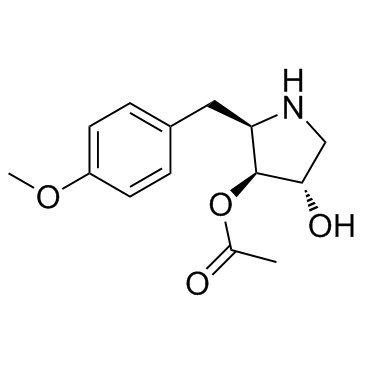
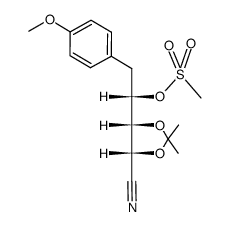
22862-76-6 structure
- Name: Anisomycin
- Chemical Name: (-)-anisomycin
- CAS Number: 22862-76-6
- Molecular Formula: C14H19NO4
- Molecular Weight: 265.305
- Catalog: API Antibiotics Other antibiotics
- Create Date: 2018-02-11 08:00:00
- Modify Date: 2026-07-03 16:39:11
-
Anisomycin is a potent protein synthesis inhibitor which interferes with protein and DNA synthesis by inhibiting peptidyl transferase or the 80S ribosome system.
| Name | (-)-anisomycin |
|---|---|
| Synonyms |
Nsc147340
(2R)-2α-(4-Methoxybenzyl)pyrrolidine-3α,4β-diol 3-acetate Anisomycin Anisomycin FLAGECIDIN;WUNINGMEISU C 2-P-METHOXYPHENYLMETHYL-3-ACETOXY-4-HYDROXYPYRROLIDINE Anisomycin (Synonyms: Flagecidin 3,4-Pyrrolidinediol, 2-(4-methoxyphenyl)methyl-, 3-acetate, (2R,3S,4S) Anisomycin,(2R,3S,4S)-2-[(4-Methoxyphenyl)methyl]-3,4-pyrrolidinediol3-acetate ANISOMYCIN, STRTOMYCES ISEOLUS Anisomycin, 10 mM in DMSO Aids-031977 2-((4-methoxyphenyl)methyl)-,3-acetate,(2r-(2-alpha,-pyrrolidinediol 2-[(4-Methoxyphenyl)methyl]-3,4-pyrrolidinediol-3-acetate Wuningmeisu C Anisomycin (Flagecidin (2R,3S,4S)-2-(4-METHOXYBENZYL)-3,4-PYRROLIDINEDOIL-3-ACETATE [2R-(2a,3a,4b)]-2-[(4-Methoxyphenyl)methyl]-3,4-pyrrolidinediol 3-Acetate ANISOMYCIN,STREPTOMYCES GRISEOLUS (2R,3S,4S)-2-(p-Methoxyphenylmethyl)-3-acetoxy-4-hydroxypyrrolidine 2-(p-methoxybenzyl)-,3-acetate,(2s,3r,4r)-4-pyrrolidinediol Anisomycin, Strtomyces iseolus - - Calbiochem (2R,3S,4S)-2-(p-Methoxybenzyl)-3,4-pyrrolidinediol 3-acetate MFCD00077650 (2R,3S,4S)-2-[(4-METHOXYPHENYL)METHYL]-3,4-PYRROLIDINEDIOL 3-ACETATE fromStrtomycesiseolus (2S,3R,4R)-2-(4-methoxybenzyl)-4-hydroxypyrrolidin-3-yl acetate D-xylo-Pentitol, 1,4,5-trideoxy-1,4-imino-5-(4-methoxyphenyl)-, 3-acetate Anisomycin> (2R,3S,4S)-4-hydroxy-2-(4-Methoxybenzyl)pyrrolidin-3-yl acetate (2R,3S,4S)-2-(4-METHOXYBENZYL)-3,4-PYRROLIDINEDIOL-3-ACETATE Anisomycin, Ready Made Solution from Strtomyces iseolus (2S,3R,4R)-4-Hydroxy-2-(4-methoxybenzyl)-3-pyrrolidinyl acetate Flagecidin, SA 3097C1, PA 106, Anhydroscopin A, NSC Aids031977 4-beta))-alph Acetic acid (2R)-4β-hydroxy-2-(4-methoxybenzyl)pyrrolidin-3α-yl ester antibiotia-106 ANISOMYCIN //BP Anisomycin from Streptomyces griseolus Anisomycin (from Strtomyces iseolus) (HPLC) 2-p-methoxyphenylmethyl-3-acetoxy-4-hydroxypyrrolidine Anisomycin (NSC-76712, AI 46, Flagecidin, Wuningmeisu C) 2-(P-METHOXYBENZYL)-3,4-PYRROLIDINEDIOL-3-ACETATE NSC 76712 Anisomycin Flagecidin antibioticpa-106 Nsc76712 (2S,3R,4R)-4-Hydroxy-2-(4-methoxybenzyl)pyrrolidin-3-yl acetate Anisomycin from Strtomyces iseolus ANISOMYCIN 1,4-Imino-5-(4-methoxyphenyl)1,4,5-trideoxy-D-xylo-pentitol 3-acetate EINECS 245-269-7 Anisomycin, (HPLC) Anisomycin, Protein synthesis inhibitor FLAGECIDIN 1,4,5-trideoxy-1,4-imino-5-(p-methoxyphenyl)-D-xylo-pentitol 3-acetate (2R,3S,4S)-2-(4-Methoxybenzyl)-3,4-pyrrolidinediol 3-Acetate |
| Description | Anisomycin is a potent protein synthesis inhibitor which interferes with protein and DNA synthesis by inhibiting peptidyl transferase or the 80S ribosome system. |
|---|---|
| Related Catalog | |
| Target |
DNA synthesis[1] |
| In Vitro | To examine whether JNK has a core role in colistin-induced neurotoxicity in PC-12 cells, an SP600125 (a highly selective inhibitor of JNK) and Anisomycin (a potent activator) are used in this study. In order to select an appropriate concentration, PC-12 cells are treated with a range of SP600125 (0-80 μM) and Anisomycin (0-20 μM) respectively for 24 h. The results show that the cells viability significantly decreases by SP600125 treatment in a concentration-dependent manner, observed at the concentrations greater than 20 μM (p<0.01). Similarly the cells viability is inhibited by Anisomycin treatment (≥8 μM) (p<0.05) [1]. |
| In Vivo | Disruption of TNFRp55/p75 attenuates Anisomycin-induced ventricular functional improvements. Anisomycin results in an improvement in left ventricular developed pressure (LVDP), which disappears in animals with disruption of TNFR p55/p75. In addition, the Anisomycin-induced improvement in LVEDP in wild-type animals is eliminated by deletion of TNFR p55/p75. Likewise, disruption of TNFR p55/p75 abrogates the recovery of rate pressure product (RPP) elicited by pretreatment of Anisomycin. TNFR p55/p75-/- mice without Anisomycin treatment do not show differences in cardiac functional recovery compared with the control wild-type mice. There are no significant differences in heart rate between wild-type and TNFR p55/p75-deficient mice. To see whether Nox2 is involved in Anisomycin-induced myocardial protection, Nox2-deficient mice are treated with Anisomycin. The improvement in the LVEDP in Anisomycin-treated mice is eliminated in Nox2-/- mice compared with wild-type mice. In addition, recovery of RPP in wild-type mice treated with Anisomycin is mitigated in Nox2-/- mice. Nox2-/- mice without Anisomycin treatment do not show the difference in cardiac functional recovery compared with wild-type control mice[2]. |
| Cell Assay | PC-12 cells are seeded in 96-well plates at a concentration of 1×10⁴ cells/well and cultured in an incubator at 37°C with 5% CO2 for at least 12 h prior to exposure to different concentrations of SP600125 (0-80 μM) or Anisomycin (0-20 μM) for 24 h. Subsequently, the culture medium is added to 20 μL of 5 mg/mL MTT working solution and the plate is incubated for 2 h at 37°C. The culture supernatant is removed and the formazan crystals are dissolved in 150 μL DMSO. Finally, the absorbance of each well is measured at 490 nm by a microplate reader. Cell viability is expressed as the percentage of the control group, which is set to 100%[1]. |
| Animal Admin | Mice[2] Adult male TNFRp55/p75 mice, adult male wild-type C57/BL and homozygous Nox2-/- mice are used in this study. Mice are randomized into six experimental groups that undergo the following treatments,. Animals are divided into six groups: group 1: control ischemia/reperfusion, wild-type mice are injected with DMSO (0.1 mL); group 2: Anisomycin+wild-type mice, wild-type mice are injected with Anisomycin (0.1 mg/kg ip); group 3: Anisomycin+TNFR p55/p75-/- mice, TNFR p55/75-/- mice are injected with Anisomycin (0.1 mg/kg ip); group 4: TNFR p55/p75-/- mice, TNFR p55/75-/- mice are not injected with Anisomycin; group 5: Anisomycin+Nox2-/- mice, Nox2-/- mice are injected with Anisomycin (0.1 mg/kg ip); and group 6: Nox2-/- mice, Nox2-/- mice are not injected with Anisomycin. Later (24 h), the hearts are subjected to 30 min of ischemia followed by 30 min of reperfusion[2]. |
| References |
| Density | 1.2±0.1 g/cm3 |
|---|---|
| Boiling Point | 398.7±42.0 °C at 760 mmHg |
| Melting Point | 140-141ºC |
| Molecular Formula | C14H19NO4 |
| Molecular Weight | 265.305 |
| Flash Point | 194.9±27.9 °C |
| Exact Mass | 265.131409 |
| PSA | 67.79000 |
| LogP | 0.42 |
| Vapour Pressure | 0.0±1.0 mmHg at 25°C |
| Index of Refraction | 1.558 |
CHEMICAL IDENTIFICATION
HEALTH HAZARD DATAACUTE TOXICITY DATA
|
| Symbol |

GHS06 |
|---|---|
| Signal Word | Danger |
| Hazard Statements | H301 |
| Precautionary Statements | P301 + P310 |
| Personal Protective Equipment | Eyeshields;Faceshields;Gloves;type P2 (EN 143) respirator cartridges |
| Hazard Codes | T: Toxic; |
| Risk Phrases | R25 |
| Safety Phrases | 45-36-26 |
| RIDADR | UN 3462 6 |
| WGK Germany | 3 |
| RTECS | BZ9800000 |
| Packaging Group | III |
| Hazard Class | 6.1(b) |
| HS Code | 2933990090 |
| Precursor 6 | |
|---|---|
| DownStream 0 | |


| HS Code | 2933990090 |
|---|---|
| Summary | 2933990090. heterocyclic compounds with nitrogen hetero-atom(s) only. VAT:17.0%. Tax rebate rate:13.0%. . MFN tariff:6.5%. General tariff:20.0% |