135042-12-5

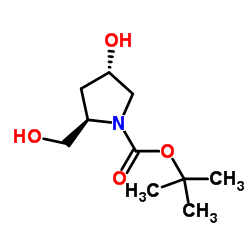
135042-12-5 structure
- Name: N-Boc-cis-4-Hydroxy-D-proline
- Chemical Name: Boc-Cis-4-Hydroxy-D-Proline
- CAS Number: 135042-12-5
- Molecular Formula: C10H17NO5
- Molecular Weight: 231.246
- Catalog: Biochemical Amino acids and their derivatives Proline derivatives
- Create Date: 2018-12-28 14:27:53
- Modify Date: 2026-06-30 18:10:41
-
N-Boc-cis-4-Hydroxy-D-proline is a non-cleavable ADC linker used in the synthesis of antibody-drug conjugates (ADCs). N-Boc-cis-4-Hydroxy-D-proline is also a alkyl chain-based PROTAC linker that can be used in the synth
| Name | Boc-Cis-4-Hydroxy-D-Proline |
|---|---|
| Synonyms |
N-BOC-CIS-6-HYDROXY-D-PROLINE
(2R,4R)-N-Boc-4-hydroxypyrrolidine-2-cboxylic acid //BP N-Boc-cis-D-Hyp-OH 1-(1,1-Dimethylethyl) (2R,4R)-4-hydroxy-1,2-pyrrolidinedicboxylate (4R)-4-Hydroxy-1-{[(2-methyl-2-propanyl)oxy]carbonyl}-D-proline N-T-BOC-CIS-4-HYDROXY-D-PROLINE (2R,4R)-1-BOC-4-Hydroxy-pyrrolidine-2-cboxylic acid (2R,4R)-N-ALPHA-T-BUTOXYCBONYL-4-HYDROXYPYRROLIDINE-2-CBOXYLIC ACID Boc-cis-D-Hyp-OH (2R,4R)-N-Boc-cis-4-hydroxy-D-proline (4R)-1-(tert-Butoxycbonyl)-4-hydroxy-D-proline (2R,4R)-N-BOC-4-HYDROXY-D-PROLINE cis-N-Boc-4-hydroxy-D-proline N-α-(t-Butoxycbonyl)-cis-4-hydroxy-D-proline (2R,4R)-1-tert-Butoxycbonyl-4-hydroxypyrrolidine-2-cboxylic acid (2R,4R)-4-Hydroxypyrrolidine-1,2-dicboxylic acid 1-tert-butyl ester N-Boc-cis-4-hydroxy- D -proline (2R,4R)N-Boc-trans-4-hydroxy-D-proline (2R,4R)-1-(tert-Butoxycarbonyl)-4-hydroxypyrrolidine-2-carboxylic acid (2r,4r)-n-boc-4-hydroxypyrrolidine-2-cboxylic acid (4S)-4-Hydroxy-1-{[(2-methyl-2-propanyl)oxy]carbonyl}-L-proline 1,2-Pyrrolidinedicboxylic acid, 4-hydroxy-, 1-(1,1-diMethylethyl) ester, (2R,4R) N-Boc-D-cis-Hyp-OH (Tert-Butoxy)carbonyl cis-D-Hyp-OH ATTERCOP-CHM AT700573 (2R,4R)-4-hydroxy-1-[(2-methylpropan-2-yl)oxycarbonyl]pyrrolidine-2-carboxylic acid (2R,4R)-N-Boc-4-hydroxy-2-pyrrolidinecarboxylic acid BOC-CIS-4-HYDROXY-D-PROLINE BOC-D-CISHYP-OH cis-Boc-D-Hyp-OH N-ALPHA-BUTOXYCBONYL-CIS-4-HYDROXY-D-PROLINE N-BOC-CIS-4-HYDROXY-D-PROLINE Boc-cis-4-hydroxy-D-proL 1,2-Pyrrolidinedicboxylic acid, 4-hydroxy-, 1-(1,1-diMethylethyl) ester, (2R-cis) cis-N-(tert-Butoxycbonyl)-4-hydroxy-D-proline (2R,4R)-N-Boc-4-hydroxy-2-pyrrolidinecboxylic acid MFCD02094407 BOC-(2R,4R)-(+)-4-HYDROXYPYRROLIDINE-2-CBOXYLIC ACID |
| Description | N-Boc-cis-4-Hydroxy-D-proline is a non-cleavable ADC linker used in the synthesis of antibody-drug conjugates (ADCs). N-Boc-cis-4-Hydroxy-D-proline is also a alkyl chain-based PROTAC linker that can be used in the synth |
|---|---|
| Related Catalog | |
| Target |
Non-cleavable |
| In Vitro | ADCs are comprised of an antibody to which is attached an ADC cytotoxin through an ADC linker[1]. PROTACs contain two different ligands connected by a linker; one is a ligand for an E3 ubiquitin ligase and the other is for the target protein. PROTACs exploit the intracellular ubiquitin-proteasome system to selectively degrade target proteins[2]. |
| References |
| Density | 1.3±0.1 g/cm3 |
|---|---|
| Boiling Point | 390.9±42.0 °C at 760 mmHg |
| Melting Point | 145ºC |
| Molecular Formula | C10H17NO5 |
| Molecular Weight | 231.246 |
| Flash Point | 190.2±27.9 °C |
| Exact Mass | 231.110672 |
| PSA | 87.07000 |
| LogP | -0.71 |
| Vapour Pressure | 0.0±2.0 mmHg at 25°C |
| Index of Refraction | 1.531 |
| Storage condition | 2-8°C |
| Symbol |

GHS07 |
|---|---|
| Signal Word | Warning |
| Hazard Statements | H319 |
| Precautionary Statements | P305 + P351 + P338 |
| Hazard Codes | Xi |
| Risk Phrases | 36 |
| Safety Phrases | 26 |
| RIDADR | NONH for all modes of transport |
| HS Code | 2933990090 |
| Precursor 9 | |
|---|---|
| DownStream 8 | |



| HS Code | 2933990090 |
|---|---|
| Summary | 2933990090. heterocyclic compounds with nitrogen hetero-atom(s) only. VAT:17.0%. Tax rebate rate:13.0%. . MFN tariff:6.5%. General tariff:20.0% |