87205-99-0
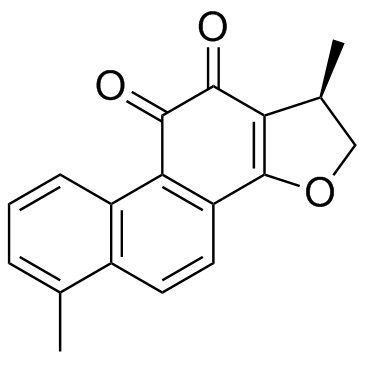
87205-99-0 structure
- Name: Dihydrotanshinone I
- Chemical Name: (1R)-1,6-dimethyl-1,2-dihydronaphtho[1,2-g][1]benzofuran-10,11-dione
- CAS Number: 87205-99-0
- Molecular Formula: C18H14O3
- Molecular Weight: 278.302
- Catalog: Natural product Moss
- Create Date: 2018-02-18 08:00:00
- Modify Date: 2026-06-30 16:49:11
-
Dihydrotanshinone I is a natural compound extracted from Salvia miltiorrhiza Bunge which has been widely used for treating cardiovascular diseases.
| Name | (1R)-1,6-dimethyl-1,2-dihydronaphtho[1,2-g][1]benzofuran-10,11-dione |
|---|---|
| Synonyms |
1,6-Dimethyl-1,2-dihydrophenanthro[1,2-b]furan-10,11-dione
1,2-dihydrotanshinone Tanshinone I,dihydro dihydrotanshinone 1 1,2-dihydrotanshinone I 15,16-dihydrotanshinone I Dihydrotanshinone I |
| Description | Dihydrotanshinone I is a natural compound extracted from Salvia miltiorrhiza Bunge which has been widely used for treating cardiovascular diseases. |
|---|---|
| Related Catalog | |
| In Vitro | In lipopolysaccharide (LPS)-stimulated human umbilical vein endothelial cells (HUVECs), DHT (10 nM) decreases lectin-like ox-LDL receptor-1 (LOX-1) and NADPH oxidase 4 (NOX4) expression, reactive oxygen species (ROS) production, NF-κB nuclear translocation, ox-LDL endocytosis and monocytes adhesion[1]. Dihydrotanshinone I induces caspase dependent apoptosis induced in HCT116 cells. Dihydrotanshinone I induces concentration and ROS dependent caspase activation. Apoptosis induced by Dihydrotanshinone I is completely prevented by Z-VAD-fmk. Apoptosis induced by Dihydrotanshinone I is significantly inhibited by pretreatment of Z-LEHD-fmk but only is partially inhibited by Z-IETD-fmk. Apoptosis induced by Dihydrotanshinone I is significantly increased by caspase-2 knockdown[3]. |
| In Vivo | DHT (10 and 25 mg/kg) significantly attenuates atherosclerotic plaque formation, alteres serum lipid profile, decreases oxidative stress and shrinks necrotic core areas in ApoE-/- mice. DHT dramatically inhibits the enhanced expression of LOX-1, NOX4, and NF-κB in aorta[1]. Dihydrotanshinone I (1, 2, 4 mg/kg) treatment can improve cardiac function, reduce infarct size, ameliorate the variations in myocardial zymogram and histopathological disorders, decrease 20-HETE generation, and regulate apoptosis-related protein in myocardial ischemia-reperfusion rats[2]. |
| Kinase Assay | Cells are treated with various concentrations of Dihydrotanshinone I (3.13-20 µM) for 48 h. For the activity assay, Ac-DEVD-AMC (1 µg/µL), Ac-IETD-AMC (1 µg/µL) or Ac-LEDH-AMC (1 µg/µL) and cell lysate are added into Protease Assay Buffer in 96-well plate. Reaction mixtures with lysis buffer are used as negative controls. Cells treated with DMSO (0.1%) are treated as vehicle control. The reaction mixtures are incubated for 1 h at 37°C. The AMC liberated from the substrates is measured using spectrofluorometer of Victor 2 plate reader with an excitation wavelength of 380 nm and an emission wavelength of 430 nm. |
| Animal Admin | Male ApoE-/- mice (6-8 weeks old) on C57BL/6J background and age-matched wild-type C57BL/6J controls housed in SPF-grade animal facilities with a 12 h light/dark cycle, at 23°C (±2°C). Starting from 6 weeks, the mice are fed with a HCD (54.35% raw grain, 20% lard, 0.15% cholesterol, 15% sucrose, 0.5% Sodium Cholate, 10% yolk powder) for 12 weeks. All ApoE-/- mice are dosed daily via intragastric gavage with 10 and 25 mg/kg Dihydrotanshinone I dissolved in 0.5% CMC-Na or administered 0.5% CMC-Na alone (vehicle control) (n=8 per group). |
| References |
| Density | 1.3±0.1 g/cm3 |
|---|---|
| Boiling Point | 479.2±45.0 °C at 760 mmHg |
| Melting Point | 214.0 to 218.0 °C |
| Molecular Formula | C18H14O3 |
| Molecular Weight | 278.302 |
| Flash Point | 214.9±28.8 °C |
| Exact Mass | 278.094299 |
| PSA | 43.37000 |
| LogP | 3.90 |
| Appearance | red |
| Vapour Pressure | 0.0±1.2 mmHg at 25°C |
| Index of Refraction | 1.671 |
| Storage condition | 2-8°C |
| Water Solubility | ethanol: soluble1mg/mL, clear, orange to red |
| Symbol |


GHS07, GHS09 |
|---|---|
| Signal Word | Warning |
| Hazard Statements | H302-H400 |
| Precautionary Statements | P273 |
| Hazard Codes | Xn,N |
| Risk Phrases | 22-50 |
| Safety Phrases | 61 |
| RIDADR | UN 3077 9 / PGIII |
| RTECS | SF8282630 |