770-05-8
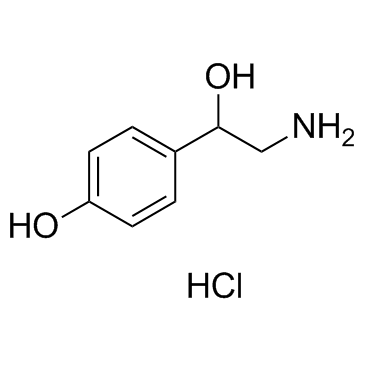
770-05-8 structure
- Name: Octopamine hydrochloride
- Chemical Name: Octopamine hydrochloride
- CAS Number: 770-05-8
- Molecular Formula: C8H12ClNO2
- Molecular Weight: 189.639
- Catalog: Biochemical Chinese herbal medicine ingredients
- Create Date: 2018-03-08 08:00:00
- Modify Date: 2026-07-23 17:06:54
-
Octopamine Hydrochloride is an endogenous biogenic amine that is closely related to norepinephrine, and has effects on the adrenergic and dopaminergic systems.Target: Dopamine Receptor; Adrenergic ReceptorOctopamine is present in relatively high concentrations in neuronal as well as in non-neuronal tissues of most invertebrate species studied, and modulates almost every physiological process. Octopamine acts as neurohormone including desensitization of sensory inputs, influence on learning and memory, or regulation of the mood of the animal in the central nervous system. Octopamine is the only neuroactive non-peptide transmitter whose physiological role is restricted to invertebrates, and all octopamine receptors belong to the family of G-protein coupled receptors [1].Octopamine (10 μM) injected into the mushroom body (MB) calyces or the antennal lobe but not the lateral protocerebral lobe produces a lasting, pairing-specific enhancement of extension of the proboscis. Octopamine (10 μM) injected into the MB calyces results in an additional pairing-specific effect, because it does not lead to an acquisition but a consolidation after conditioning [2]. Octopamine treatment significantly elevates levels of octopamine in the brain and caused a significant dose-dependent increase in the number of new foragers. Octopamine treatment is effective only when given to bees old enough to forage, i.e., older than 4 days of age. Octopamine influences division of labor in honey bee colonies [3].
| Name | Octopamine hydrochloride |
|---|---|
| Synonyms |
1-[P-HYDROXYPHENYL]-2-AMINOETHANOL HCL
4-(2-amino-1-hydroxyethyl)phenol hydrochloride OCTOPAMINE HYDROCHLORIDE UNII:37YAS5L9HQ (+)p-octopaMine hydrochloride P-(+/-)-ALPHA-(AMINOMETHYL)HYDROXYBENZYL ALCOHOL, HCL MFCD00012881 4-(2-Amino-1-hydroxyethyl)phenol hydrochloride (1:1) (+/-)-Octopamine hydrochloride Benzenemethanol, .alpha.-(aminomethyl)-4-hydroxy-, hydrochloride, (.+-.) DL-α-(aminomethyl)-p-hydroxybenzylic alcohol hydrochloride OCTAPAMINE HCL dl-irenor hydrochlor DL-Octopamine hydrochloride (±)-p-OctopaMine-a,-d3 HCl DL-alpha-(aminomethyl)-p-hydroxybenzylic alcohol hydrochloride (+/-)-1-(4-HYDROXYPHENYL)-2-AMINOETHANOL HYDROCHLORIDE (±)-1-(4-Hydroxyphenyl)-2-amino-ethanol hydrochloride dl-octopamine OCTOPAMINE HCL Octopamine hydrochloride, 10 mM in DMSO Octopamine hydrochloride, beta3 agonist: invertebrate biogenic amine 4-(2-Amino-1-hydroxyethyl)phenol hydrochloride 1-[P-HYDROXYPHENYL]-2-AMINOETHANOL HYDROCHLORIDE (±)-p-Octopamine hydrochlorid dl-alpha-(aminomethyl)-4-hydroxybenzyl alcohol hydrochloride DL-1-(4-HYDROXYPHENYL)-2-AMINOETHANOL HYDROCHLORIDE (+,-)-Octopamine HCl Octopamine hydrochloride min Benzyl alcohol, .alpha.-(aminomethyl)-p-hydroxy-, hydrochloride, (.+-.) DL-Octapamine hydrochloride (±)-pa-Octopamine (hydrochloride) alpha-(Aminomethyl)-p-hydroxybenzylic alcohol hydrochloride OCTOPAMINE HCL(RG) (±)-Octopamine hydrochloride EINECS 212-216-4 4-(2-Amino-1-hydroxyethyl)phenol HCl P-HYDROXYPHENYLAMINOETHANOL HYDROCHLORIDE OCTOPAMINE HCL(P) (±)-Octopamine hydrochloride in Methanol (+/-)-p-OctopaMaine-Hydrochloride DL-Octopamine hydrochloride //BP (±)-Octopamine hydrochloride,α-(Aminomethyl)-4-hydroxybenzyl alcohol hydrochloride, (±)-1-(4-Hydroxyphenyl)-2-amino-ethanol hydrochloride Octopamine(Norsynhrine) Benzenemethanol, α-(aminomethyl)-4-hydroxy-, hydrochloride (1:1) Chapter hydrochloride DL-OCTOPAMINE HYDROCHLORIDE (±)-1-(4-Hydroxyphenyl)-2-amino alpha-(Aminomethyl)-4-hydroxybenzyl Alcohol Hydrochloride Octopamine (hydrochloride) ALPHA-(AMINOMETHYL)-4-HYDROXYBENZENEMETHANOL HYDROCHLORIDE DL-Octopamine hydrochloride (HPLC,anhydrous basis) OctopaMinehydrochlorid α-(Aminomethyl)-4-hydroxybenzyl alcohol hydrochloride, (±)-1-(4-Hydroxyphenyl)-2-aminoethanol hydrochloride (+/-)-Octopamine hydrochloride analytical standd DL-A-(AMINOMETHYL)-P-HYDROXYBENZYL ALCOHOL HYDROCHLORIDE OctopaMine HCl Min Octopamine HCL ChapteraMine hydrochloride 2H4]-(±)-Octopamine hydrochloride salt DL-Octopaminehydroc |
| Description | Octopamine Hydrochloride is an endogenous biogenic amine that is closely related to norepinephrine, and has effects on the adrenergic and dopaminergic systems.Target: Dopamine Receptor; Adrenergic ReceptorOctopamine is present in relatively high concentrations in neuronal as well as in non-neuronal tissues of most invertebrate species studied, and modulates almost every physiological process. Octopamine acts as neurohormone including desensitization of sensory inputs, influence on learning and memory, or regulation of the mood of the animal in the central nervous system. Octopamine is the only neuroactive non-peptide transmitter whose physiological role is restricted to invertebrates, and all octopamine receptors belong to the family of G-protein coupled receptors [1].Octopamine (10 μM) injected into the mushroom body (MB) calyces or the antennal lobe but not the lateral protocerebral lobe produces a lasting, pairing-specific enhancement of extension of the proboscis. Octopamine (10 μM) injected into the MB calyces results in an additional pairing-specific effect, because it does not lead to an acquisition but a consolidation after conditioning [2]. Octopamine treatment significantly elevates levels of octopamine in the brain and caused a significant dose-dependent increase in the number of new foragers. Octopamine treatment is effective only when given to bees old enough to forage, i.e., older than 4 days of age. Octopamine influences division of labor in honey bee colonies [3]. |
|---|---|
| Related Catalog | |
| References |
[1]. Roeder, T., Octopamine in invertebrates. Prog Neurobiol, 1999. 59(5): p. 533-61. |
| Boiling Point | 360.7ºC at 760 mmHg |
|---|---|
| Melting Point | ~170 °C (dec.)(lit.) |
| Molecular Formula | C8H12ClNO2 |
| Molecular Weight | 189.639 |
| Flash Point | 172ºC |
| Exact Mass | 189.055649 |
| PSA | 66.48000 |
| LogP | 1.88660 |
| Storage condition | Desiccate at RT |
| Stability | Stable. |
| Water Solubility | soluble |
| Symbol |

GHS07 |
|---|---|
| Signal Word | Warning |
| Hazard Statements | H302 + H312 + H332 |
| Precautionary Statements | P280 |
| Personal Protective Equipment | dust mask type N95 (US);Eyeshields;Gloves |
| Hazard Codes | Xn:Harmful |
| Risk Phrases | R20/21/22 |
| Safety Phrases | S36 |
| RIDADR | 3249 |
| WGK Germany | 3 |
| Packaging Group | III |
| Hazard Class | 6.1(b) |
| HS Code | 2922199090 |
| Precursor 0 | |
|---|---|
| DownStream 2 | |


| HS Code | 2922199090 |
|---|---|
| Summary | 2922199090. other amino-alcohols, other than those containing more than one kind of oxygen function, their ethers and esters; salts thereof. VAT:17.0%. Tax rebate rate:13.0%. . MFN tariff:6.5%. General tariff:30.0% |