Top Suppliers:I want be here


84-65-1

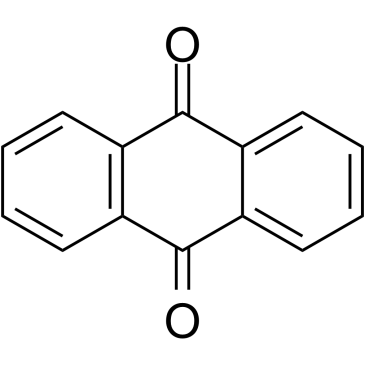
84-65-1 structure
84-65-1 structure
  • Name: Anthraquinone
  • Chemical Name: 9,10-anthraquinone
  • CAS Number: 84-65-1
  • Molecular Formula: C14H8O2
  • Molecular Weight: 208.212
  • Catalog: Organic raw materials Terpenoid
  • Create Date: 2018-02-06 08:00:00
  • Modify Date: 2026-07-02 11:56:57
  • Anthraquinone is used as a precursor for dye formation.

Name 9,10-anthraquinone
Synonyms Anthracene-9,10-quinone
anthraquinone (bsi,e-iso,f-iso)
GAUCHO BLE
9,10-ANTHRAQUINONE
2,6-dimethyl-4-(3-methylphenyl)-1,4-dihydropyridine-3,5-dicboxylic acid dimethyl ester
ANTHRAQUINONE, ANTHRAQUINONE, ANTHRAQUINONE
Anthradione
MELTING POINT STANDD ANTHRAQUINONE
CORBIT
ALPHA RAXIL CA
ANTHRAQUINONE(RG)
ANTHRAQUINONELAXATIVES
9,10-DIHYDRO-9,10-ANTHRACENEDIONE
anthracene-9,10(8aH,10aH)-dione
9,10(9H,10H)-anthracenedione
Kawasaki AQ
Dihydrodiketoanthracene
Anthracene, 9,10-dihydro-9,10-dioxo
9,10-anthracenequinone
Hoelite
Anthraquinone(AQ)
ANTHRAQUINONE PESTANAL
MORKIT
EINECS 201-549-0
Anthracenedione
ANTHRAQUINONE FOR SYMTHESIS
9,10-dihydro-9,10-dioxoanthracene
9,10-Dioxoanthracene 9,10-Anthraquinone
Ordinyanthraquinone
ANTHRAQUINONE
9,10-dihydro-9,10-dioxo-anthracen
anthrachinone
9,10-anthracenedione
9,10-DIOXOANTHRACENE
ANTHRAQUINONE G
anthracene-9,10-dione
Anthraquinone Vetec(TM) ade
MFCD00001188
9,10-dihydro-9,10-diketoanthracene
'L'
9,10-ANTHRAQUINONE,M, NEAT
9,10-Anthracenedione
9,10-Anthrachinon
Anthrachinon
Anthraquinone, ade
Anthraquinone, synthesis ade
anthraquinone
Anthra-9,10-quinone
Anthraquinone;9,10-Dioxoanthracene
CORBIT(R)
Anthraquinone P.A
Melting point standd .C
Description Anthraquinone is used as a precursor for dye formation.
Related Catalog
Density 1.3±0.1 g/cm3
Boiling Point 377.0±12.0 °C at 760 mmHg
Melting Point 284-286 °C(lit.)
Molecular Formula C14H8O2
Molecular Weight 208.212
Flash Point 141.4±16.6 °C
Exact Mass 208.052429
PSA 34.14000
LogP 3.38
Vapour density 7.16 (vs air)
Vapour Pressure 0.0±0.9 mmHg at 25°C
Index of Refraction 1.659
Stability Stable. Incompatible with strong oxidizing agents. Combustible.
Water Solubility <0.1 g/100 mL at 23 ºC

CHEMICAL IDENTIFICATION

RTECS NUMBER :
CB4725000
CHEMICAL NAME :
Anthraquinone
CAS REGISTRY NUMBER :
84-65-1
LAST UPDATED :
199712
DATA ITEMS CITED :
20
MOLECULAR FORMULA :
C14-H8-O2
MOLECULAR WEIGHT :
208.22
WISWESSER LINE NOTATION :
L C666 BV IVJ

HEALTH HAZARD DATA

ACUTE TOXICITY DATA

TYPE OF TEST :
LDLo - Lowest published lethal dose
ROUTE OF EXPOSURE :
Oral
SPECIES OBSERVED :
Rodent - rat
DOSE/DURATION :
15 gm/kg
TOXIC EFFECTS :
Details of toxic effects not reported other than lethal dose value
TYPE OF TEST :
LC50 - Lethal concentration, 50 percent kill
ROUTE OF EXPOSURE :
Inhalation
SPECIES OBSERVED :
Rodent - rat
DOSE/DURATION :
>1300 mg/m3/4H
TOXIC EFFECTS :
Details of toxic effects not reported other than lethal dose value
TYPE OF TEST :
LD50 - Lethal dose, 50 percent kill
ROUTE OF EXPOSURE :
Administration onto the skin
SPECIES OBSERVED :
Rodent - rat
DOSE/DURATION :
>1 gm/kg
TOXIC EFFECTS :
Details of toxic effects not reported other than lethal dose value
TYPE OF TEST :
LD50 - Lethal dose, 50 percent kill
ROUTE OF EXPOSURE :
Intraperitoneal
SPECIES OBSERVED :
Rodent - rat
DOSE/DURATION :
3500 mg/kg
TOXIC EFFECTS :
Details of toxic effects not reported other than lethal dose value
TYPE OF TEST :
LD50 - Lethal dose, 50 percent kill
ROUTE OF EXPOSURE :
Oral
SPECIES OBSERVED :
Rodent - mouse
DOSE/DURATION :
>5 gm/kg
TOXIC EFFECTS :
Details of toxic effects not reported other than lethal dose value
TYPE OF TEST :
LD50 - Lethal dose, 50 percent kill
ROUTE OF EXPOSURE :
Unreported
SPECIES OBSERVED :
Bird - quail
DOSE/DURATION :
>2 gm/kg
TOXIC EFFECTS :
Details of toxic effects not reported other than lethal dose value
TYPE OF TEST :
TDLo - Lowest published toxic dose
ROUTE OF EXPOSURE :
Oral
SPECIES OBSERVED :
Rodent - rat
DOSE/DURATION :
164 mg/kg/13W-C
TOXIC EFFECTS :
Liver - changes in liver weight Kidney, Ureter, Bladder - changes in bladder weight Nutritional and Gross Metabolic - weight loss or decreased weight gain
TYPE OF TEST :
TDLo - Lowest published toxic dose
ROUTE OF EXPOSURE :
Oral
SPECIES OBSERVED :
Rodent - rat
DOSE/DURATION :
12200 mg/m3/5H/17W-I
TOXIC EFFECTS :
Lungs, Thorax, or Respiration - emphysema Blood - pigmented or nucleated red blood cells Nutritional and Gross Metabolic - weight loss or decreased weight gain
TYPE OF TEST :
TDLo - Lowest published toxic dose
ROUTE OF EXPOSURE :
Oral
SPECIES OBSERVED :
Rodent - mouse
DOSE/DURATION :
328 mg/kg/13W-C
TOXIC EFFECTS :
Liver - other changes Liver - changes in liver weight Kidney, Ureter, Bladder - other changes
TYPE OF TEST :
DNA damage

MUTATION DATA

TYPE OF TEST :
Micronucleus test
TEST SYSTEM :
Rodent - hamster Embryo
DOSE/DURATION :
12500 ug/L
REFERENCE :
MUREAV Mutation Research. (Elsevier Science Pub. B.V., POB 211, 1000 AE Amsterdam, Netherlands) V.1- 1964- Volume(issue)/page/year: 392,61,1997 *** OCCUPATIONAL EXPOSURE LIMITS *** OEL-RUSSIA:STEL 5 mg/m3 JAN 1993 *** NIOSH STANDARDS DEVELOPMENT AND SURVEILLANCE DATA *** NIOSH OCCUPATIONAL EXPOSURE SURVEY DATA : NOHS - National Occupational Hazard Survey (1974) NOHS Hazard Code - 81710 No. of Facilities: 81 (estimated) No. of Industries: 4 No. of Occupations: 8 No. of Employees: 2202 (estimated) NOES - National Occupational Exposure Survey (1983) NOES Hazard Code - 81710 No. of Facilities: 435 (estimated) No. of Industries: 5 No. of Occupations: 7 No. of Employees: 6187 (estimated) No. of Female Employees: 1602 (estimated)
Symbol GHS07
GHS07
Signal Word Warning
Hazard Statements H317
Precautionary Statements P280
Personal Protective Equipment dust mask type N95 (US);Eyeshields;Faceshields;Gloves
Hazard Codes Xi:Irritant
Risk Phrases R36/37/38;R43
Safety Phrases S36/37-S37/39-S26-S24
RIDADR NONH for all modes of transport
WGK Germany 1
RTECS CB4725000
HS Code 2914610000
HS Code 2914610000
Summary 2914610000 anthracene-9,10-dione。Supervision conditions:None。VAT:17.0%。Tax rebate rate:9.0%。Lowest tariff:5.5%。General tariff:30.0%
The content on this webpage is sourced from various professional data sources. If you have any questions or concerns regarding the content, please feel free to contact service1@chemsrc.com.