- Shanghai Nianxing Industrial Co., Ltd
- China
- Product Name: Palmitic acid
- Price: Check
- Purity: 98.0%
- Stocking Period: 10 Day
- Contact: Yang
- Email: sales@echemcloud.com
- BioBioPha
- China
- Product Name: Deoxycholic acid
- Price: ¥Inquiry/5mg
- Purity: 98.0%
- Stocking Period: 10 Day
- Contact: Xueping-Zheng
- Email: 1477035482@qq.com
- Dayang Chem (Hangzhou) Co., Ltd.
- China
- Product Name: Deoxycholic acid
- Price: $Inquiry/100g $Inquiry/1kg $Inquiry/100kg $Inquiry/1000kg
- Purity: 98.0%
- Stocking Period: Inquiry
- Contact: Ms Wang
- Email: enquiry@dycnchem.com
- Henan Tianfu Chemical Co., Ltd.
- China
- Product Name: Deoxycholic Acid
- Price: $Inquiry/1kg $Inquiry/25kg $Inquiry/1000kg $Inquiry/10ton
- Purity: 99.0%
- Stocking Period: Inquiry
- Contact: Anson
- Email: info@tianfuchem.com
- Zhongshan Xingrui Chemical Co. , Ltd.
- China
- Product Name: Deoxycholic acid
- Price: ¥Inquiry/25kg
- Purity: 99.0%
- Stocking Period: Inquiry
- Contact: Wang Jie

- Email: 3096638339@qq.com
83-44-3
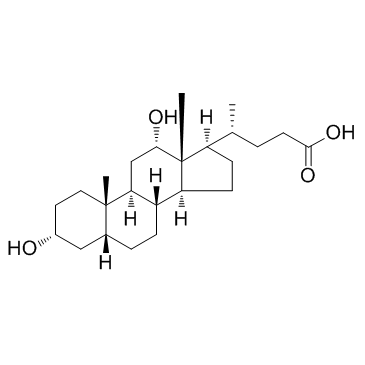
83-44-3 structure
- Name: Deoxycholic acid
- Chemical Name: Deoxycholic Acid
- CAS Number: 83-44-3
- Molecular Formula: C24H40O4
- Molecular Weight: 392.572
- Catalog: Biochemical Chinese herbal medicine ingredients
- Create Date: 2018-03-19 08:00:00
- Modify Date: 2026-07-01 21:22:36
-
Deoxycholic acid is specifically responsible for activating the G protein-coupled bile acid receptor TGR5 that stimulates brown adipose tissue (BAT) thermogenic activity.
| Name | Deoxycholic Acid |
|---|---|
| Synonyms |
Cholan-24-oicacid,3,12-dihydroxy-,(3.alpha.,5.beta.,12.alpha.)
5β-Deoxycholic Acid DEOXYCHOLIC ACID desoxycholsaeure DESOXYCHOLIC ACID cholorebic 3,12-dihydroxy-,(3-alpha,5-beta,12-alpha)-cholan-24-oicaci 7alpha-deoxycholicacid EINECS 201-478-5 3alpha,12alpha-dihydroxy-5beta-cholan-24-oicaci 12α -Dihydroxy-5β-cholan-24-oic acid 7α-Deoxycholic acid Deoxy-cholic Αcid ATX-101 3ALPHA,12ALPHA-DIHYDROXY-5BETA-CHOLAN-24-OIC ACID 3ALPHA,12ALPHA-DIHYDROXYCHLOLANIC ACID Dihydroxycholanoic acid stochol 3-ALPHA,12-ALPHA-DIHYDROXYCHOLANIC ACID pyrochol 5B-CHOLAN-24-OIC ACID-3A,12A-DIOL 3,12-dihydroxycholanicacid (R)-4-((3R,5R,8R,9S,10S,12S,13R,14S,17R)-3,12-dihydroxy-10,13-diMethylhexadecahydro-1H-cyclopenta[a]phenanthren-17-yl)pentanoic acid 17b-(1-Methyl-3-carboxypropyl)etiocholane-3a,12a-diol deoxy-Cholic acid 3α,12α-dihydroxy-5β-cholan-24-oic acid (3alpha,5beta,12alpha)-3,12-dihydroxy-cholan-24-oic acid 17B-(1-METHYL-3-CBOXYPROPYL)ETIOCHOLANE-3A,12A-DIOL DEOXYCHOLIC ACID FREE ACID Stocholl 3α,12α-Dihydroxy-5β-dhoianic acid (3a,5b,12a)-3,12-Dihydroxy-5-cholan-24-oic Acid Deoxycholic acid, R 5-BETA-CHOLANIC ACID-3-ALPHA, 12-ALPHA-DIOL 3alpha,12alpha-dihydroxy-5beta-cholanoicacid deoxycholic 3,12-dihydroxy-,(3alpha,5beta,12alpha)-cholan-24-oicaci 3-alpha,12-alpha-dihydroxy-5-beta-cholan-24-oicaci 3-alpha,12-alpha-dihydroxy-5-beta-cholanoicacid deoxcholic acid 3,12-dihydroxy-,(3.alpha.,5.beta.,12.alpha.)-Cholan-24-oicacid (4R)-4-[(3R,5R,8R,9S,10S,12S,13R,14S,17R)-3,12-Dihydroxy-10,13-dimethylhexadecahydro-1H-cyclopenta[a]phenanthren-17-yl]pentanoic acid MFCD00003673 5-beta-deoxycholicacid cholerebic 5β-Cholan-24-oic acid-3α,12α-diol 3ALPHA, 12ALPHA-DIHYDROXY-5BETA-CHOLANIC ACID (4R)-4-[(3R,5R,8R,9S,10S,12S,13S,14S,17R)-3,12-dihydroxy-10,13-dimethyl-2,3,4,5,6,7,8,9,11,12,14,15,16,17-tetradecahydro-1H-cyclopenta[a]phenanthren-17-yl]pentanoate 7-DEOXYCHOLIC ACID 17β-(1-Methyl-3-cboxypropyl)etiocholane-3α,12α-diol 5β-Cholanic Acid-3α,12α-diol deoxycholaticacid 5BETA-CHOLAN-24-OIC ACID-3ALPHA,12ALPHA-DIOL 5b-Deoxycholic acid l7-beta-(1-methyl-3-cboxypropyl)-etiocholane-3-alpha,12-alpha-diol 5BETA-CHOLAN-3ALPHA, 12BETA-DIOL 3,12-dihydroxy-(3alpha,5beta,12alpha)-cholan-24-oi Deoxycholatic acid DEOXYCHOLIC ACID FREE ACID SIGMAULTRA degalol CHOLAIC ACID (3α,5β,12α)-3,12-Dihydroxycholan-24-oic acid Kybella droxolan 5b-Cholanic acid-3a,12a-diol 3α,12α-Dihydroxy-5β-cholanoic Acid CHOLEIC ACID 17-beta-(1-methyl-3-cboxypropyl)-etiocholane-3-alpha,12-alpha-diol Chenodeoxycolic acid(Chenodiol)95 3-alpha,12-alpha-dihydroxycholansaeure deoxy-cholicaci |
| Description | Deoxycholic acid is specifically responsible for activating the G protein-coupled bile acid receptor TGR5 that stimulates brown adipose tissue (BAT) thermogenic activity. |
|---|---|
| Related Catalog | |
| Target |
Human Endogenous Metabolite |
| In Vitro | Deoxycholic acid (DCA) and chenoDeoxycholic acid (CDCA), as the common ingredients of duodenal reflux, act synergistically in many physiological and pathological processes. The cells are repeatedly exposed to 100 μM CDCA and Deoxycholic acid at pH 5.5 for up to 120 min. To simulate chronic local recurrent disease in vitro, the gastric cancer cell line MGC803 is exposed to acidified medium (pH 5.5) containing 100 μM Deoxycholic acid and CDCA. An untreated log-growth MGC803 cell line is generated to be used as a control in normal pH media. After daily 10 min exposure to the acidified bile acids for 60 weeks, MGC803-resistant cells are able to survive and proliferate after 120 min exposure[2]. |
| Cell Assay | MGC803 cells are cultured in Roswell Park Memorial Institute media supplemented with 10% fetal calf serum and 100 U/mL Penicillin and 100 mg/mL Streptomycin. To generate MGC803-resistant cells, the pH value of the MGC803 culture medium is adjusted to the experimental conditions using the hydrochloric acid (A). The bile acids GCDA and Deoxycholic acid are diluted to optimal working concentrations of 100 μM (B) with culture medium, and the overall pH (A+B) is adjusted to pH 5.5, simulating the gastric environment. Initially, MGC803 cells are chronically exposed to acidified medium with bile acids (A+B) for 10 min every 24 h. The experimental time and conditions are optimized in our preliminary experiments, which show that 10 min is enough and does not result in cell damage. This procedure is repeated and it takes 60 weeks for the MGC803 cells to survive and proliferate under the exposure of A+B for 120 min. Control untreated cells are cultured in neutral RPMI medium at pH 7.4 in parallel to the resistant cells for 60 weeks. The morphological changes in MGC803 cells exposed to acidified bile acids (A+B) are documented at 30 and 60 weeks[2]. |
| References |
| Density | 1.1±0.1 g/cm3 |
|---|---|
| Boiling Point | 547.1±35.0 °C at 760 mmHg |
| Melting Point | 171-174 °C(lit.) |
| Molecular Formula | C24H40O4 |
| Molecular Weight | 392.572 |
| Flash Point | 298.8±22.4 °C |
| Exact Mass | 392.292664 |
| PSA | 77.76000 |
| LogP | 4.66 |
| Vapour Pressure | 0.0±3.3 mmHg at 25°C |
| Index of Refraction | 1.543 |
| Water Solubility | 0.24 g/L (15 ºC) |
CHEMICAL IDENTIFICATION
HEALTH HAZARD DATAACUTE TOXICITY DATA
MUTATION DATA
|
| Symbol |

GHS07 |
|---|---|
| Signal Word | Warning |
| Hazard Statements | H302 |
| Precautionary Statements | P301 + P312 + P330 |
| Personal Protective Equipment | dust mask type N95 (US);Eyeshields;Gloves |
| Hazard Codes | Xn:Harmful |
| Risk Phrases | R22;R36/37/38 |
| Safety Phrases | S26-S36-S37/39 |
| RIDADR | NONH for all modes of transport |
| WGK Germany | 3 |
| RTECS | FZ2100000 |
| Precursor 9 | |
|---|---|
| DownStream 8 | |