Benzonatate
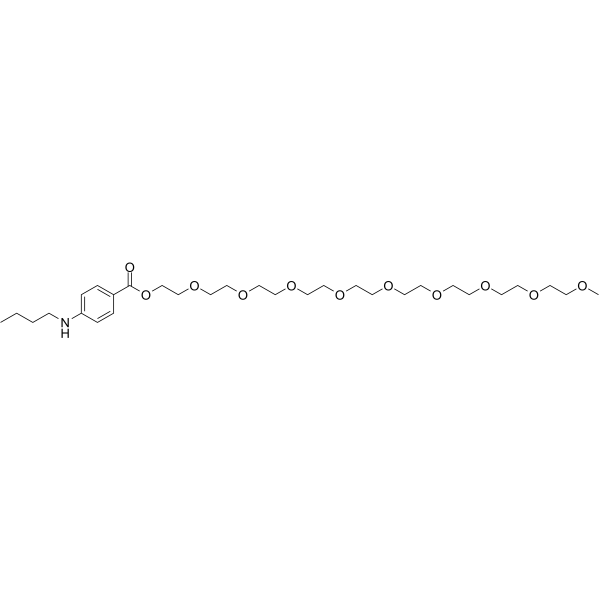
Benzonatate structure
|
Common Name | Benzonatate | ||
|---|---|---|---|---|
| CAS Number | 104-31-4 | Molecular Weight | 603.74200 | |
| Density | 1.096 g/cm3 | Boiling Point | N/A | |
| Molecular Formula | C30H53NO11 | Melting Point | N/A | |
| MSDS | N/A | Flash Point | 346.3ºC | |
Use of BenzonatateBenzonatate (Benzononatine) is a peripheral oral antitussive that dampens the activity of cough stretch receptors. Benzonatate has sodium channel-blocking properties and local anesthetic effects on the respiratory stretch receptors due to a tetracaine-like metabolite[1][2]. |
This table lists Chinese names, IUPAC names and various aliases of this chemical substance.
| Name | benzonatate |
|---|---|
| Synonym | More Synonyms |
This table contains bioactivity, target information and biological‑assay experimental data of this compound.
| Description | Benzonatate (Benzononatine) is a peripheral oral antitussive that dampens the activity of cough stretch receptors. Benzonatate has sodium channel-blocking properties and local anesthetic effects on the respiratory stretch receptors due to a tetracaine-like metabolite[1][2]. |
|---|---|
| Related Catalog | |
| References |
This table shows physicochemical parameters including melting point, boiling point, density, solubility and optical rotation. Missing data is marked as N/A.
| Density | 1.096 g/cm3 |
|---|---|
| Molecular Formula | C30H53NO11 |
| Molecular Weight | 603.74200 |
| Flash Point | 346.3ºC |
| Exact Mass | 603.36200 |
| PSA | 121.40000 |
| LogP | 2.90760 |
| Vapour Pressure | 9.98E-17mmHg at 25°C |
| Index of Refraction | 1.495 |
| InChIKey | MAFMQEKGGFWBAB-UHFFFAOYSA-N |
| SMILES | CCCCNc1ccc(C(=O)OCCOCCOCCOCCOCCOCCOCCOCCOCCOC)cc1 |
| Storage condition | 2-8°C |
This table summarizes toxicological test data, acute & chronic toxicity and ecological hazard parameters for this chemical.
CHEMICAL IDENTIFICATION
HEALTH HAZARD DATAACUTE TOXICITY DATA
|
This table contains target information, in‑vitro & in‑vivo assay data for this compound.
|
Name: Primary qHTS assay for inhibitors of alpha-synuclein gene (SNCA) expression
Source: NCGC
External Id: SNCA-p-activity-luciferase
|
|
Name: Fluorescence-based cell-based primary high throughput screening assay to identify ago...
Source: The Scripps Research Institute Molecular Screening Center
Target: muscarinic acetylcholine receptor M1 [Homo sapiens]
External Id: CHRM1_AG_FLUO8_1536_1X%ACT PRUN
|
|
Name: Cytochrome P450 Family 1 Subfamily A Member 2 (CYP1A2) small molecule antagonists: lu...
Source: 824
External Id: CYP273
|
|
Name: Fluorescence-based cell-based primary high throughput screening assay to identify pos...
Source: The Scripps Research Institute Molecular Screening Center
Target: muscarinic acetylcholine receptor M1 [Homo sapiens]
External Id: CHRM1_PAM_FLUO8_1536_1X%ACT PRUN
|
|
Name: qHTS Assay for Small Molecule Inhibitors of the Human hERG Channel Activity
Source: NCGC
External Id: HERG01
|
|
Name: qHTS for Inhibitors of TGF-b: Cytotox Counterscreen
Source: NCGC
Target: N/A
External Id: SMAD3201
|
|
Name: uHTS identification of cystic fibrosis induced NFkb Inhibitors in a fluoresence assay
Source: Burnham Center for Chemical Genomics
Target: cystic fibrosis transmembrane conductance regulator [Homo sapiens]
External Id: SBCCG-A764-CF-PAF-Primary-Assay
|
|
Name: Fluorescence-based cell-based primary high throughput screening assay to identify ant...
Source: The Scripps Research Institute Molecular Screening Center
Target: muscarinic acetylcholine receptor M1 [Homo sapiens]
External Id: CHRM1_ANT_FLUO8_1536_1X%INH PRUN
|
|
Name: Primary qHTS for inhibitors of NSP2Pro chikungunya virus (CHIKV)
Source: NCGC
External Id: APP-Toga-CHIKV-nsp2-p
|
This table collects all English aliases, systematic names and CAS‑related synonyms of the compound.
| Benzononatine |
| 2-[2-[2-[2-[2-[2-[2-[2-(2-methoxyethoxy)ethoxy]ethoxy]ethoxy]ethoxy]ethoxy]ethoxy]ethoxy]ethyl 4-(butylamino)benzoate |
| Benzonatato |
| EINECS 203-194-7 |
| Tessalon |
| Benzonatate |
| Exangit |
| MFCD00072060 |
| Benzonatatum |
| Tessalon-ciba |
| Benzononantin |
| Ventussin-loz |
| Ventussin |
This section contains frequently‑asked‑questions about this compound, including basic parameters, properties, storage conditions and corresponding answers.
| Q: What is the CAS number of benzonatate? |
| A: CAS number of benzonatate is 104-31-4. |
| Q: What English synonyms does benzonatate have? |
| A: English synonyms of benzonatate: Benzononatine, 2-[2-[2-[2-[2-[2-[2-[2-(2-methoxyethoxy)ethoxy]ethoxy]ethoxy]ethoxy]ethoxy]ethoxy]ethoxy]ethyl 4-(butylamino)benzoate, Benzonatato, EINECS 203-194-7, Tessalon, Benzonatate, Exangit, MFCD00072060, Benzonatatum, Tessalon-ciba, Benzononantin, Ventussin-loz, Ventussin. |
| Q: What is the SMILES notation of benzonatate? |
| A: SMILES notation of benzonatate is CCCCNc1ccc(C(=O)OCCOCCOCCOCCOCCOCCOCCOCCOCCOC)cc1. |
| Q: What is the InChIKey of benzonatate? |
| A: InChIKey of benzonatate is MAFMQEKGGFWBAB-UHFFFAOYSA-N. |
| Q: What are the storage conditions for benzonatate? |
| A: Storage conditions for benzonatate: 2-8°C. |
| Q: What is the polar surface area (PSA) of benzonatate? |
| A: Polar surface area (PSA) of benzonatate is 121.40000. |
| Q: What are the uses of benzonatate? |
| A: Main uses of benzonatate: Benzonatate (Benzononatine) is a peripheral oral antitussive that dampens the activity of cough stretch receptors. Benzonatate has sodium channel-blocking properties and local anesthetic effects on the respiratory stretch receptors due to a tetracaine-like metabolite[1][2]. |
| Q: What is the molecular formula of benzonatate? |
| A: Molecular formula of benzonatate is C30H53NO11. |
| Q: What is the English name of benzonatate? |
| A: The English name of benzonatate is benzonatate. |
| Q: What is the LogP of benzonatate? |
| A: LogP of benzonatate is 2.90760. |
This table lists manufacturers and suppliers of this compound, including vendor names and product supply reference information.
| Shanghai Nianxing Industrial Co., Ltd |
| Dayang Chem (Hangzhou) Co., Ltd. |