TPE-MI
Modify Date: 2025-08-25 13:38:20
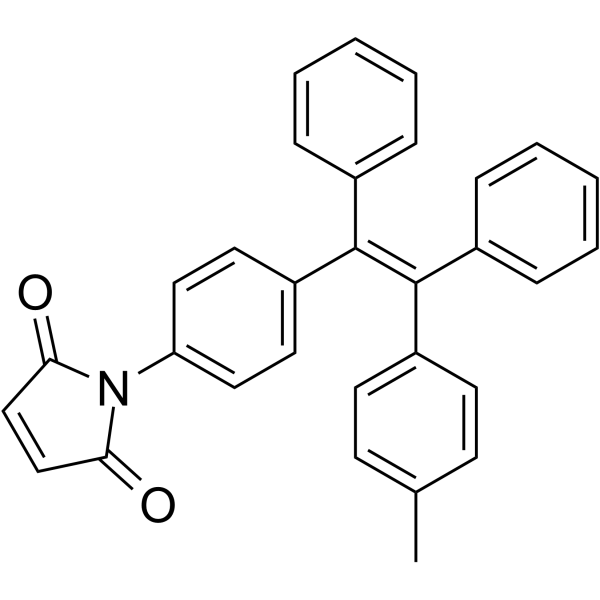
TPE-MI structure
|
Common Name | TPE-MI | ||
|---|---|---|---|---|
| CAS Number | 1245606-71-6 | Molecular Weight | 441.520 | |
| Density | 1.2±0.1 g/cm3 | Boiling Point | 565.7±29.0 °C at 760 mmHg | |
| Molecular Formula | C31H23NO2 | Melting Point | N/A | |
| MSDS | USA | Flash Point | 228.0±16.6 °C | |
Use of TPE-MITPE-MI (Tetraphenylethene maleimide) is a thiol probe for measuring unfolded protein load and proteostasis in cells. TPE-MI can report imbalances in proteostasis in induced pluripotent stem cell models of Huntington disease, as well as cells transfected with mutant Huntington exon 1 before the formation of visible aggregates. TPE-MI also detects protein damage following dihydroartemisinin treatment of the malaria parasitesPlasmodium falciparum [1][2]. |
| Name | TPE-Thiol |
|---|---|
| Synonym | More Synonyms |
| Description | TPE-MI (Tetraphenylethene maleimide) is a thiol probe for measuring unfolded protein load and proteostasis in cells. TPE-MI can report imbalances in proteostasis in induced pluripotent stem cell models of Huntington disease, as well as cells transfected with mutant Huntington exon 1 before the formation of visible aggregates. TPE-MI also detects protein damage following dihydroartemisinin treatment of the malaria parasitesPlasmodium falciparum [1][2]. |
|---|---|
| Related Catalog | |
| In Vitro | TPE-MI is inherently non-fluorescent until it is conjugated to a thiol via the maleimide. TPE-MI fluorescence is activated upon labelling free cysteine thiols, normally buried in the core of globular proteins that are exposed upon unfolding[1]. TPE-MI (50 µM; 0-60 min) exhibits a homogeneous cytoplasmic labelling pattern in live HeLa cells, with a lower level of labelling in the nucleus and apparent concentration in the region of the ER, which was anticipated as a major location for protein synthesis and folding[1]. At the high expression level, the mutant 97Q form of Httex1 was associated with an elevated TPE-MI fluorescence signal relative to a non-disease-causing 25Q form of Httex1[1]. TPE-MI consists of the aggregation-induced emission (AIE) fluorogen tetraphenylethane (TPE) and the thiol-reactive group maleimide (MI), thereby possessing both AIE phenomenon and selective thiol reactivity[2]. |
| References |
| Density | 1.2±0.1 g/cm3 |
|---|---|
| Boiling Point | 565.7±29.0 °C at 760 mmHg |
| Molecular Formula | C31H23NO2 |
| Molecular Weight | 441.520 |
| Flash Point | 228.0±16.6 °C |
| Exact Mass | 441.172882 |
| LogP | 7.74 |
| Vapour Pressure | 0.0±1.5 mmHg at 25°C |
| Index of Refraction | 1.665 |
| InChIKey | CIMVFJJQFXGASK-UHFFFAOYSA-N |
| SMILES | Cc1ccc(C(=C(c2ccccc2)c2ccc(N3C(=O)C=CC3=O)cc2)c2ccccc2)cc1 |
| RIDADR | NONH for all modes of transport |
|---|
|
Simple Biosensor with High Selectivity and Sensitivity: Thiol-Specific Biomolecular Probing and Intracellular Imaging by AIE Fluorogen on a TLC Plate through a Thiol–Ene Click Mechanism Yang Liu, Yong Yu, Jacky W. Y. Lam, Yuning Hong, Mahtab Faisal, et al
Chemistry 16(28) , 8433-8438, (2010)
|
| 1-[4-[2-(4-Methylphenyl)-1,2-diphenylethenyl]phenyl]-1H-pyrrole-2,5-dione |
| 1-{4-[(E)-2-(4-Methylphenyl)-1,2-diphenylvinyl]phenyl}-1H-pyrrole-2,5-dione |
| TPE-Thiol |
| 1H-Pyrrole-2,5-dione, 1-[4-[(E)-2-(4-methylphenyl)-1,2-diphenylethenyl]phenyl]- |