Tomatine
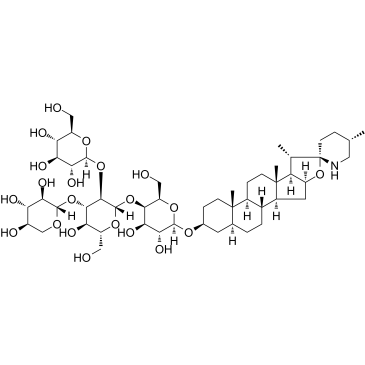
Tomatine structure
|
Common Name | Tomatine | ||
|---|---|---|---|---|
| CAS Number | 17406-45-0 | Molecular Weight | 1034.19 | |
| Density | 1.5±0.1 g/cm3 | Boiling Point | N/A | |
| Molecular Formula | C50H83NO21 | Melting Point | 300-305ºC | |
| MSDS | N/A | Flash Point | N/A | |
Use of TomatineTomatine is a glycoalkaloid, found in the tomato plant (Lycopersicon esculentum Mill.). Tomatine elicits neurotoxicity in RIP1 kinase and caspase-independent manner. Tomatine promotes the upregulation of nuclear apoptosis inducing factor (AIF) in neuroblastoma cells. Tomatine also inhibits 20S proteasome activity[1]. |
This table lists Chinese names, IUPAC names and various aliases of this chemical substance.
| Name | tomatine |
|---|---|
| Synonym | More Synonyms |
This table contains bioactivity, target information and biological‑assay experimental data of this compound.
| Description | Tomatine is a glycoalkaloid, found in the tomato plant (Lycopersicon esculentum Mill.). Tomatine elicits neurotoxicity in RIP1 kinase and caspase-independent manner. Tomatine promotes the upregulation of nuclear apoptosis inducing factor (AIF) in neuroblastoma cells. Tomatine also inhibits 20S proteasome activity[1]. |
|---|---|
| Related Catalog | |
| In Vitro | Tomatine inhibits gastric carcinoma cell line (AGS), neuroblastoma cell line (SH-SY5Y) and non-small cell lung cancer cell line (A549) with IC50s of 2 µM, 1.6 µM and 1.1 µM, respectively[1]. |
| References |
This table shows physicochemical parameters including melting point, boiling point, density, solubility and optical rotation. Missing data is marked as N/A.
| Density | 1.5±0.1 g/cm3 |
|---|---|
| Melting Point | 300-305ºC |
| Molecular Formula | C50H83NO21 |
| Molecular Weight | 1034.19 |
| Exact Mass | 1033.545776 |
| PSA | 337.86000 |
| LogP | 2.22 |
| Index of Refraction | 1.638 |
| InChIKey | REJLGAUYTKNVJM-NUKVSUKUSA-N |
| SMILES | CC1CCC2(NC1)OC1CC3C4CCC5CC(OC6OC(CO)C(OC7OC(CO)C(O)C(OC8OCC(O)C(O)C8O)C7OC7OC(CO)C(O)C(O)C7O)C(O)C6O)CCC5(C)C4CCC3(C)C1C2C |
This table provides MSDS information including hazard classification, first‑aid, fire‑fighting, spill handling, operation and storage instructions.
This table summarizes toxicological test data, acute & chronic toxicity and ecological hazard parameters for this chemical.
CHEMICAL IDENTIFICATION
HEALTH HAZARD DATAACUTE TOXICITY DATA
MUTATION DATA
|
This table covers safety warnings, protective measures, incompatible substances and disposal guidelines for this compound.
| Hazard Codes | Xn: Harmful; |
|---|---|
| Risk Phrases | R23/25 |
| Safety Phrases | 45-24/25-22 |
| RIDADR | UN 1544 |
| RTECS | XW1050000 |
| HS Code | 29329990 |
This table contains target information, in‑vitro & in‑vivo assay data for this compound.
This table collects all English aliases, systematic names and CAS‑related synonyms of the compound.
| Lycopersicin |
| (3β,5α,25S)-Spirosolan-3-yl-β-D-glucopyranosyl-(1->2)-[β-D-xylopyranosyl-(1->3)]-β-D-glucopyranosyl-(1->4)-β-D-galactopyranoside |
| EINECS 241-429-5 |
| TOMATINE |
| (2S,3R,4S,5S,6R)-2-{[(2S,3R,4S,5R,6R)-2-{[(2R,3R,4R,5R,6R)-4,5-Dihydroxy-2-(hydroxyméthyl)-6-{[(2S,4aS,4bS,5'S,6aS,6bR,7S,8S,9aS,10aS,10bR,12aS)-4a,5',6a,7-tétraméthyloctadécahydrospiro[naphto[2',1':4,5]indéno[2,1-b]furane-8,2'-pipéridin]-2-yl]oxy}tétrahydro-2H-pyran-3-yl]oxy}-5-hydroxy-6-(hydroxyméthyl)-4-{[(2S,3R,4S,5R)-3,4,5-trihydroxytétrahydro-2H-pyran-2-yl]oxy}tétrahydro-2H-pyran-3-yl]oxy}-6-(hydroxyméthyl)tétrahydro-2H-pyran-3,4,5-triol |
| Tomatin |
| (3β,5α,25S)-Spirosolan-3-yl β-D-glucopyranosyl-(1->2)-[β-D-xylopyranosyl-(1->3)]-β-D-glucopyranosyl-(1->4)-β-D-galactopyranoside |
| (2S,3R,4S,5S,6R)-2-{[(2S,3R,4S,5R,6R)-2-{[(2R,3R,4R,5R,6R)-4,5-Dihydroxy-2-(hydroxymethyl)-6-{[(2S,4aS,4bS,5'S,6aS,6bR,7S,8S,9aS,10aS,10bR,12aS)-4a,5',6a,7-tetramethyloctadecahydrospiro[naphtho[2',1':4,5]indeno[2,1-b]furan-8,2'-piperidin]-2-yl]oxy}tetrahydro-2H-pyran-3-yl]oxy}-5-hydroxy-6-(hydroxymethyl)-4-{[(2S,3R,4S,5R)-3,4,5-trihydroxytetrahydro-2H-pyran-2-yl]oxy}tetrahydro-2H-pyran-3-yl]oxy}-6-(hydroxymethyl)tetrahydro-2H-pyran-3,4,5-triol |
This section contains frequently‑asked‑questions about this compound, including basic parameters, properties, storage conditions and corresponding answers.
| Q: What are the uses of tomatine? |
| A: Main uses of tomatine: Tomatine is a glycoalkaloid, found in the tomato plant (Lycopersicon esculentum Mill.). Tomatine elicits neurotoxicity in RIP1 kinase and caspase-independent manner. Tomatine promotes the upregulation of nuclear apoptosis inducing factor (AIF) in neuroblastoma cells. Tomatine also inhibits 20S proteasome activity[1]. |
| Q: What is the SMILES notation of tomatine? |
| A: SMILES notation of tomatine is CC1CCC2(NC1)OC1CC3C4CCC5CC(OC6OC(CO)C(OC7OC(CO)C(O)C(OC8OCC(O)C(O)C8O)C7OC7OC(CO)C(O)C(O)C7O)C(O)C6O)CCC5(C)C4CCC3(C)C1C2C. |
| Q: What is the English name of tomatine? |
| A: The English name of tomatine is tomatine. |
| Q: What is the safety information for tomatine? |
| A: Safety information for tomatine: 45-24/25-22. |
| Q: What is the molecular weight of tomatine? |
| A: Molecular weight of tomatine is 1034.19. |
| Q: What is the melting point of tomatine? |
| A: Melting point of tomatine is 300-305ºC. |
| Q: What is the LogP of tomatine? |
| A: LogP of tomatine is 2.22. |
| Q: What is the polar surface area (PSA) of tomatine? |
| A: Polar surface area (PSA) of tomatine is 337.86000. |
| Q: What is the InChIKey of tomatine? |
| A: InChIKey of tomatine is REJLGAUYTKNVJM-NUKVSUKUSA-N. |
| Q: What is the CAS number of tomatine? |
| A: CAS number of tomatine is 17406-45-0. |
This table lists manufacturers and suppliers of this compound, including vendor names and product supply reference information.
| Shanghai Nianxing Industrial Co., Ltd |
| naturewill |