Trypanothione synthetase-IN-1
Modify Date: 2025-11-15 15:41:52
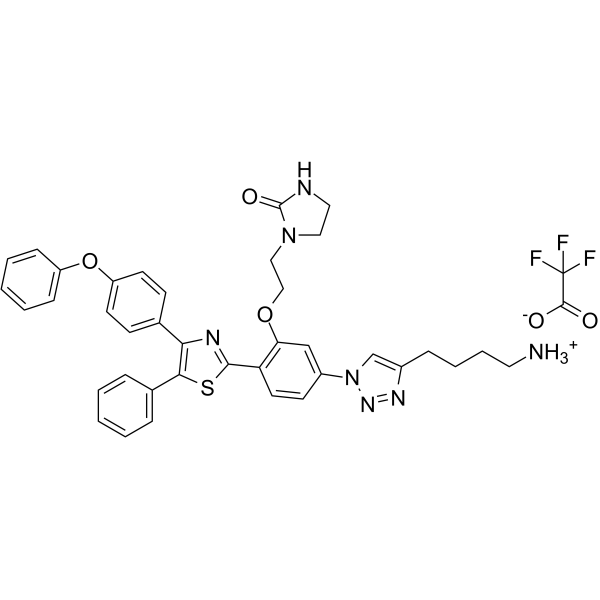
Trypanothione synthetase-IN-1 structure
|
Common Name | Trypanothione synthetase-IN-1 | ||
|---|---|---|---|---|
| CAS Number | 2355349-41-4 | Molecular Weight | 785.83 | |
| Density | N/A | Boiling Point | N/A | |
| Molecular Formula | C40H38F3N7O5S | Melting Point | N/A | |
| MSDS | N/A | Flash Point | N/A | |
Use of Trypanothione synthetase-IN-1Trypanothione synthetase-IN-1 (Compound 1) is a competitive Leishmania infantum trypanothione synthetase (TryS) inhibitor with an IC50 of 14.8 μM when triamine spermidine is as polyamine S[1]. |
| Name | Trypanothione synthetase-IN-1 |
|---|
| Description | Trypanothione synthetase-IN-1 (Compound 1) is a competitive Leishmania infantum trypanothione synthetase (TryS) inhibitor with an IC50 of 14.8 μM when triamine spermidine is as polyamine S[1]. |
|---|---|
| Related Catalog | |
| Target |
IC50: 14.8 μM (LiTryS, triamine spermidine as polyamine S), 16.2 μM (LiTryS, glutathionylspermidine as polyamine S)[1] |
| In Vitro | Trypanothione synthetase-IN-1 (Compound 1) (0-75 μM; 24 or 72 h) shows leishmanicidal activity with cytotoxicity[1]. Trypanothione synthetase-IN-1 competes with ATP and the polyamine substrate for binding to LiTryS[1]. Cell Cytotoxicity Assay[1] Cell Line: L. infantum, HepG2 Concentration: 0-75 μM Incubation Time: 24 h (L. infantum axenic amastigotes) or 72 h Result: Showed leishmanicidal activity with EC50s of 21.5 ± 2.4 μM and 13.5 ± 0.9 μM against axenic amastigotes and intracellular amastigotes, respectively. Showed cytotoxicity with a CC50 of 15.9 ± 0.4 μM against HepG2 cells. |
| References |
| Molecular Formula | C40H38F3N7O5S |
|---|---|
| Molecular Weight | 785.83 |
| InChIKey | QDQJVAJYYFXPLZ-UHFFFAOYSA-N |
| SMILES | NCCCCc1cn(-c2ccc(-c3nc(-c4ccc(Oc5ccccc5)cc4)c(-c4ccccc4)s3)c(OCCN3CCNC3=O)c2)nn1.O=C(O)C(F)(F)F |