BH3I-1
Modify Date: 2025-08-21 09:43:53
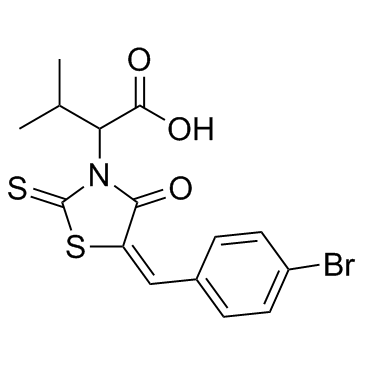
BH3I-1 structure
|
Common Name | BH3I-1 | ||
|---|---|---|---|---|
| CAS Number | 300817-68-9 | Molecular Weight | 400.31100 | |
| Density | N/A | Boiling Point | N/A | |
| Molecular Formula | C15H14BrNO3S2 | Melting Point | N/A | |
| MSDS | Chinese USA | Flash Point | N/A | |
| Symbol |

GHS07 |
Signal Word | Warning | |
Use of BH3I-1BH3I-1 is a Bcl-2 family antagonist, which inhibits the binding of the Bak BH3 peptide to Bcl-xL with a Ki of 2.4±0.2 μM in FP assay. BH3I-1 has a Kd of 5.3 μM against the p53/MDM2 pair. |
| Name | bh3i-1 |
|---|---|
| Synonym | More Synonyms |
| Description | BH3I-1 is a Bcl-2 family antagonist, which inhibits the binding of the Bak BH3 peptide to Bcl-xL with a Ki of 2.4±0.2 μM in FP assay. BH3I-1 has a Kd of 5.3 μM against the p53/MDM2 pair. |
|---|---|
| Related Catalog | |
| Target |
Bcl-2 Bcl-xL Bak Bim p53/mDM2:5.3 μM (Kd) |
| In Vitro | BH3I-1, while inhibiting its reported target Bcl-2/Bim and Bcl-xL/Bim, shows significant inhibition of both the p53/hDM2 and p300/Hif-1α interactions. This surprising promiscuity, displays by a well studied compound leads to further interrogate the p53/hDM2 interaction utilizing a standard fluorescence polarization (FP) assay with purified protein. The results from the FP assay validates the split-luciferase screen and demonstrates that BH3I-1 has a Kd=5.3 μM against the p53/mDM2 pair, which is comparable to its low micromolar potency reported for the BH3 family of receptors[2]. BH3I-1 inhibits interaction between the BH3 domain and Bcl-xL. NMR analyses reveal that BH3I-1 targets the BH3-binding pocket of Bcl-xL with a Ki of 7.8±0.9 μM[3]. |
| Cell Assay | Jurkat cells overexpressing Bcl-xL, FL 5.12 and FL 5.12/Bcl-xL cells (5×10⁴ cells per well) are seeded into white 96-well plates and treated with various concentrations of the compounds (e.g., BH3I-1; 30 μM and 90 μM)for 48 h. For zVAD-FMK protection experiments, cells are preincubated with 100 μM zVAD-FMK for 1 h before the addition of chemicals. Cell viability is determined with an MTS assay with a Victor plate reader. For PI staining experiments, cells are grown in 24-well plates and then incubated with 2 μg/mL PI. Cell death is determined by FACS analysis in a FACSCalibur machine[3]. |
| References |
| Molecular Formula | C15H14BrNO3S2 |
|---|---|
| Molecular Weight | 400.31100 |
| Exact Mass | 398.96000 |
| PSA | 115.00000 |
| LogP | 3.69740 |
| InChIKey | COHIEJLWRGREHV-UHFFFAOYSA-N |
| SMILES | CC(C)C(C(=O)O)N1C(=O)C(=Cc2ccc(Br)cc2)SC1=S |
| Storage condition | -20℃ |
| Symbol |
GHS07 |
|---|---|
| Signal Word | Warning |
| Hazard Statements | H302-H312-H332 |
| Precautionary Statements | P280 |
| Personal Protective Equipment | dust mask type N95 (US);Eyeshields;Gloves |
| Risk Phrases | 20/21/22 |
| Safety Phrases | 36 |
| RIDADR | NONH for all modes of transport |
| 5-(p-bromobenzylidene)-a-isopropyl-4-oxo-2-thioxo-3-thiazolidine acetic acid |
| 5-(p-bromobenzylidene)-alpha-isopropyl-4-oxo-2-thioxo-3-thiazolidine acetic acid |