Sodium deoxycholate

Sodium deoxycholate structure
|
Common Name | Sodium deoxycholate | ||
|---|---|---|---|---|
| CAS Number | 302-95-4 | Molecular Weight | 414.554 | |
| Density | 1.128g/cm3 | Boiling Point | 547.1ºC at 760 mmHg | |
| Molecular Formula | C24H39NaO4 | Melting Point | 357-365 °C | |
| MSDS | Chinese USA | Flash Point | N/A | |
| Symbol |

GHS07 |
Signal Word | Warning | |
Use of Sodium deoxycholateDeoxycholic acid sodium salt is specifically responsible for activating the G protein-coupled bile acid receptor TGR5 that stimulates brown adipose tissue (BAT) thermogenic activity. |
| Name | sodium deoxycholate |
|---|---|
| Synonym | More Synonyms |
| Description | Deoxycholic acid sodium salt is specifically responsible for activating the G protein-coupled bile acid receptor TGR5 that stimulates brown adipose tissue (BAT) thermogenic activity. |
|---|---|
| Related Catalog | |
| Target |
TGR5[1] |
| In Vitro | Deoxycholic acid (DCA) and chenoDeoxycholic acid (CDCA), as the common ingredients of duodenal reflux, act synergistically in many physiological and pathological processes. The cells are repeatedly exposed to 100 μM CDCA and Deoxycholic acid at pH 5.5 for up to 120 min. To simulate chronic local recurrent disease in vitro, the gastric cancer cell line MGC803 is exposed to acidified medium (pH 5.5) containing 100 μM Deoxycholic acid and CDCA. An untreated log-growth MGC803 cell line is generated to be used as a control in normal pH media. After daily 10 min exposure to the acidified bile acids for 60 weeks, MGC803-resistant cells are able to survive and proliferate after 120 min exposure[2]. |
| Cell Assay | MGC803 cells are cultured in Roswell Park Memorial Institute media supplemented with 10% fetal calf serum and 100 U/mL Penicillin and 100 mg/mL Streptomycin. To generate MGC803-resistant cells, the pH value of the MGC803 culture medium is adjusted to the experimental conditions using the hydrochloric acid (A). The bile acids GCDA and Deoxycholic acid are diluted to optimal working concentrations of 100 μM (B) with culture medium, and the overall pH (A+B) is adjusted to pH 5.5, simulating the gastric environment. Initially, MGC803 cells are chronically exposed to acidified medium with bile acids (A+B) for 10 min every 24 h. The experimental time and conditions are optimized in our preliminary experiments, which show that 10 min is enough and does not result in cell damage. This procedure is repeated and it takes 60 weeks for the MGC803 cells to survive and proliferate under the exposure of A+B for 120 min. Control untreated cells are cultured in neutral RPMI medium at pH 7.4 in parallel to the resistant cells for 60 weeks. The morphological changes in MGC803 cells exposed to acidified bile acids (A+B) are documented at 30 and 60 weeks[2]. |
| References |
| Density | 1.128g/cm3 |
|---|---|
| Boiling Point | 547.1ºC at 760 mmHg |
| Melting Point | 357-365 °C |
| Molecular Formula | C24H39NaO4 |
| Molecular Weight | 414.554 |
| Exact Mass | 414.274597 |
| PSA | 80.59000 |
| LogP | 3.14320 |
| InChIKey | FHHPUSMSKHSNKW-SMOYURAASA-M |
| SMILES | CC(CCC(=O)[O-])C1CCC2C3CCC4CC(O)CCC4(C)C3CC(O)C12C.[Na+] |
| Water Solubility | 330 g/L (15 ºC) |
CHEMICAL IDENTIFICATION
HEALTH HAZARD DATAACUTE TOXICITY DATA
MUTATION DATA
|
| Symbol |
GHS07 |
|---|---|
| Signal Word | Warning |
| Hazard Statements | H302-H335 |
| Precautionary Statements | P301 + P312 + P330 |
| Personal Protective Equipment | dust mask type N95 (US);Eyeshields;Gloves |
| Hazard Codes | Xn:Harmful; |
| Risk Phrases | R22 |
| Safety Phrases | S22 |
| RIDADR | NONH for all modes of transport |
| WGK Germany | 3 |
| RTECS | FZ2250000 |
| HS Code | 29181930 |
| Precursor 0 | |
|---|---|
| DownStream 1 | |
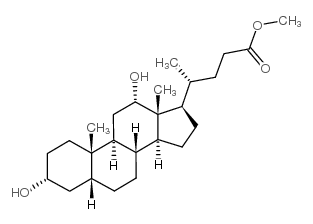 CAS#:3245-38-3
| HS Code | 29181930 |
|---|
|
Salicylic acid signaling controls the maturation and localization of the arabidopsis defense protein ACCELERATED CELL DEATH6.
Mol. Plant 7(8) , 1365-83, (2014) ACCELERATED CELL DEATH6 (ACD6) is a multipass membrane protein with an ankyrin domain that acts in a positive feedback loop with the defense signal salicylic acid (SA). This study implemented biochemi... |
|
|
Salicylic acid regulates Arabidopsis microbial pattern receptor kinase levels and signaling.
Plant Cell 26(10) , 4171-87, (2014) In Arabidopsis thaliana, responses to pathogen-associated molecular patterns (PAMPs) are mediated by cell surface pattern recognition receptors (PRRs) and include the accumulation of reactive oxygen s... |
|
|
Co-ordinated brain and craniofacial development depend upon Patched1/XIAP regulation of cell survival.
Hum. Mol. Genet. 24(3) , 698-713, (2015) Congenital brain and craniofacial defects often occur together as a consequence of their developmental dependency on common progenitor tissue interactions and signaling pathways during embryogenesis. ... |
|
Name: Luminescence-based cell-based primary high throughput screening assay to identify ago...
Source: The Scripps Research Institute Molecular Screening Center
Target: mu-type opioid receptor isoform MOR-1 [Homo sapiens]
External Id: OPRM1-OPRD1_AG_LUMI_1536_1X%ACT PRUN
|
|
Name: Fluorescence-based cell-based primary high throughput screening assay to identify ago...
Source: The Scripps Research Institute Molecular Screening Center
Target: muscarinic acetylcholine receptor M1 [Homo sapiens]
External Id: CHRM1_AG_FLUO8_1536_1X%ACT PRUN
|
|
Name: Cytochrome P450 Family 1 Subfamily A Member 2 (CYP1A2) small molecule antagonists: lu...
Source: 824
External Id: CYP273
|
|
Name: Fluorescence-based cell-based primary high throughput screening assay to identify pos...
Source: The Scripps Research Institute Molecular Screening Center
Target: muscarinic acetylcholine receptor M1 [Homo sapiens]
External Id: CHRM1_PAM_FLUO8_1536_1X%ACT PRUN
|
|
Name: Fluorescence polarization-based biochemical high throughput primary assay to identify...
Source: The Scripps Research Institute Molecular Screening Center
Target: RecName: Full=Sialate O-acetylesterase; AltName: Full=H-Lse; AltName: Full=Sialic acid-specific 9-O-acetylesterase; Flags: Precursor [Homo sapiens]
External Id: SIAE_INH_FP_1536_1X%INH PRUN
|
|
Name: p53 small molecule agonists, cell-based qHTS assay: qHTS cell viability counter scree...
Source: 824
Target: N/A
External Id: P53600
|
|
Name: p53 small molecule agonists, cell-based qHTS assay with rat liver microsomes: qHTS ce...
Source: 824
Target: N/A
External Id: P53MS958
|
|
Name: p53 small molecule agonists, cell-based qHTS assay with rat liver microsomes: Summary
Source: 824
External Id: P53MS482
|
|
Name: p53 small molecule agonists, cell-based qHTS assay with human liver microsomes
Source: 824
Target: tumor suppressor p53 [Homo sapiens]
External Id: P53MS233
|
| Sodium (4R)-4-[(3R,5R,8R,9S,10S,12S,13R,14S,17R)-3,12-dihydroxy-10,13-dimethylhexadecahydro-1H-cyclopenta[a]phenanthren-17-yl]pentanoate |
| Sodium Choleate |
| desoxycholatesodium |
| EINECS 206-132-7 |
| deoxycholatesodium |
| Sodium deoxycholate |
| SODIUM DESOXYCHOLATE |
| Deoxycholic acid,sodium salt |
| OXIDE EXTRACT |
| SODIUMDISOXYCHOLATE |
| na-desoxycholat |
| deoxycholic acid sodium salt |
| Choleic Acid Sodium Salt |
| MFCD00064139 |
| sodium7-deoxycholate |
| Sodium (3α,5β,12α,20R)-3,12-dihydroxycholan-24-oate |
| Cholan-24-oic acid, 3,12-dihydroxy-, sodium salt, (3α,5β,12α,20R)- (1:1) |
The content on this webpage is sourced from various professional data sources. If you have any questions or concerns regarding the content, please feel free to contact service1@chemsrc.com.
- Shanghai Nianxing Industrial Co., Ltd
- China
- Product Name: Sodium deoxycholate
- Price: Check
- Purity: 98.0%
- Delivery: 10 Day
- Contact: Yang
- Email: sales@echemcloud.com
- Dayang Chem (Hangzhou) Co., Ltd.
- China
- Product Name: Sodium deoxycholate
- Price: $Inquiry/100g $Inquiry/1kg $Inquiry/100kg $Inquiry/1000kg
- Purity: 98.0%
- Delivery: Inquiry
- Contact: Ms Wang
- Email: enquiry@dycnchem.com
- naturewill
- China
- Product Name: Sodium deoxycholate
- Price: ¥Inquiry/5mg ¥Inquiry/20mg ¥Inquiry/100mg ¥Inquiry/1g
- Purity: 98.0%
- Delivery: Inquiry
- Contact: Bella
- Email: 3157321941@qq.com
- Henan Tianfu Chemical Co., Ltd.
- China
- Product Name: Sodium Deoxycholate
- Price: $Inquiry/1kg $Inquiry/25kg $Inquiry/1000kg $Inquiry/10ton
- Purity: 99.0%
- Delivery: Inquiry
- Contact: Anson
- Email: info@tianfuchem.com
- Zhongshan Xingrui Chemical Co. , Ltd.
- China
- Product Name: Sodium deoxycholate
- Price: ¥Inquiry/25kg
- Purity: 99.0%
- Delivery: Inquiry
- Contact: Wang Jie

- Email: 3096638339@qq.com
Get all suppliers and price by the below link:
Reference only. check more Sodium deoxycholate price